
21 Gray Bedroom Ideas That Transform Your Space with Modern Comfort


Gray is the quiet workhorse of bedroom design. It never shouts, it never dates quickly, and it gives every other choice in the room, from bedding to lighting to art, a calm place to land. That is why gray bedrooms keep showing up in real homes: a soft gray wall can make a small room feel airy, a charcoal accent wall can make a plain room feel designed, and a warm gray can make a cold, north facing room feel inviting rather than flat.
This guide takes the original 21 ideas and builds them out properly, with the materials, measurements, color pairings, and step by step detail you actually need to copy a look at home. You do not need a full renovation for most of these. A weekend, a tin of paint, new bedding, or a single furniture swap is often enough. If you are planning a wider refresh, these modern bedroom ideas pair naturally with the gray schemes below, and you can mix two or three ideas from this list rather than copying one room exactly.
Before you start, pick your gray family. Cool grays with a blue or violet undertone suit bright, modern rooms. Warm grays with a beige or taupe undertone suit rooms with wood floors, cream trim, or low natural light. Test a large swatch, at least 60 cm square, on the wall you see first when you walk in, and check it in morning light, evening light, and lamplight before you commit. A gray that looks perfect on a paint chip can turn blue, green, or purple on a full wall.
1. Soft Gray Walls for a Calm Escape
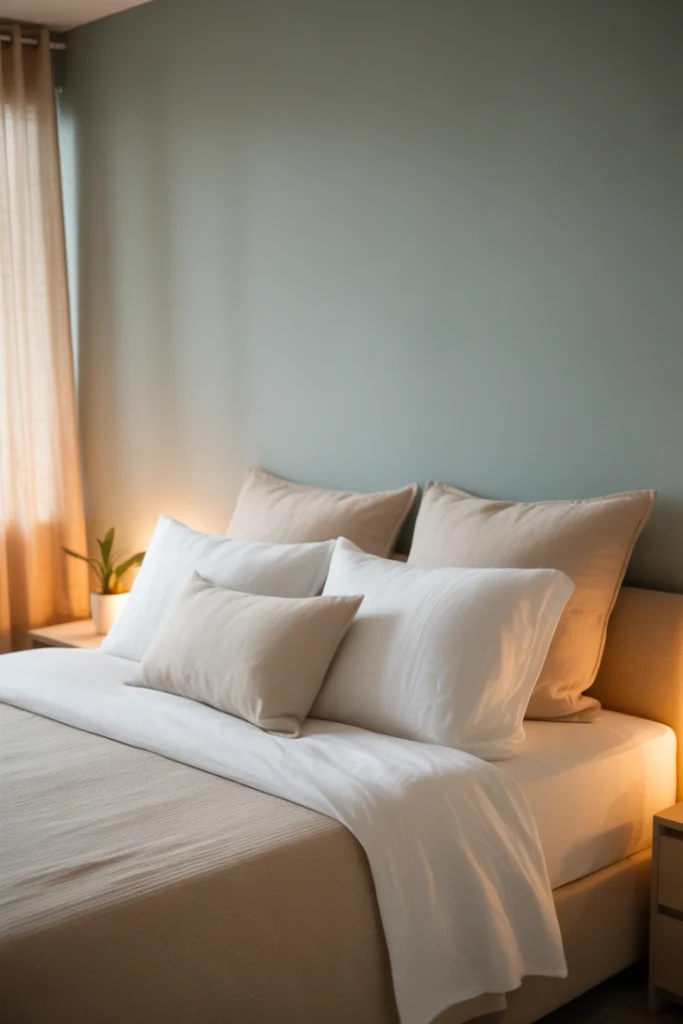
Soft gray walls are the easiest foundation for a relaxing bedroom, and they work in almost any size of room. Choose a light to mid gray with a Light Reflectance Value (LRV) of roughly 55 to 70 if you want the room to stay bright. Shades in this range bounce light around without looking white, and they give white bedding, oak furniture, and natural linen a soft backdrop instead of a stark one. In a small room, paint all four walls the same soft gray and keep the ceiling a clean white to hold the height.
To paint it well, clean the walls, fill holes, and use one coat of primer over any strong existing color or patched areas. Cut in around the ceiling, skirting, and door frames first, then roll in a W pattern in sections about 1 metre wide, keeping a wet edge so you do not get roller lines. Two coats are usually enough. Let the first coat dry fully, usually 2 to 4 hours, before the second. A matte or eggshell finish hides wall imperfections best in a bedroom; save satin or semi gloss for trim.
Style soft gray walls with layered bedding in white, cream, and one deeper gray, a warm wood bedside table, and lamps with warm white bulbs (2700K to 3000K). Add one textured throw, a woven basket, and a simple framed print, and the room feels finished without feeling busy. If the room starts to feel too cool, swap in a beige throw, a rattan lamp, or a wooden tray to warm it up instantly.
2. Charcoal Gray Accent Wall for Bold Drama
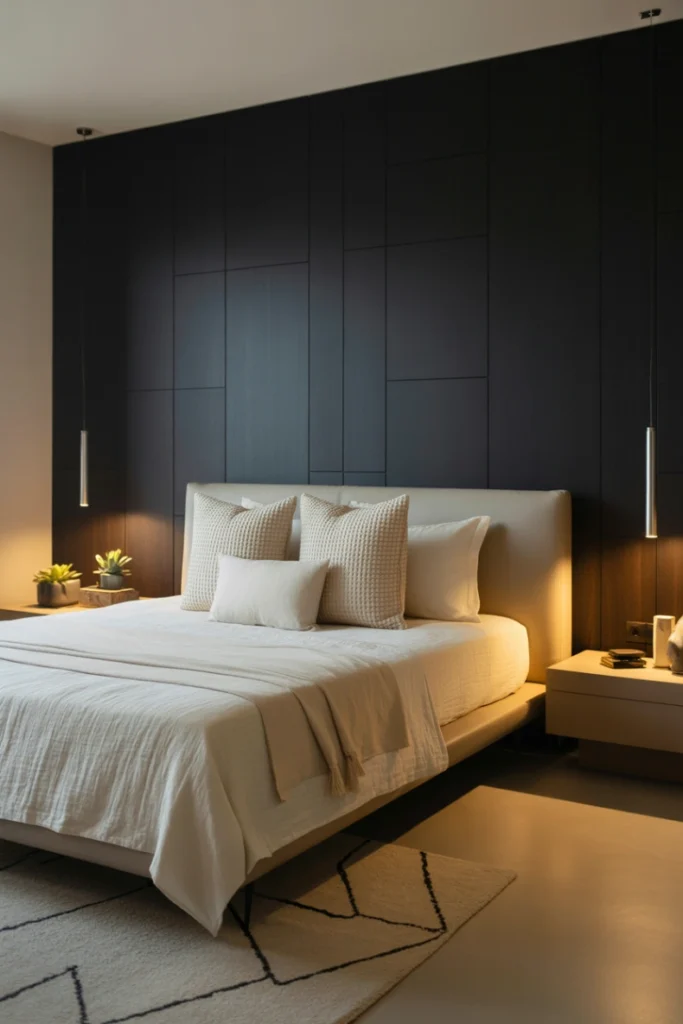
A charcoal gray accent wall adds instant depth and makes the bed the clear focal point of the room. This works best on the wall behind the headboard, where the dark color frames the bed rather than closing the room in. Choose a charcoal with an LRV of about 10 to 20, deep enough to read as dramatic, but not so black that it swallows the light. In a room under about 12 square metres, keep the other three walls light, and use a large mirror or light bedding to keep the balance.
Preparation matters more with dark paint because every flaw shows. Fill and sand any dents, prime with a gray tinted primer if your primer is white, and plan on two full coats, sometimes three over a pale wall. Paint the accent wall last in your decorating order, after the ceiling and other walls, and protect the adjoining walls with painter’s tape pressed firmly along the corners. Remove the tape while the final coat is still slightly tacky for the cleanest edge.
Balance the drama with light bedding, a pale or natural wood headboard, and metallic touches such as brushed brass lamps or a black framed print with a white mount. Keep the rest of the decor simple: one piece of art, two bedside lamps, and a plain rug in cream or light gray. The contrast does the work, so you do not need a lot of pattern competing with it.
3. Gray and White Minimalist Bedroom
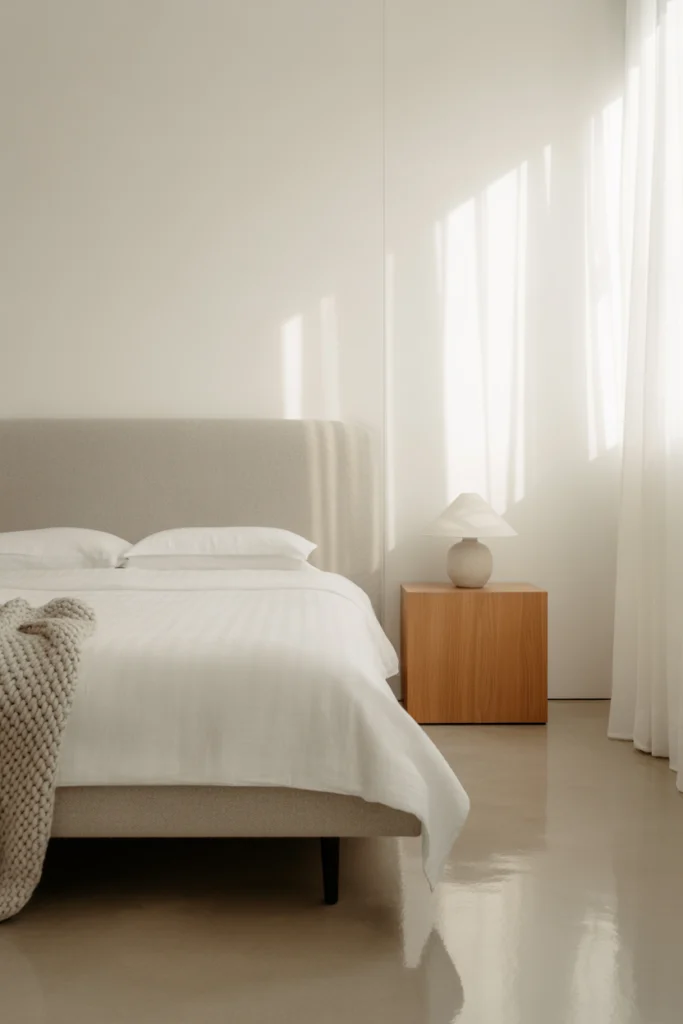
Gray and white minimalism is about restraint done well, not about an empty room. The palette is simple, two neutrals, so texture has to carry the interest. Combine a soft mid gray wall or bedding with crisp white sheets, a white or light gray duvet, and one darker gray throw. Add natural materials, light oak, linen, cotton, and a single plant, and the room feels calm rather than clinical. This scheme is especially kind to small bedroom ideas, because the light palette and lack of visual clutter make the walls feel further apart.
To get the look, edit first. Remove anything that does not serve a purpose or earn its place, then give everything left a home: a bedside drawer for chargers and books, a lidded basket for extra blankets, and hooks or a rail inside a wardrobe door for tomorrow’s clothes. Keep surfaces to two or three items each. A lamp, a book, and a glass of water on a nightstand is enough. Choose furniture with clean lines and legs you can see under, which keeps the floor visible and the room feeling larger.
Lighting makes or breaks a minimalist bedroom. Use layered light rather than one harsh ceiling light: bedside lamps for reading, a dimmable overhead light for cleaning and dressing, and, if you have one, a small warm light near a chair or dressing area. Keep window treatments simple too, white or light gray linen curtains hung high and wide, so the window looks larger and the light stays soft.
4. Layered Gray Bedding for Cozy Warmth

Layered gray bedding is the fastest way to make a bed look expensive and feel inviting. Start with the base: a fitted sheet in white or pale gray, then a flat sheet or duvet in a mid gray. Add a second layer, a quilt, coverlet, or waffle weave blanket, folded back about one third of the way down the bed so the layers are visible. Finish with a chunky knit or faux fur throw across the foot and pillows in at least two shades of gray. The gradient from pearl to slate is what creates depth.
Mix textures deliberately rather than stacking the same fabric three times. Pair smooth cotton or linen sheets with a quilted coverlet, a knitted throw, and velvet or linen pillowcases. This contrast is what stops a gray bed from looking flat. For a standard double or queen bed, a good formula is two sleeping pillows, two standard pillowcases in the main bedding color, and two or three decorative cushions in different sizes and textures. For a king bed, add one more cushion and a lumbar pillow.
Care matters with layered bedding. Wash the duvet cover and pillowcases weekly, the quilt or coverlet every two to three weeks, and the throw according to its label, usually monthly. Keep a spare set of sheets so the bed never sits bare on laundry day. If you sleep hot, choose cotton percale or linen for the layers closest to your skin and keep the heavier knit throw only as a top layer you can push aside.
5. Gray Furniture for Subtle Elegance
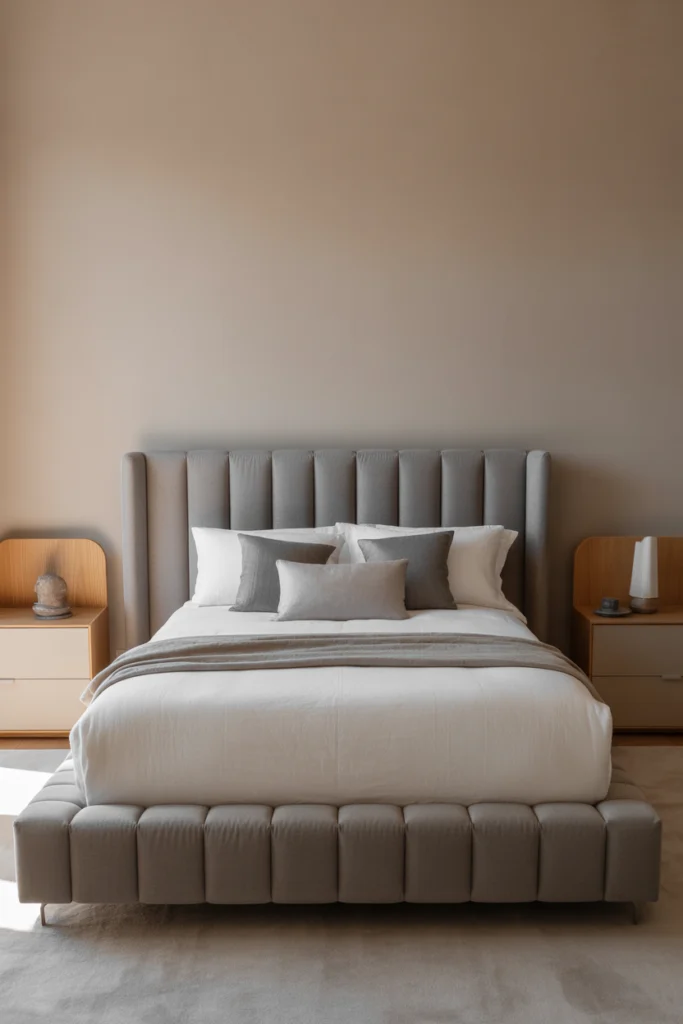
Gray bedroom furniture gives you style without dominating the room. A gray upholstered bed frame, a painted dresser, or a pair of gray nightstands blends with almost any wall color, which makes it a safe long term investment if you like to change bedding or wall color often. Choose the finish to match your room: matte painted wood suits traditional and farmhouse rooms, brushed or lacquered gray suits modern rooms, and gray fabric upholstery suits soft, hotel style rooms.
When buying, check the build before the color. Drawers should slide smoothly and close fully, a bed frame should not creak when you sit on the edge, and an upholstered headboard should feel padded all the way to the edges, not hollow in the middle. Measure doorways, stair turns, and the room itself before ordering, and leave at least 60 cm of clear walking space on each side of the bed and 75 cm in front of a dresser so drawers can open fully.
Style gray furniture by giving it one contrasting partner: warm wood lamps, brass handles, a cream rug, or a green plant. If all the furniture is the same gray, the room can feel like a showroom, so break it up with a wooden bench at the foot of the bed, a rattan basket, or a framed print with warm tones. Replace plain gray knobs with brushed brass or matte black pulls for an instant upgrade that costs very little.
6. Rustic Gray Wood Elements
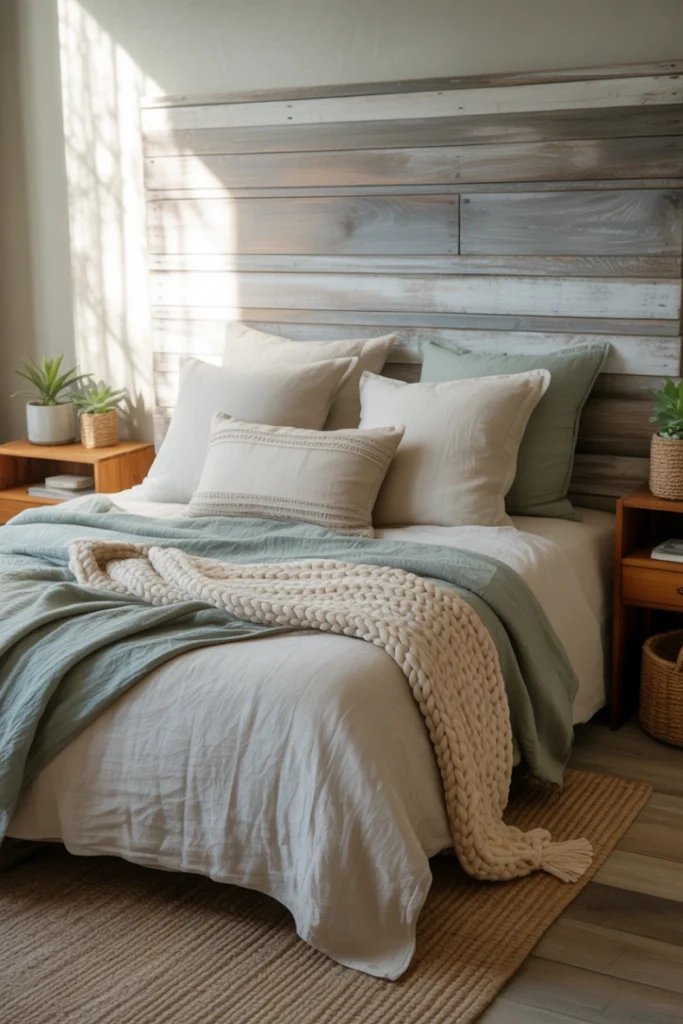
Gray washed wood brings rustic charm without the heaviness of dark barn wood. The weathered finish, pale gray over visible grain, suits headboards, side tables, accent walls, and even a sliding wardrobe door. It pairs naturally with farmhouse and cabin styles, but it also softens a modern room when used in one place only, for example a single gray washed feature wall behind the bed while the rest of the room stays smooth and simple.
To create the look on raw pine, sand the wood to 120 grit, brush on a gray wood stain or a diluted gray paint wash (roughly one part paint to one part water), wipe off the excess with a cloth so the grain shows through, and seal with a clear matte topcoat once dry. Always test on a scrap piece first, because pine absorbs unevenly and the same wash can look darker on a knotty board. If you are buying ready made pieces, look for a finish that shows grain variation rather than a flat printed pattern.
Balance rustic gray wood with softness, or the room can feel cold. Add cream linen bedding, a wool throw, warm lamps, and a plant or two. Keep the wood to two or three pieces in one room: a headboard and one nightstand, or an accent wall and a bench, is plenty. Too many weathered pieces compete with each other and the room starts to feel like a themed set rather than a home.
7. Gray Upholstered Headboard for Comfort
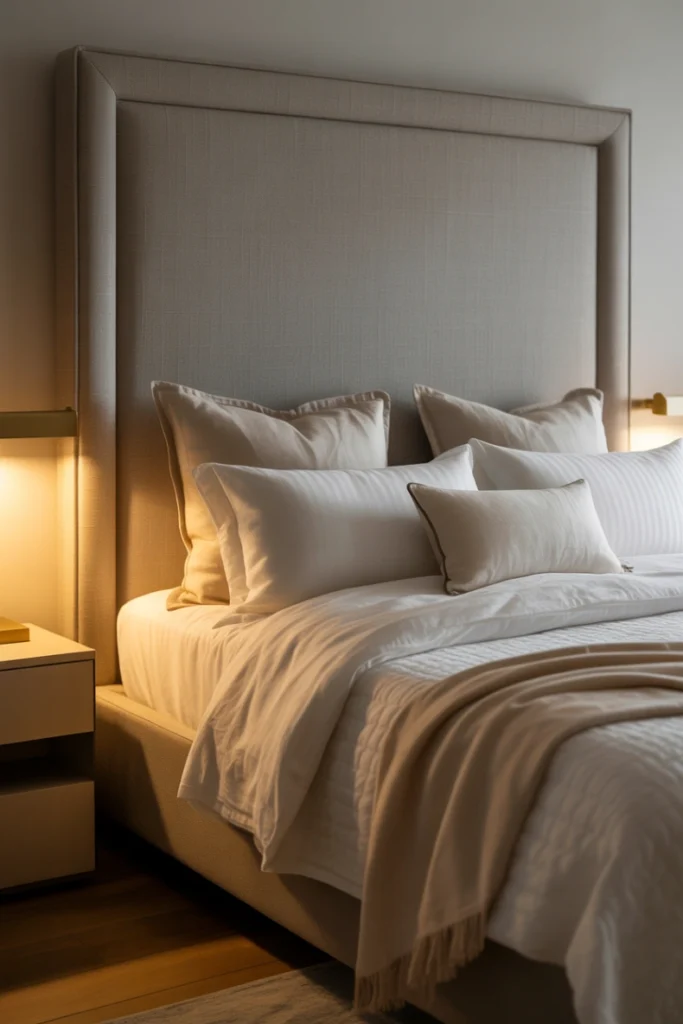
A gray upholstered headboard is one of the most comfortable upgrades you can make, especially if you read or watch television in bed. It softens the wall, supports your back, and instantly makes the bed look finished. Tufted velvet reads luxurious, flat linen reads relaxed and modern, and a tall channel tufted design reads like a boutique hotel. Height matters: a headboard 120 to 150 cm tall suits a standard room with a 240 cm ceiling and gives enough support for sitting up, while a lower 90 cm headboard suits a small room or a low platform bed.
Before you buy, measure the bed width and the wall space. A headboard should match the bed width or extend 5 to 10 cm beyond it on each side, never narrower than the mattress. Check that it can mount to your bed frame or directly to the wall with the fixings supplied, and that the fabric is removable or at least spot cleanable if you have pets or children. Performance fabrics and darker mid grays hide everyday marks far better than pale velvet.
Style it with pillows that work with the headboard, not against it. Two sleeping pillows flat against the headboard, two Euro pillows (65 cm square) in front, and one or two smaller cushions complete the look. Keep the wall above the headboard simple: one wide piece of art, a pair of sconces, or nothing at all. The headboard is the feature, so it does not need competition.
8. Gray Curtains for Soft Light Control
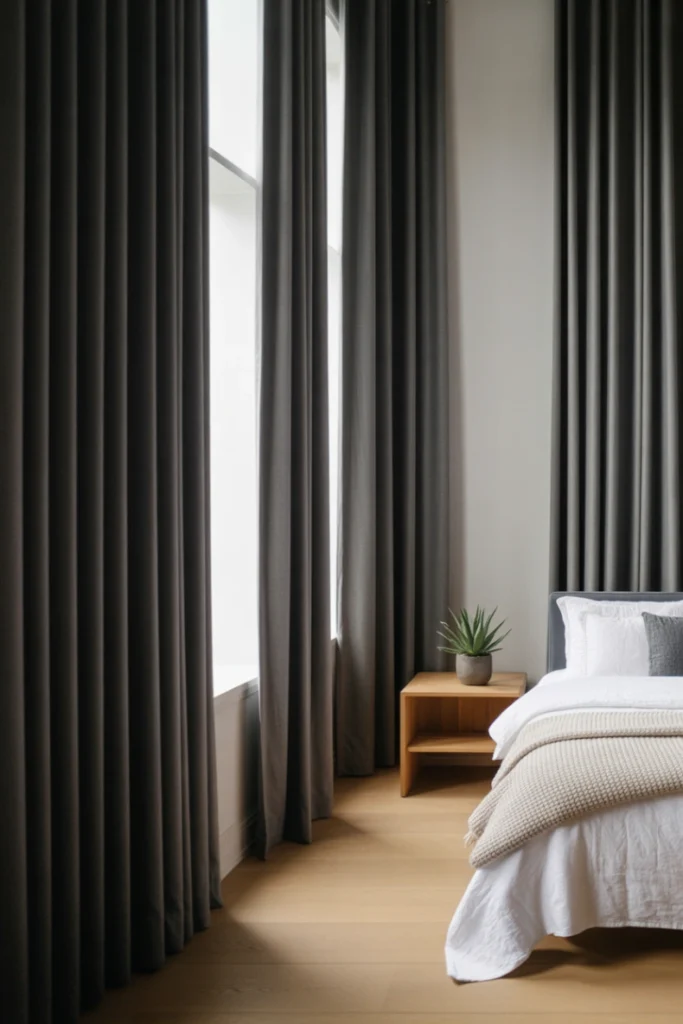
Gray curtains do two jobs at once: they soften daylight and they finish the window. Sheer gray voiles filter light and give privacy during the day while keeping the room bright. Gray blackout curtains, lined with a blackout layer, block morning light and streetlight at night and help with sleep. Many people get the best result by layering both: a sheer panel on a slim rod close to the window, and a heavier gray drape on a second rod in front.
Hang curtains high and wide for the best effect. Mount the rod 15 to 20 cm above the window frame, or close to the ceiling in a room with low ceilings, and extend it 15 to 25 cm beyond the frame on each side. Curtains should be long enough to just touch the floor or puddle by 2 to 3 cm for a relaxed look, never stopping halfway down the wall unless the window sits above a radiator or built in furniture. For a standard 140 cm wide window, two panels of 140 to 200 cm each, gathered, give a full look when closed.
Choose the gray to match your walls, one shade lighter or darker, rather than an exact match, which can look flat. Light grays keep a small room airy, while charcoal drapes in a large room add coziness and drama. Wash or steam curtains every few months, and vacuum the folds with a brush attachment in between, so dust does not dull the color.
9. Marble-Effect Gray Wallpaper
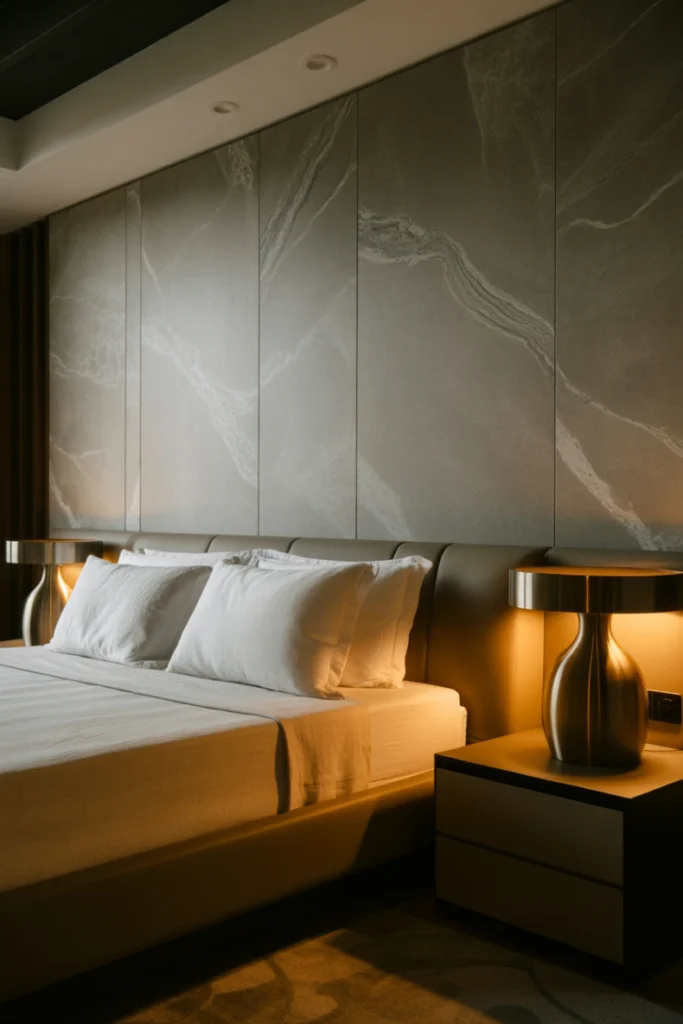
Gray marble effect wallpaper gives you the luxury of stone without the cost, weight, or cold surface of real marble. The veining adds movement to a plain wall and works especially well as a single accent wall behind the bed. Because the pattern is busy, one wall is usually enough; papering all four walls in marble effect can feel overwhelming and makes it hard to hang art or shelves cleanly.
To hang it well, start with a smooth wall. Fill holes, sand bumps, and apply a wallpaper primer so the paper adheres evenly and can be removed later without tearing the plaster. Paste the wall products are the most forgiving for a first timer: roll paste onto the wall, hang the first length with a plumb line, and smooth from the center outward with a plastic smoother to push out air bubbles. Match the pattern at the seams by cutting each new length from the same point in the repeat, and trim at the ceiling and skirting with a sharp blade and a straight edge.
Keep the rest of the room calm so the wall stays the star. White or pale gray bedding, simple furniture, and metallic accents in silver, chrome, or brushed nickel echo the cool tones of marble. Avoid another strong pattern on the bed or rug in the same room; a plain textured throw and a solid rug let the wallpaper breathe.
10. Gray and Gold Glam Bedroom

Gray and gold is a classic glam pairing because cool gray calms gold’s warmth, and gold stops gray from feeling flat. The trick is restraint: gold should be an accent, not a second main color. Aim for roughly 80 percent gray and neutrals, 15 percent white or cream, and 5 percent gold, spread across lighting, frames, and small decor pieces. A pair of gold sconces, a gold framed mirror, and brass lamp bases are enough to carry the whole scheme.
Start with the lighting, because it sets the tone. A gold or brass pendant, a pair of wall sconces beside the bed, or a table lamp with a metallic base gives a warm glow that flatters gray walls. Add gold in the details next: picture frames, a decorative tray on the dresser, drawer pulls, and the edge of a mirror. Keep bedding mostly gray and white with one gold or champagne cushion, rather than a full gold bedspread, which can tip the room from glam into costume.
Choose the right gold finish for your gray. Warm, brushed gold suits warm grays and cream bedding. Cooler, champagne gold suits cool grays and white bedding. Avoid mixing too many metallic finishes in one room; pick gold as the hero metal and keep other metals, such as chrome or nickel, to a minimum, ideally in the same room only on functional items like a curtain rod.
11. Cool Gray Scandinavian Style
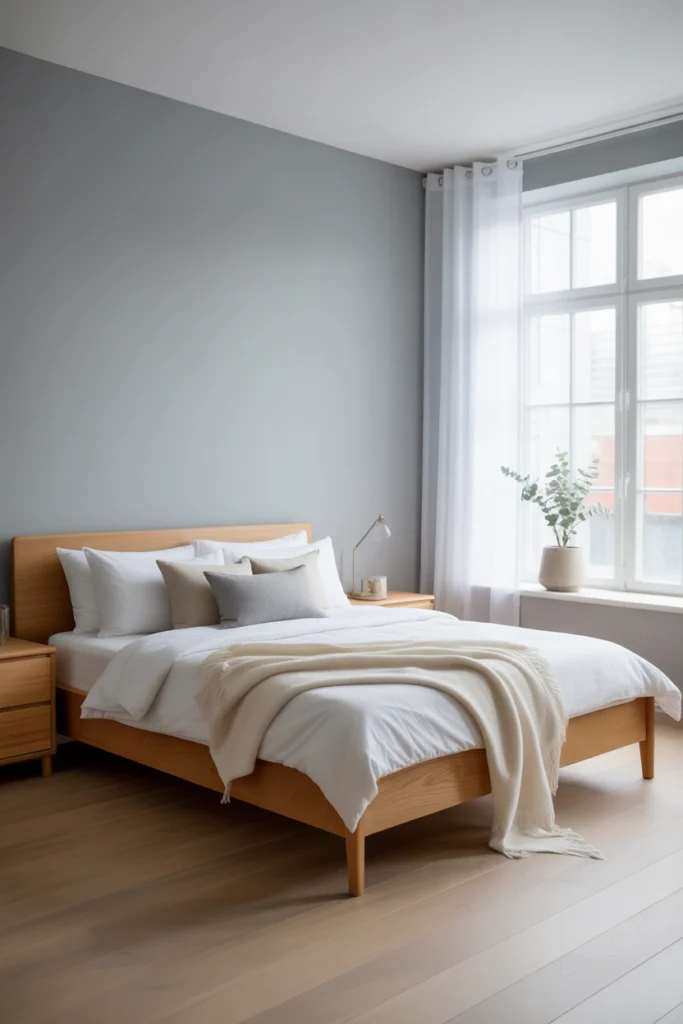
Scandinavian bedrooms use cool gray as a calm base and then add warmth through wood, light, and texture, never through strong color. The palette is pale gray walls, white bedding, light oak or birch furniture, and black accents used sparingly. The result feels fresh and uncluttered, and it works particularly well in rooms with good daylight, where the pale gray stays bright instead of turning cold.
Build the look in layers. Start with pale gray walls and a light wood floor or a large pale rug. Add a simple wooden bed frame, white or light gray linen bedding, and a wool throw in a slightly darker gray. Keep furniture low and leggy so the floor stays visible. Add warmth with a wooden bench, a rattan basket, a paper or fabric pendant light, and one or two plants. Avoid heavy curtains; a light linen panel or a simple roller blind keeps the light coming in.
Storage is part of the style, not an afterthought. Scandinavian rooms look calm because clutter is hidden: clothes in a wardrobe, books on a single shelf, and only a few objects on display. Choose one or two pieces of art in simple frames, keep bedside tables to a lamp and a book, and use a lidded basket for blankets. If the room starts to feel too pale, add a sheepskin rug beside the bed or a warm wood tray; both add warmth without adding color.
12. Gray Boho Bedroom with Textured Layers
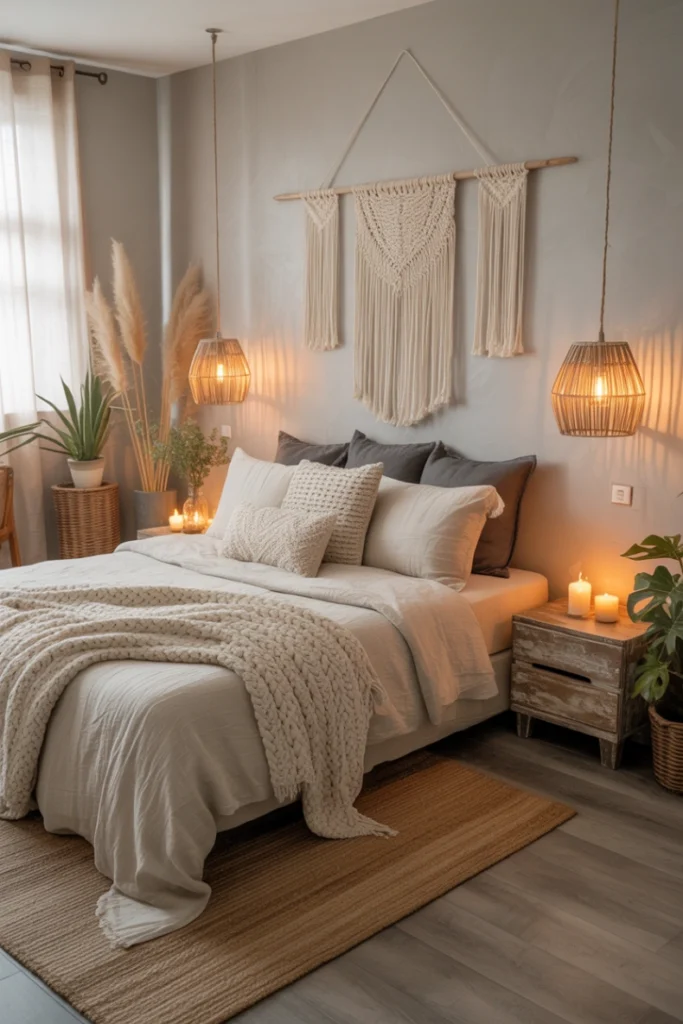
A gray boho bedroom is built on texture, not color. The gray backdrop stays quiet while woven rugs, macrame wall hangings, rattan, linen, and layered throws create the personality. This is a forgiving style: nothing has to match exactly, and pieces collected over time look better than a matching set bought in one go. The key is to keep the gray consistent, one family of grays, warm or cool, so the textures read as intentional rather than random.
Layer from the floor up. Start with a large woven rug, jute or wool, that extends at least 60 cm beyond the bed on each side. Add linen bedding in a mid gray, a cotton kantha quilt or a waffle throw, and cushions in different weaves: a chunky knit, a woven stripe, and a plain linen. Hang one macrame piece or a woven wall hanging above the bed, add a rattan pendant light or a pair of woven baskets, and finish with plants in terracotta or woven pots. Trailing plants on a shelf soften the whole room.
Keep the room from tipping into clutter by giving the eye places to rest. Leave one wall mostly bare, keep the bedside table to a lamp and a small plant, and choose a plain gray duvet as the anchor so the patterned throws and cushions have something calm to sit against. Dust woven pieces regularly with a brush attachment, and rotate throws and cushions seasonally so the room feels fresh without buying anything new.
13. Hotel-Inspired Gray Luxury

Hotel bedrooms feel luxurious because every layer is considered: crisp bedding, a tall headboard, layered lighting, and nothing out of place. You can recreate that feeling at home with gray as the base. Start with a tall upholstered headboard in mid gray, white or pale gray sheets with a high thread count, a white duvet, and a gray throw folded neatly across the foot. Add two bedside tables with matching lamps, and keep the surfaces almost clear.
Lighting is what separates a hotel room from an ordinary bedroom. Use three layers: a dimmable overhead light, bedside lamps for reading, and a soft accent light, such as a picture light or a small lamp on a dresser. Warm white bulbs (2700K) flatter gray and skin tones and make the room feel inviting in the evening. If you can, add dimmer switches to the bedside lamps so you can lower the light as you wind down.
Finish with the small hotel details that cost little but change the feel: a luggage style bench or a chair for clothes, a carafe and glass on a tray, a single scented candle or diffuser, and a folded throw within reach. Keep the color palette tight, gray, white, and one metallic, and iron or steam the bedding once a week so it keeps that crisp, freshly made look. These dreamy bedroom style ideas use the same layering principle if you want to push the look further toward soft and romantic.
14. Gray and Navy Blue Contrast
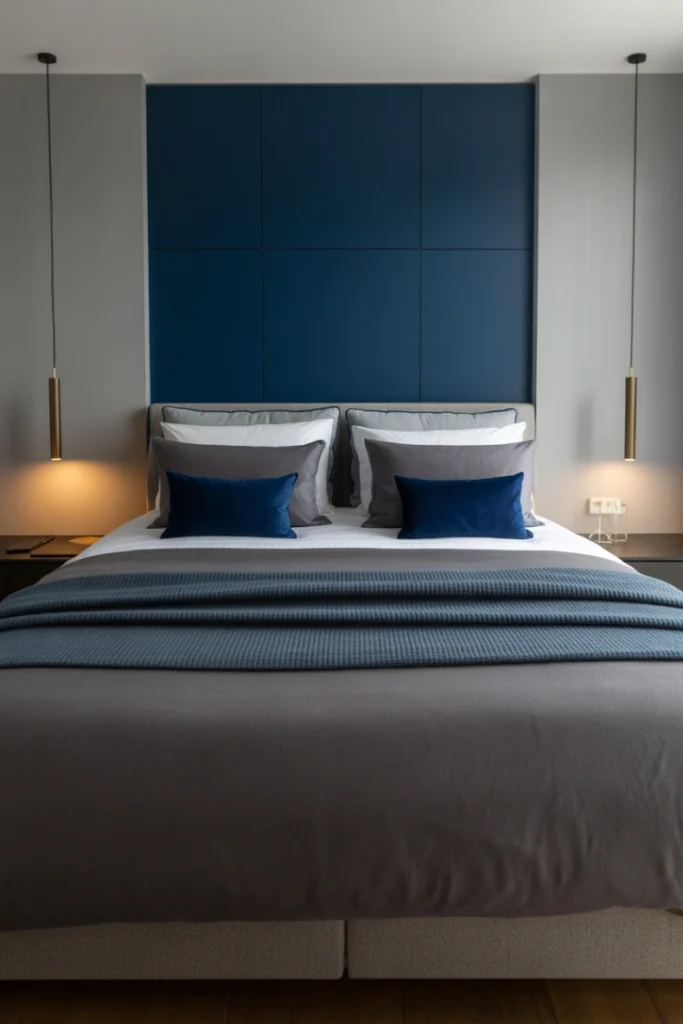
Gray and navy is a mature, confident pairing. Navy adds depth and richness, gray keeps it from feeling heavy, and together they suit both small and large rooms. The safest split is gray as the main color, walls, bedding, and large furniture, and navy as the accent, an accent wall, a headboard, cushions, a throw, or a single upholstered chair. Reversing the split, navy walls with gray bedding, also works in a large room with good light, but it needs more lighting to stay welcoming.
To make the pairing work, watch the undertones. A cool gray with a blue undertone sits naturally next to navy, while a warm gray can clash slightly unless you add a bridging neutral such as white, cream, or natural wood. Test the two fabrics or paint swatches side by side in daylight before you commit. Add white to lift the scheme: white sheets, white lamp shades, or a white framed print stop the darker colors from closing the room in.
Style it with metallic or natural accents rather than a third strong color. Brushed brass lamps warm up navy beautifully, silver or chrome suits a cooler gray, and light oak furniture keeps the room grounded. Keep patterns simple, stripes, a subtle geometric, or a plain texture, so the color contrast remains the main event.
15. Industrial Gray Bedroom Style
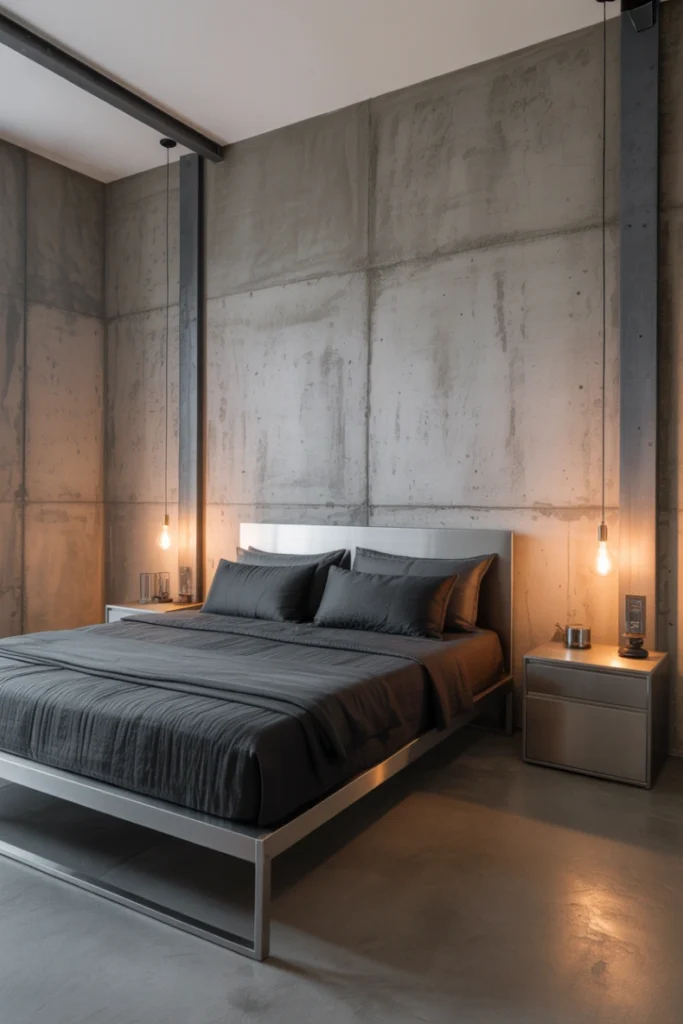
Industrial bedrooms use gray as a raw, urban base: concrete effect walls, metal frames, exposed brick painted gray, and black accents. The look is bold but it needs softening, or it can feel like a warehouse. The formula is simple: hard surfaces in gray and black, soft layers in fabric, and warm light throughout. A concrete effect wall or a gray brick accent wall gives the industrial character, while linen bedding, a wool rug, and warm lamps make it a bedroom rather than a studio set.
Start with one industrial feature, not five. A metal frame bed, a concrete effect accent wall, a set of black metal shelves, or a reclaimed wood and metal dresser is enough. Pair it with plain gray or white bedding, a simple rug, and warm wood touches such as a wooden stool or a wooden picture ledge. Exposed bulbs look industrial, but use warm white filament bulbs and a dimmer so the light stays comfortable; bare cool white bulbs will make the room feel harsh.
Storage suits the industrial look when it is open and honest: black metal shelving, wire baskets, and leather or canvas boxes. Keep the palette tight, gray, black, white, and one warm wood tone, and avoid bright colors that break the industrial mood. If the room feels too cold, add a rust or mustard throw for a single season, then remove it when you want the cleaner industrial look back.
16. Warm Gray for Cozy Comfort
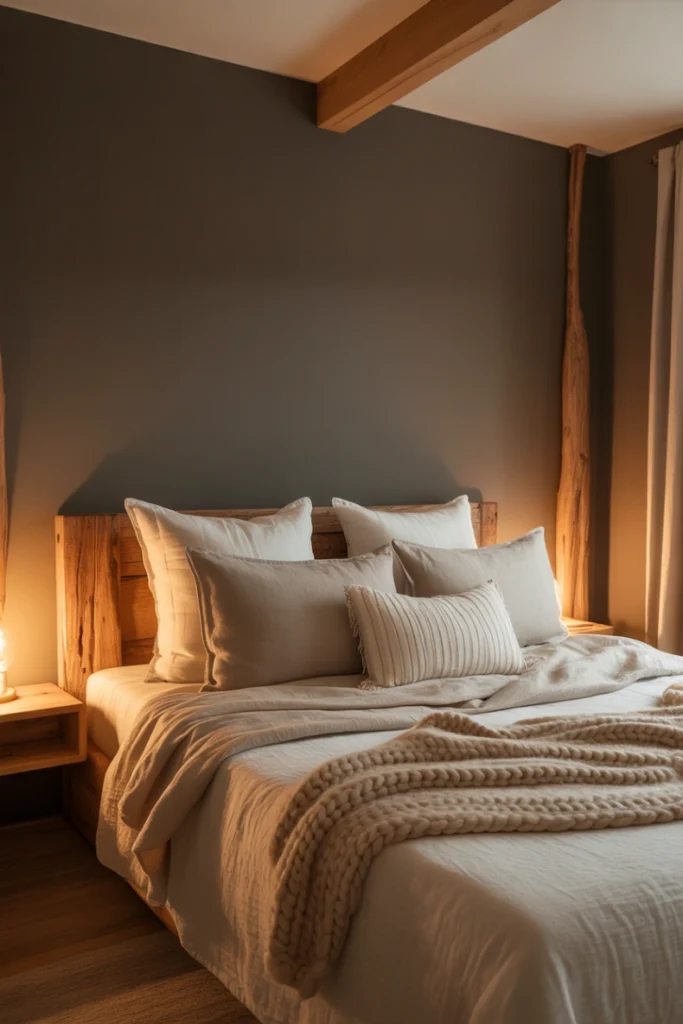
Warm gray, sometimes called greige, is gray with a beige or taupe undertone, and it is the most forgiving gray for rooms with low light or a lot of wood. Where a cool gray can turn chilly in a north facing room, a warm gray glows softly and pairs naturally with cream, beige, oak, and brass. It is the best gray family if you want a cozy room that still looks modern, and it is a good choice if the rest of your home already uses warm neutrals.
Choosing the right warm gray takes testing, because the beige undertone can read pink or yellow on a large wall. Paint a large swatch and check it next to your flooring, trim, and bedding in both daylight and lamplight. Pair warm gray walls with cream bedding rather than stark white, which can look too cold next to it, and add texture through a wool throw, linen cushions, and a natural fiber rug. For a full palette, see these bedroom color schemes that show how warm gray sits alongside other neutrals.
Warm gray also suits layered lighting. Use warm white bulbs, wooden lamp bases, and a cream or linen shade to keep the glow soft. Add one darker accent, a charcoal cushion, a walnut bench, or a deep green plant, so the room has depth and does not drift into an all beige blur. The contrast should be gentle, not sharp, which is exactly what makes warm gray feel restful.
17. Gray Accent Ceiling for Subtle Drama
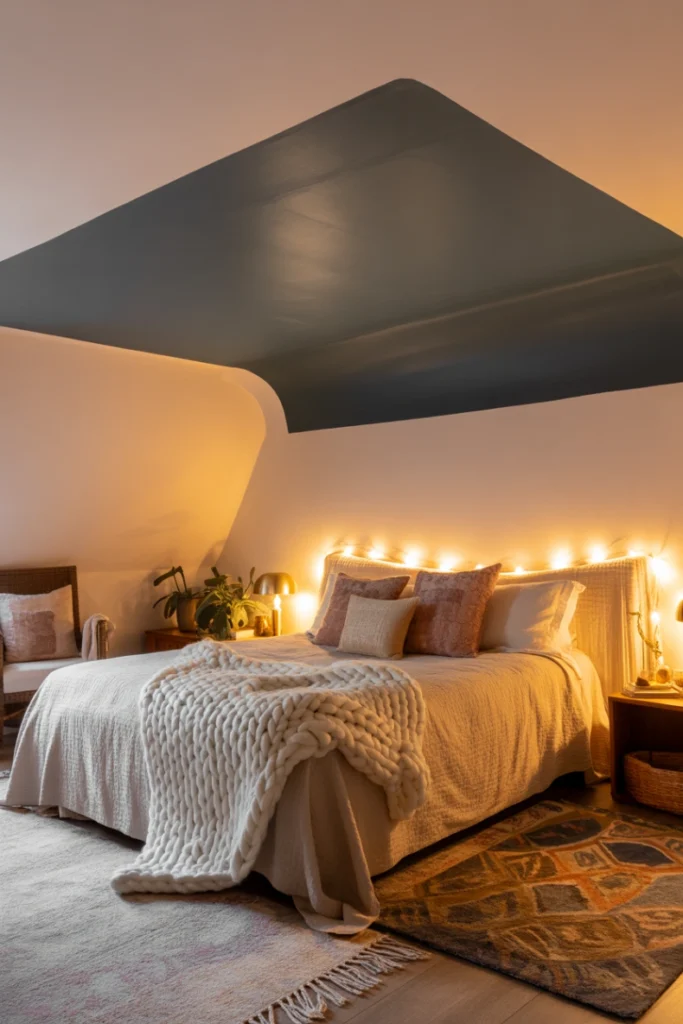
Painting the ceiling gray is an unexpected move that adds intimacy without the commitment of a dark accent wall. A light gray ceiling with white walls lowers the visual height slightly and makes a large room feel cozier. A mid to dark gray ceiling with white walls creates a dramatic canopy effect, especially in a bedroom with a tall headboard or a four poster bed, but it needs good lighting and a room at least 270 cm high to avoid feeling low.
To paint a ceiling well, remove light fittings or mask them carefully, protect the floor and furniture with dust sheets, and use a roller with an extension pole and a paint tray with a grid. Cut in around the edges with a brush first, then roll in straight, overlapping lines across the shortest dimension of the room, keeping a wet edge. Two coats of ceiling paint in a flat finish hide imperfections and reduce glare. Flat paint is important on a ceiling; any sheen will highlight every bump.
Balance a gray ceiling with white or pale walls, light bedding, and plenty of light. Add a statement pendant or a pair of bedside lamps that throw light upward as well as down, so the ceiling reads as a design choice rather than a shadow. Keep crown molding or ceiling trim white if you have it; the white frame makes the gray panel look intentional and crisp.
18. Gray Bedding with Patterned Details
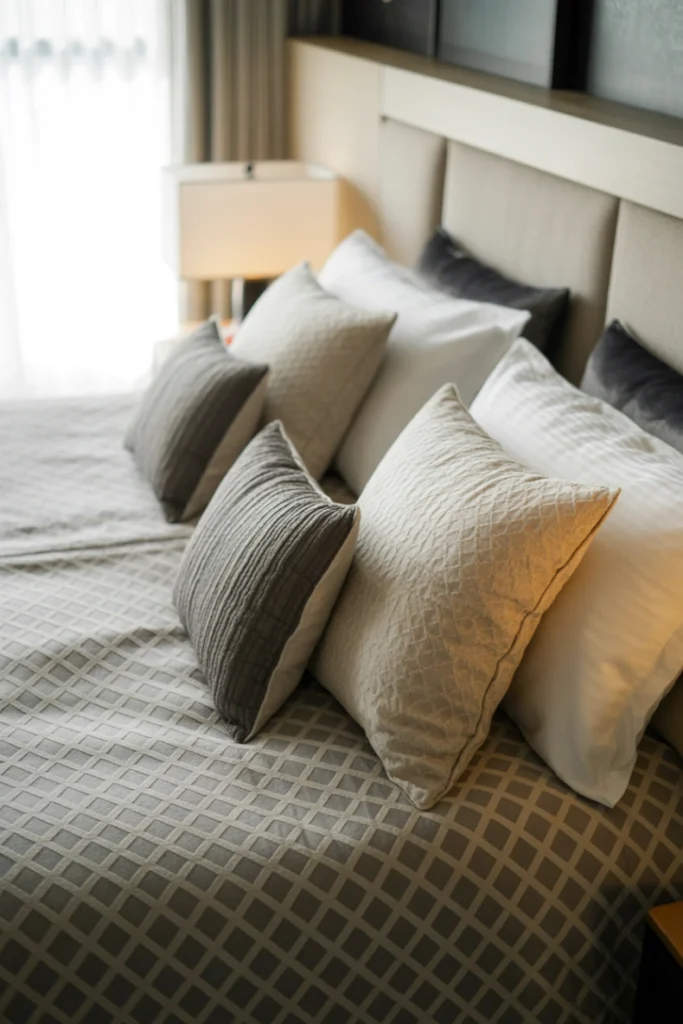
Patterned gray bedding adds personality while keeping the room calm, because gray is a neutral base for almost any pattern. Geometric prints feel modern, subtle stripes feel classic, and a small floral or botanical print feels soft and romantic. The rule for mixing patterns is scale: combine one large scale pattern, such as a wide stripe or a bold geometric duvet, with one small scale pattern, such as a tiny dot or a fine stripe on a cushion, and keep the rest plain.
To style it, choose the duvet as the hero pattern and keep sheets plain white or pale gray. Add two patterned cushions at most, in the same gray family as the duvet, and keep the throw plain or lightly textured. If the duvet pattern is busy, choose a plain rug and plain curtains so the bed remains the focus. If the duvet pattern is subtle, you can add a patterned rug or a textured throw without the room feeling busy.
Wash patterned bedding inside out on a cool cycle to protect the print, and avoid harsh bleach, which can fade gray unevenly. Rotate between two duvet sets if you can, one patterned and one plain, so the room feels fresh each time you change the bed and the patterned set lasts longer.
19. Gray Nightstands for Balanced Styling
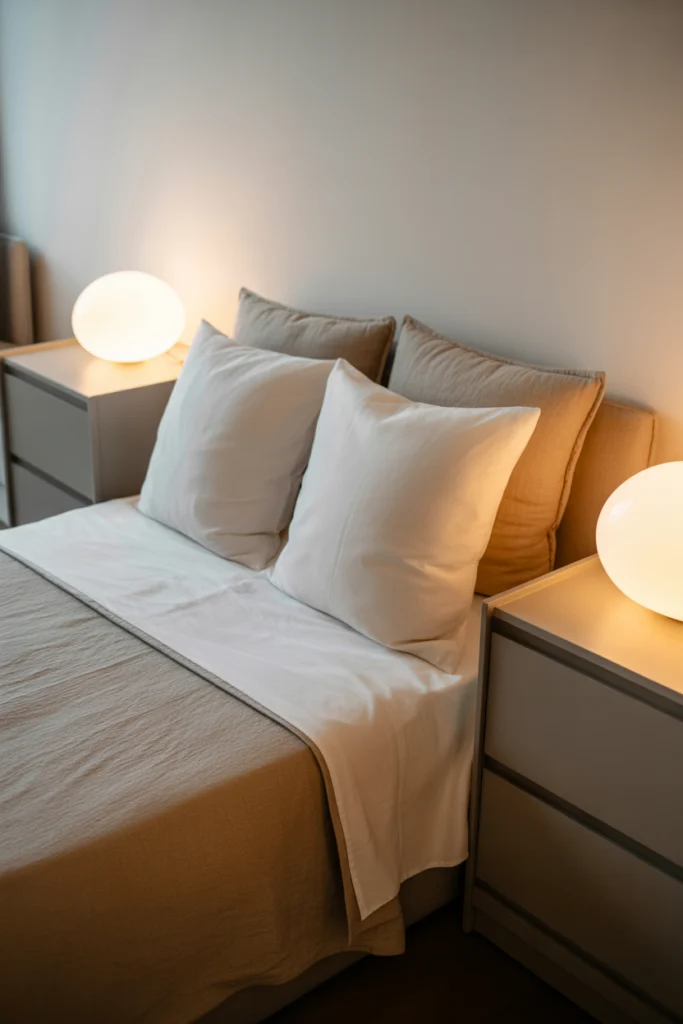
Gray nightstands are a small change with a big balancing effect. They frame the bed, anchor the lamps, and add just enough contrast against light or dark walls without demanding attention. A pair of matching nightstands gives symmetry, which suits a formal or hotel style room, while a single nightstand paired with a small stool or a stack of books on the other side suits a relaxed, collected room.
Size matters more than style here. A nightstand should sit within 5 cm of the mattress height, so you can reach a lamp or a glass of water without stretching, and it should be wide enough for a lamp base plus a book, usually 45 to 60 cm wide. Leave a small gap, 2 to 5 cm, between the nightstand and the bed so bedding does not catch on the drawer. If space is tight, a wall mounted shelf at nightstand height or a narrow 30 cm table can work just as well.
Style each nightstand with no more than three items: a lamp, one personal item such as a book or a photo, and one functional item such as a small tray for a phone or glasses. Matching lamps give calm symmetry; different lamps in the same finish give a collected look without chaos. Keep the drawer for chargers, medication, and other items you want out of sight, so the surface stays clear.
20. Moody Dark Gray Bedroom
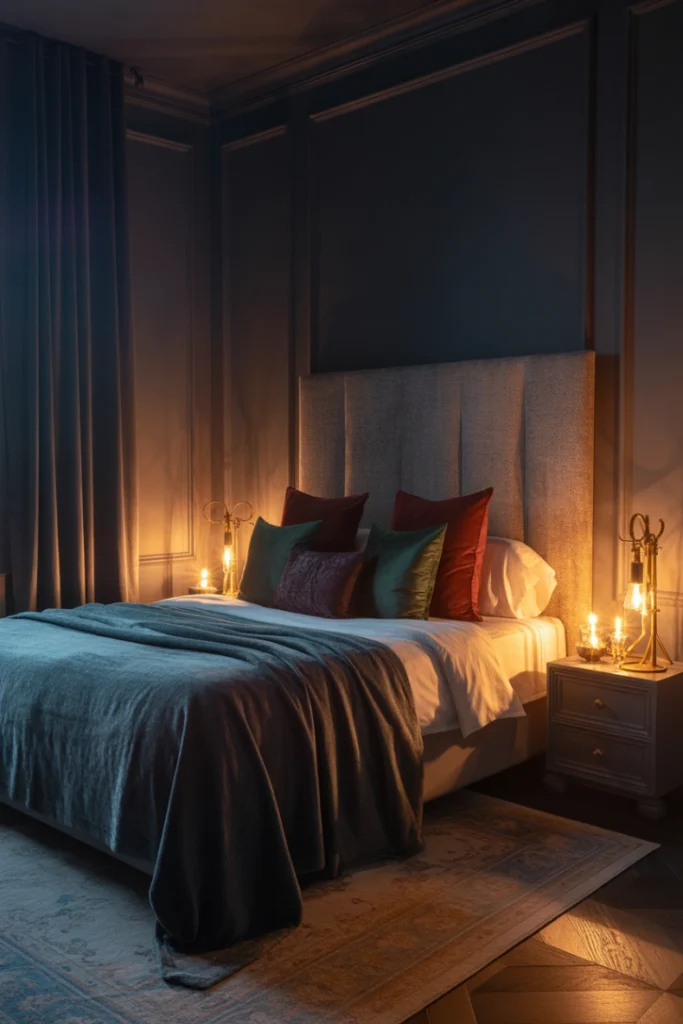
A moody dark gray bedroom is about embracing depth: walls in charcoal or slate, bedding in layered grays, and warm lighting that makes the darkness feel cocooning rather than gloomy. This look suits medium and large rooms best, but a small room can carry it if the lighting is generous and the bedding is light enough to break up the dark walls. The key is contrast within the darkness, not a single flat dark tone everywhere.
Paint the walls in a deep gray with an LRV below 20, keep the ceiling white or a very pale gray to hold some height, and use warm white lighting throughout, ideally on dimmers. Add layers of texture to stop the dark color from feeling flat: velvet cushions, a chunky knit throw, a wool rug, and linen bedding. Metallic accents in brass or gold reflect the warm light and add points of brightness, while a large mirror opposite the window doubles the available light.
Keep the room functional in the dark palette. Use bedside lamps you can switch on from the bed, a clear path to the door with no low furniture to trip over, and light colored bedding or a pale rug so the bed and the floor remain visible at night. Dark rooms photograph beautifully, but they live even better when the lighting is planned, not left to a single ceiling light.
21. Gray Bedroom with Pops of Color
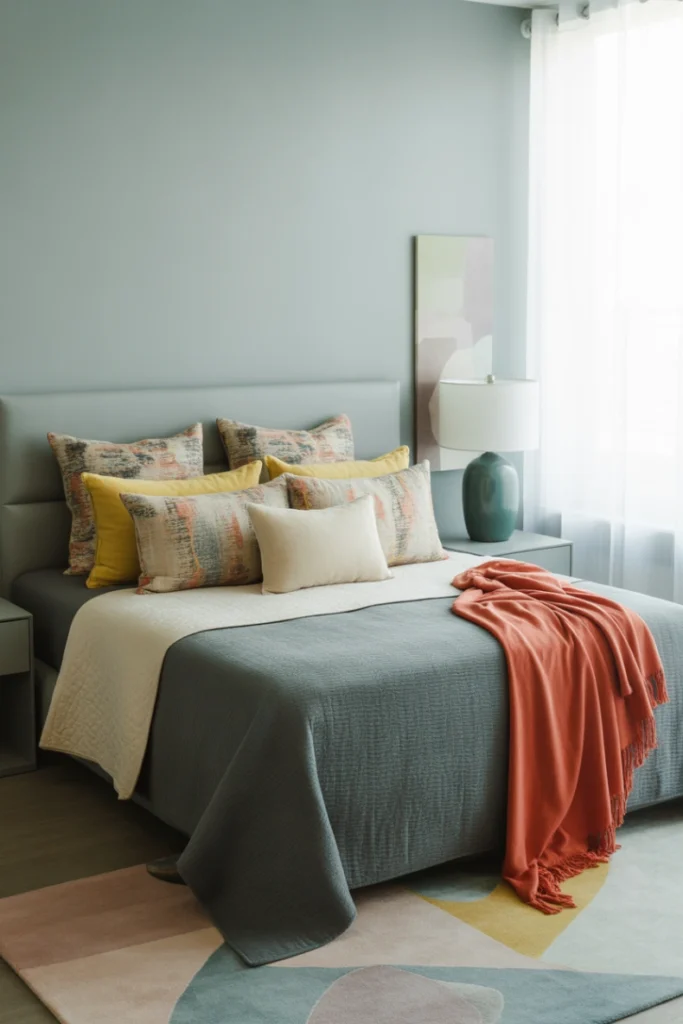
Gray is the ideal backdrop for color because it lets a bright accent shine without competing with it. The easiest way to add color is through items you can change cheaply: cushions, a throw, a rug, art, and a vase of flowers. Yellow and mustard add energy, blush pink adds softness, teal adds depth, and green, through plants, adds life to any gray room. Choose one accent color and use it in three places, for example cushions, art, and a throw, so it feels deliberate rather than random.
Start small if you are unsure. Swap two cushion covers and add a throw in your chosen color, live with it for a week, and then decide whether to add a rug or art in the same family. This low cost test avoids a full repaint or a new bedspread you later regret. If you love the color, you can go further: paint one small piece of furniture, such as a stool or a picture frame, in the accent color, or hang a large print that carries the color at scale.
Seasonal swaps keep a gray bedroom feeling fresh all year. Use mustard and rust in autumn, blush and sage in spring, teal and white in summer, and deep green and gold in winter. Because the gray base never changes, each seasonal swap takes minutes and costs little, and the room always looks intentional. Keep the accent to about 10 percent of the room so the gray calm remains the dominant feeling.
Conclusion
Gray works in a bedroom because it is flexible, forgiving, and genuinely restful. Whether you choose soft gray walls, a charcoal accent wall, layered gray bedding, or a moody dark scheme, the same principles apply: pick the right gray family for your light, layer texture so the room does not feel flat, balance dark tones with light bedding and warm lighting, and let one or two accents do the talking. You do not need to copy any single idea exactly. Take the wall color from one idea, the bedding layers from another, and the lighting from a third, and you will end up with a room that feels collected, comfortable, and unmistakably yours.
Start with the change that will make the biggest difference in your room. In most bedrooms that is either the wall color or the bedding, and both can be done in a weekend. Test your gray, layer your textures, add warm light, and step back. A gray bedroom done well does not shout for attention. It quietly makes every morning easier and every evening calmer, which is exactly what a bedroom should do.
Frequently Asked Questions
What gray paint color works best in a bedroom?
For most bedrooms, a light to mid gray with an LRV of 50 to 70 works best, because it stays bright while still reading as gray. In a room with plenty of daylight, a cool gray with a blue undertone looks fresh and modern. In a room with low light or warm wood floors, a warm gray with a beige undertone feels cozier. Always test a large swatch on the wall in daylight and lamplight before buying a full tin.
Does a gray bedroom feel cold?
A gray bedroom only feels cold if the gray is too cool for the room and the textures are all smooth and hard. Warm it up with layered bedding, a wool or cotton throw, wooden furniture, warm white bulbs at 2700K to 3000K, and a plant or two. A warm gray paint, cream bedding instead of stark white, and a natural fiber rug will also remove any chilly feeling quickly.
What colors go well with a gray bedroom?
Almost any color works with gray, which is why it is such a useful base. White and cream keep it calm, navy adds depth, gold and brass add glamour, blush pink adds softness, mustard adds energy, and green through plants adds life. Pick one accent color and repeat it in three places, such as cushions, art, and a throw, for a deliberate look.
Should I paint all walls gray or just one accent wall?
Paint all four walls gray if you choose a light to mid gray, because it creates a calm, enveloping feel and makes the room look larger. Use a single accent wall if you choose a dark charcoal or a bold patterned wallpaper, because a full room in a dark color can feel heavy unless the room is large and well lit. In a small room, keep dark gray to the wall behind the headboard and light gray or white on the other walls.
How do I keep a gray bedroom from looking boring?
Mix textures, not just shades. Combine smooth cotton sheets with a quilted coverlet, a chunky knit throw, velvet cushions, and a woven rug, and the same gray palette suddenly has depth. Add one contrasting element, a wooden bench, brass lamps, a large plant, or a colorful piece of art, and vary the lighting with bedside lamps and a dimmer so the room changes mood from day to evening.
More Ideas You Will Love
 20 Bedroom Decor Ideas for a Cozy, Stylish, and Inviting Space
 24 Wardrobe & Armoire Ideas: Smart Storage for Every Room
 13 Shared Bedroom Ideas That Are Cute, Aesthetic & Functional
 21 Creative Kids Bedroom Ideas with Fun Themes & Practical Decor Tips
 21 Bedroom Furniture Ideas – Fresh Ways to Elevate Your Space
 14 Boy Nursery Ideas with Inspiring Themes and Layout Tips