
12 Easy Ways to Beautify Your Porch with Hanging Plants

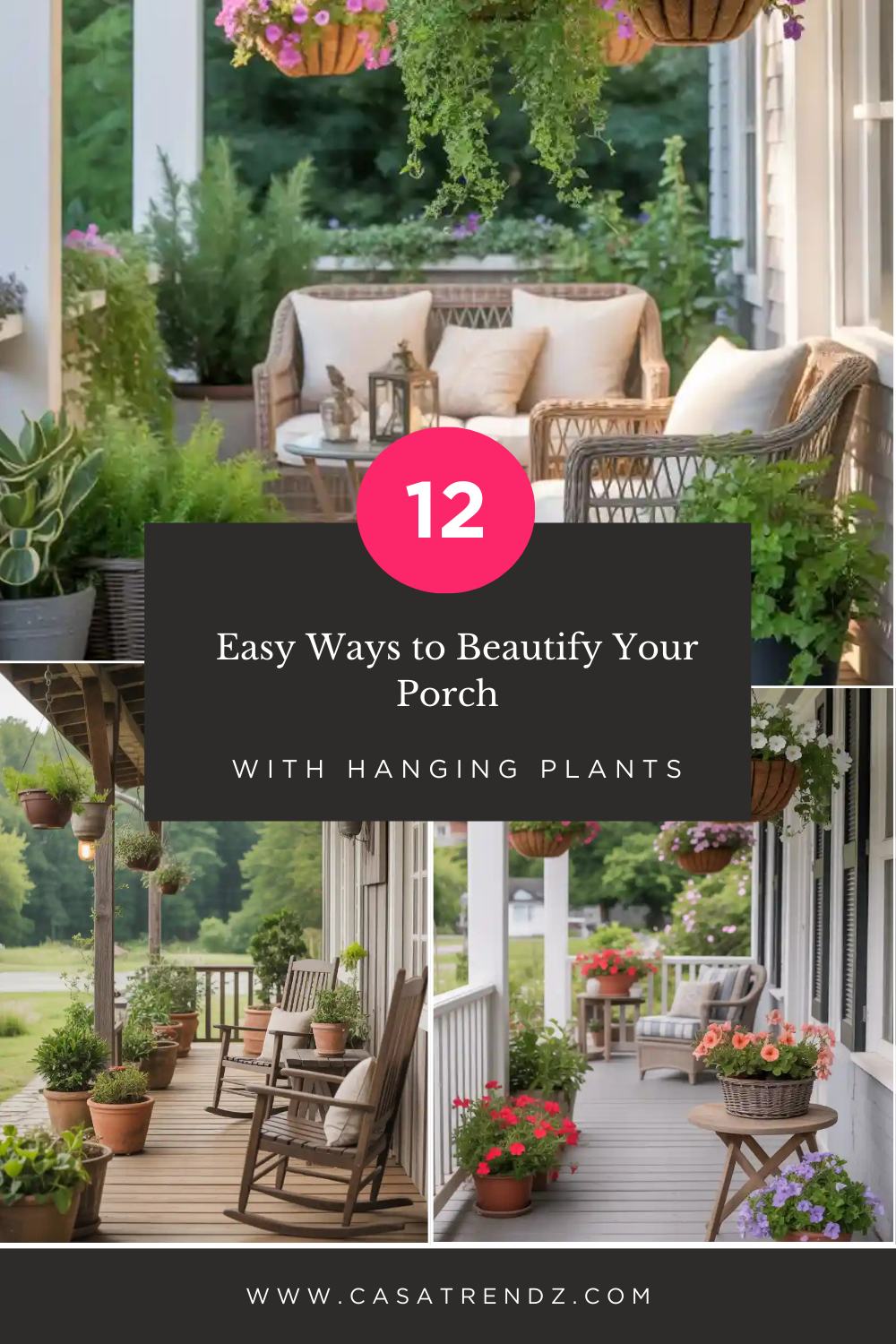
Your porch is the first thing guests notice when they arrive at your home, and hanging plants are one of the simplest ways to make that first impression warm, lush, and welcoming. A few well chosen baskets can turn a plain concrete slab or a bare wooden deck into a green retreat that feels alive from spring through fall. The best part is that hanging plants use vertical space, so even the smallest porch can look full and layered without losing a single inch of floor space for chairs, a welcome mat, or a place to set down groceries.
Before you buy a single plant, take a quick look at how much sun your porch actually gets. A south facing porch in full sun needs heat tolerant blooms like petunias and lantana, while a shaded north facing porch is a perfect home for ferns, pothos, and ivy. Check the weight limit of your ceiling hooks too, because a freshly watered 14 inch basket can weigh 15 to 20 pounds. With those two basics sorted, the twelve ideas below will help you build a porch display that looks intentional, stays healthy, and fits your style, whether you love a cozy farmhouse look or a clean modern finish. If you are starting from scratch, browse these front porch decor ideas first to plan the whole space, then layer in the hanging plants.
1. Classic Hanging Flower Baskets
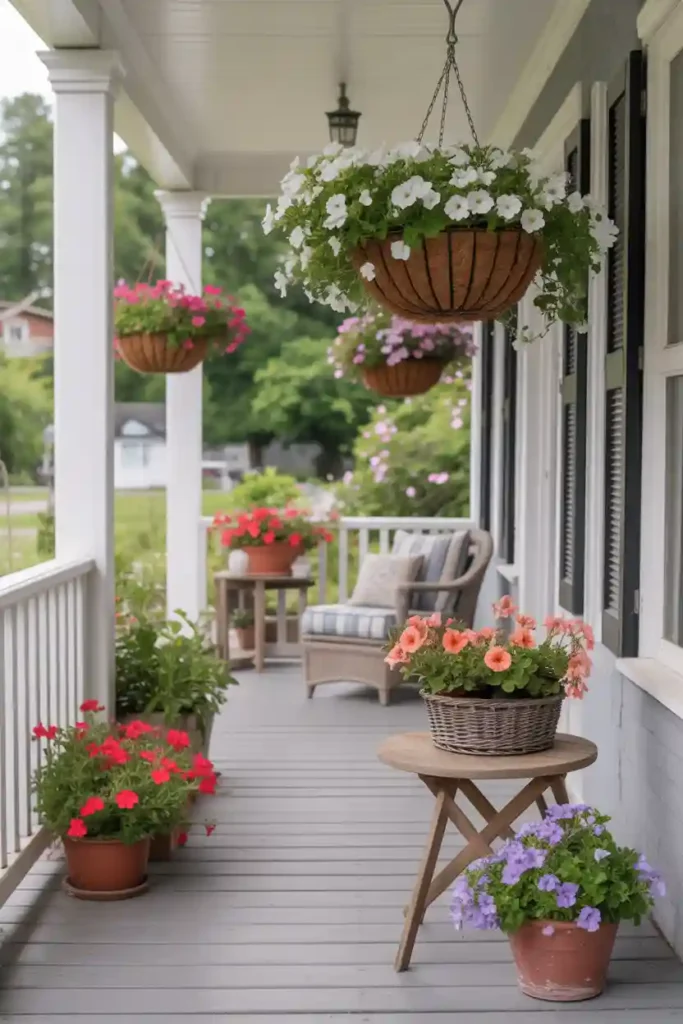
Classic hanging flower baskets are the easiest win on any porch. A single basket filled with petunias, geraniums, or begonias adds instant color at eye level, right where guests look as they walk up to the door. Choose a 12 to 14 inch basket for a full look, and pick plants in three habits for a professional finish: one upright thriller in the center, like a geranium or upright fuchsia, two or three fillers around it, like calibrachoa or bacopa, and one spiller at the edge, like trailing lobelia or sweet potato vine. This thriller, filler, spiller formula is the same one nurseries use, and it keeps the basket looking balanced instead of flat.
Pick a basket with real drainage holes and a coconut fiber or moss liner, then fill it with a light potting mix made for containers, not heavy garden soil. Water slowly until you see a few drops from the bottom, and feed every two weeks with a half strength liquid fertilizer while the plants are blooming. Hang baskets 7 to 8 feet high so the bottom of the basket sits just above head height, and space them 3 to 4 feet apart so each one has room to breathe. Trim spent blooms once a week and the plants will keep flowering for months instead of going leggy by midsummer.
- Best flowers: petunias, geraniums, begonias, calibrachoa, and trailing verbena.
- Best basket size: 12 to 14 inches wide for a full, lush look.
- Care tip: water daily in hot weather, since hanging baskets dry out faster than ground beds.
2. Cascading Vines for a Lush Look
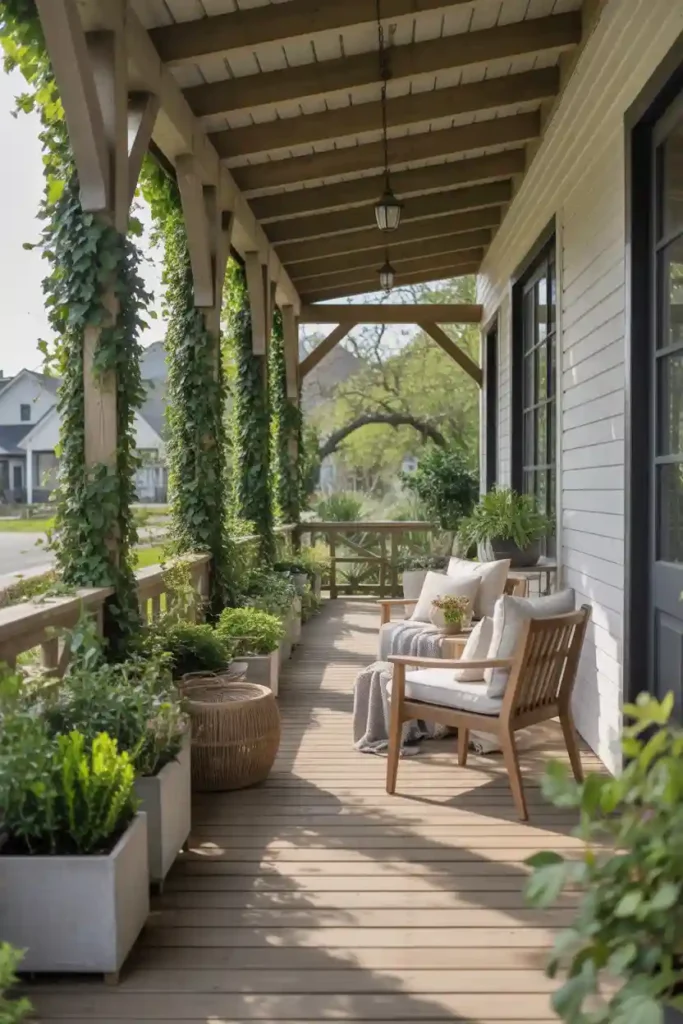
Cascading vines add softness and movement that no upright plant can match. Golden pothos, English ivy, string of pearls, and trailing lobelia spill over the rim of a hanging planter in long green ribbons, framing your doorway and softening hard porch lines. A vine that trails 2 to 3 feet long creates a living curtain effect, which looks especially good on the corners of a porch or along a beam where the eye naturally travels.
Vines are forgiving plants, which makes them a great choice if you are new to porch gardening. Pothos and ivy tolerate shade and only need watering when the top inch of soil feels dry, while trailing lobelia prefers a bit more sun and regular moisture. Plant one vine per 10 inch pot and let it grow; resist the urge to crowd three vines into one basket, because they will compete and thin out. Pinch the growing tips every few weeks to encourage branching, and trim any bare stems back to a leaf node to keep the plant full from top to bottom.
- Best vines: golden pothos, English ivy, string of pearls, creeping Jenny, and trailing lobelia.
- Placement: corners, door frames, and along beams where the vines can frame the entrance.
- Care tip: pinch the tips often so the vine branches instead of growing one long bare stem.
3. Macrame Plant Hangers for Boho Charm
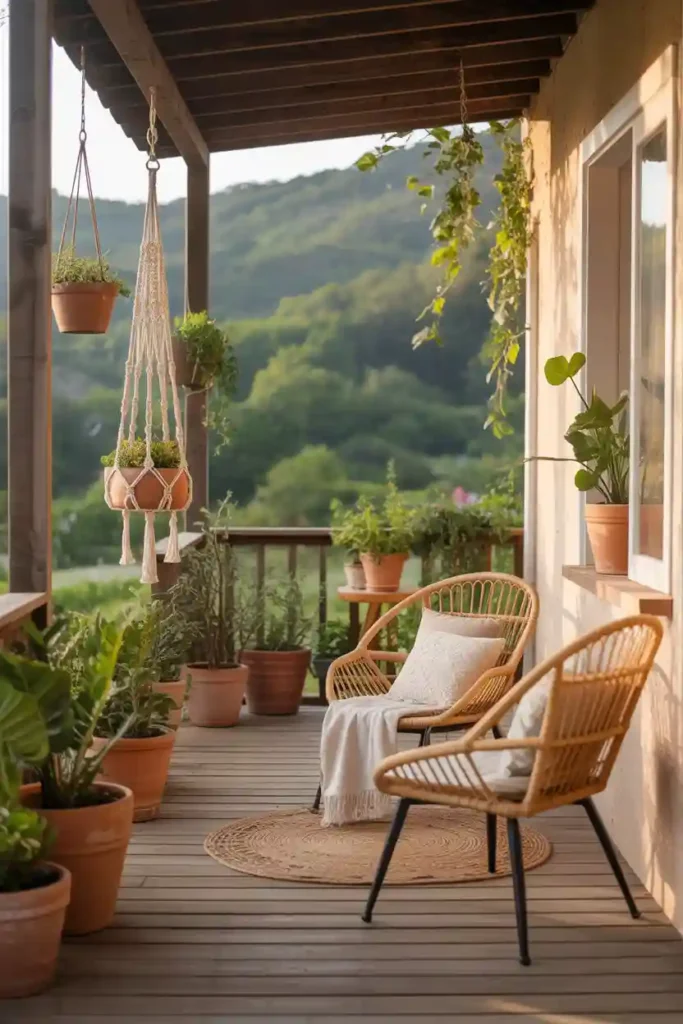
Macrame plant hangers bring texture and a handcrafted feel that plain chains and hooks cannot match. The knotted cotton cords add a soft, bohemian layer to your porch, and they look beautiful against wood siding, brick, or a painted beadboard ceiling. Choose natural undyed cotton for a calm, earthy look, or pick a hanger dyed in terracotta, sage, or dusty blue to pull in a color from your cushions or door wreath.
Hang macrame planters at two or three different lengths to create a layered display. A good starting point is one hanger at 24 inches, one at 30 inches, and one at 36 inches from the hook to the pot, so the plants sit at staggered heights instead of lining up in a row. Use a lightweight pot, like a 6 to 8 inch terracotta or ceramic pot, and pick a plant that trails a little, such as a spider plant or a small pothos, so the greenery spills over the knots. Keep macrame hangers under a covered porch or bring them in during heavy rain, because cotton cord stays damp and can mildew if it never dries out. A quick spray with a fabric protector at the start of the season helps too.
- Best pots: 6 to 8 inch terracotta or ceramic pots that are light enough for cord hangers.
- Best plants: spider plant, pothos, string of hearts, and small ferns.
- Care tip: keep macrame under cover and let it dry fully after rain to prevent mildew.
4. Layered Hanging Planters at Different Heights
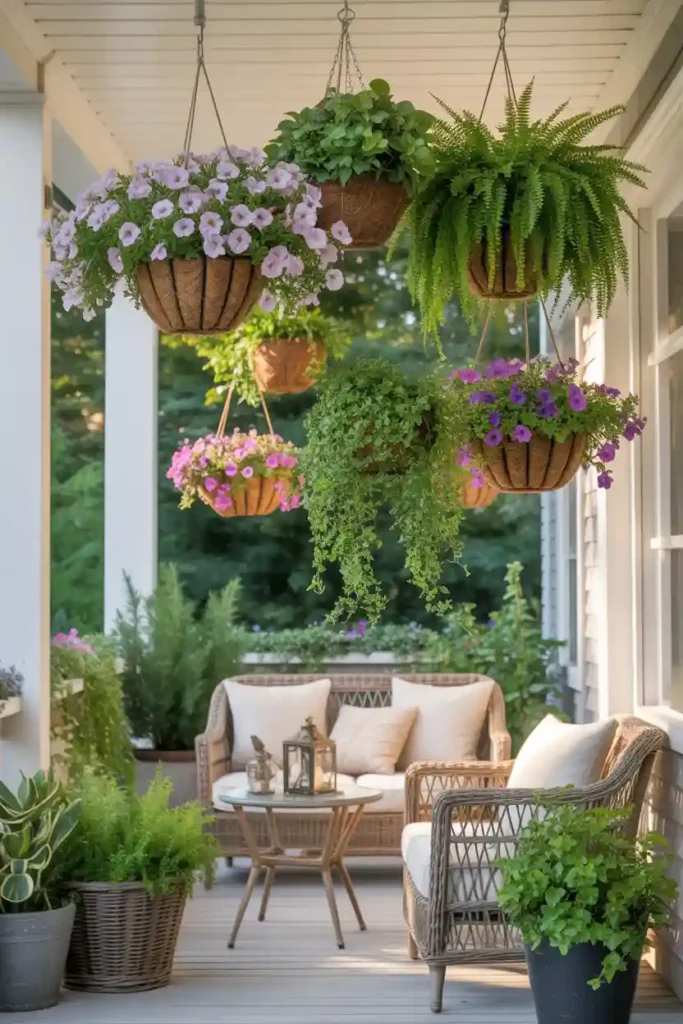
Layering planters at different heights is the fastest way to make a porch look designed rather than decorated. When every basket hangs at the same level, the eye slides right past them. When you stagger heights by 6 to 12 inches between planters, you create depth and movement, and each plant gets its own moment. This technique works best on porches with ceilings 9 feet or higher, where you have room to play without the lowest basket blocking the walkway.
Start with the tallest planter nearest the wall and step down toward the outer edge of the porch, or arrange a cluster of three over a seating area, with the middle planter hanging 6 inches lower than the two on either side. Mix textures as you layer: pair a flowering basket with a leafy fern and a trailing vine so the group has variety in shape, color, and size. Leave at least 12 inches of air between planters so air can circulate and each plant gets light. Adjustable chains or S-hooks make it easy to fine tune the heights until the arrangement feels balanced, and they let you raise the planters in winter when you want more light reaching the porch floor. On a narrow porch, the same layering idea works with two planters instead of three, and these small front porch ideas show how to fit the look into a tight space.
- Height rule: stagger planters by 6 to 12 inches for visible depth.
- Spacing rule: keep at least 12 inches between planters for airflow and light.
- Hardware tip: adjustable chains and S-hooks let you change heights in seconds.
5. Hanging Ferns for a Timeless Porch
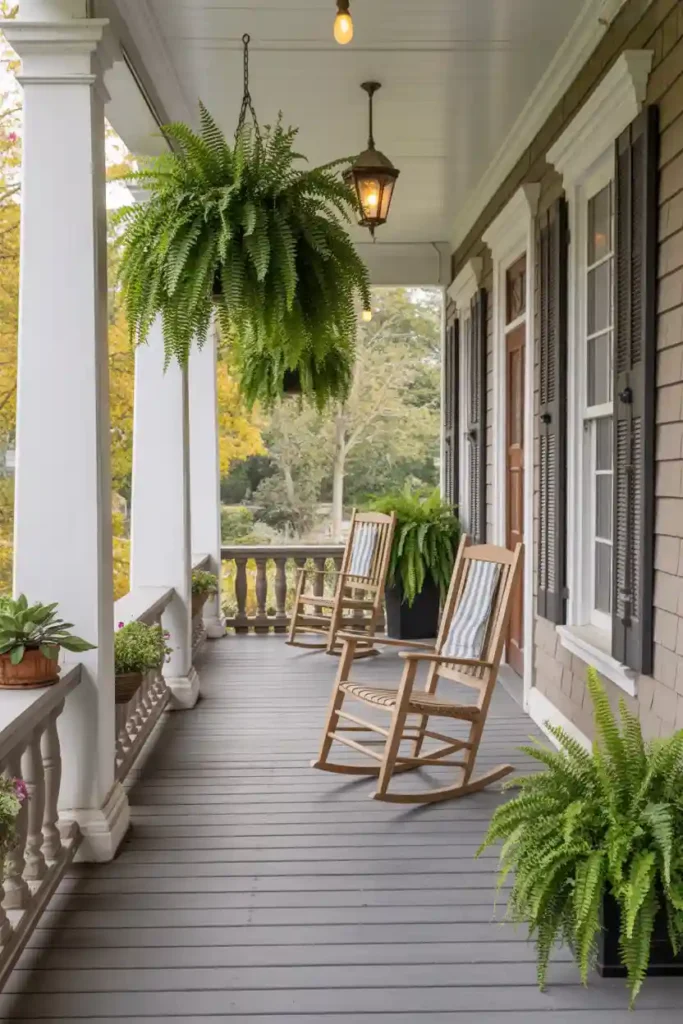
Hanging ferns are the classic porch plant for a reason. A Boston fern in a 12 inch basket grows into a full green ball of feathery fronds that can reach 2 to 3 feet wide, softening the hard lines of posts, railings, and door frames. Ferns thrive in shade and partial shade, which makes them perfect for covered porches that never get direct sun, and they bring a calm, traditional feel that suits farmhouse, cottage, and Southern style homes.
Ferns are thirsty plants, so plan on watering every day in summer and misting the fronds two or three times a week to keep the humidity up. Hang them where they get bright indirect light and good air movement, but shelter them from strong wind, which dries the fronds and turns the edges brown. Feed once a month with a half strength balanced fertilizer, and trim any brown fronds at the base to keep the plant tidy. In fall, bring the fern indoors before the first frost and hang it near a bright window, then move it back outside in spring after the nights stay above 50 degrees. With that routine, one fern can last for years.
- Best ferns: Boston fern, Kimberly Queen fern, and asparagus fern for sunnier spots.
- Watering: daily in summer, plus misting 2 to 3 times a week for full fronds.
- Care tip: bring ferns indoors before the first frost and keep them above 50 degrees.
6. Minimalist Modern Planters

If your home leans modern, minimalist planters let the greenery do the talking. Matte black metal, white ceramic, raw concrete, and brushed steel planters create a clean, sculptural look that pairs well with straight lines, dark trim, and simple furniture. Instead of a busy mix of flowers, choose one or two structured plants per planter, like a snake plant, a string of pearls, or a compact fern, and let the shape of the plant become part of the design.
Keep the color palette tight. Two or three planters in the same finish, hung in a straight line along a beam, look far more polished than five mismatched pots. Hang them at exactly the same height, about 7 feet from the porch floor to the bottom of the planter, and leave 3 to 4 feet between them so the arrangement reads as intentional. Use a simple chain or a thin black cord rather than a decorative hook, and skip the saucer if the planter has a built in reservoir. Concrete planters are heavy, so check that your ceiling hook is rated for at least 25 pounds before you hang one, and use a masonry anchor if you are drilling into a brick or concrete ceiling.
- Best finishes: matte black metal, white ceramic, raw concrete, and brushed steel.
- Best plants: snake plant, string of pearls, compact fern, and ZZ plant.
- Care tip: check the hook rating first, since a concrete planter can weigh 25 pounds or more.
7. Hanging Herb Garden
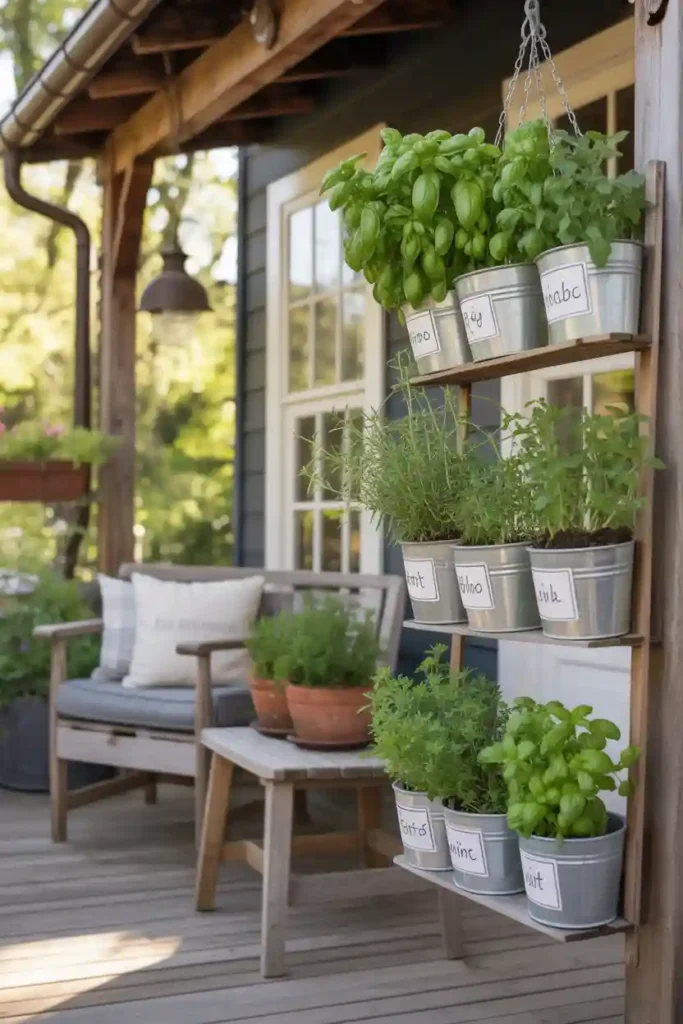
A hanging herb garden turns your porch into a working garden that smells wonderful and saves you trips to the store. Basil, mint, rosemary, thyme, and parsley all grow well in 6 to 8 inch hanging pots, and a row of five or six pots near the kitchen door gives you fresh herbs all summer. Mint grows fast and takes over, so always give it a pot of its own, and keep rosemary and thyme in the sunniest spot, since both love heat and dry soil.
Arrange the herb pots in a straight row along a beam or in a two tier hanging rack, and label each pot with a small wooden plant marker so guests and family can find the right herb at a glance. Use a potting mix with added perlite for drainage, and water in the morning so the leaves dry before evening, which helps prevent mildew. Harvest often, because cutting the top few inches encourages the plant to branch and produce more leaves. Pinch basil just above a leaf pair, and never take more than one third of the plant at once. If you cook with herbs weekly, a porch herb garden can pay for itself in a single season.
- Best herbs: basil, mint, rosemary, thyme, parsley, and chives.
- Pot size: 6 to 8 inches per herb, with mint always in its own pot.
- Care tip: harvest in the morning and never cut more than one third of the plant.
8. Color-Coordinated Flower Arrangements
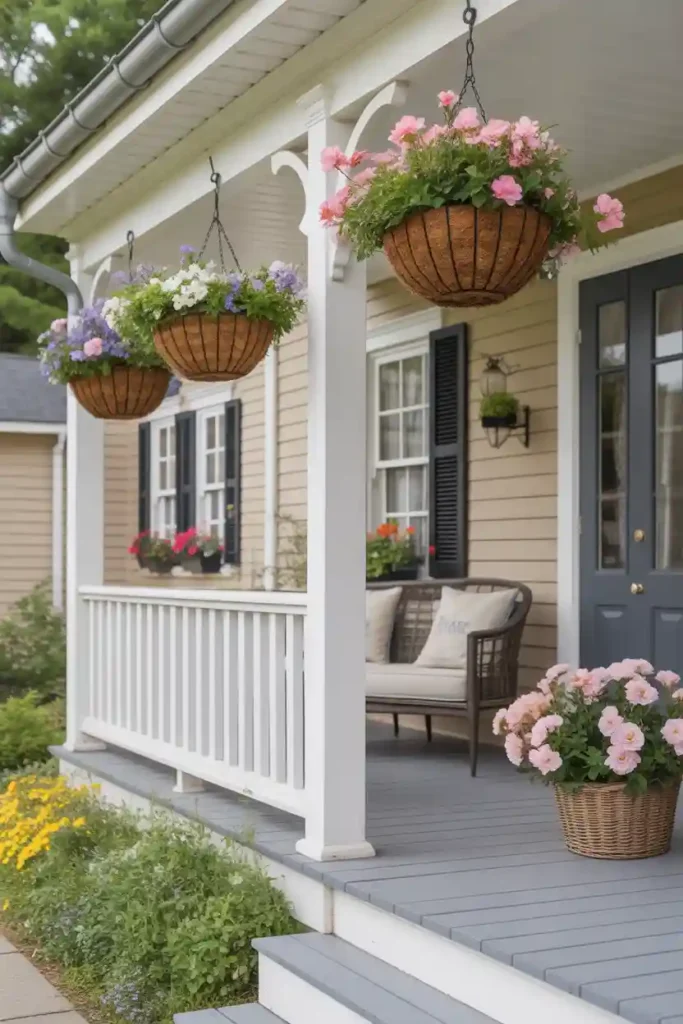
Color coordination is what separates a porch that looks thrown together from one that looks styled. Pick one palette and stick to it across every basket. Soft pastels like blush pink, lavender, and white feel romantic and calm. Bold reds, oranges, and deep purples feel festive and energetic. An all white and green scheme with white petunias, white bacopa, and trailing ivy looks fresh and elegant against any house color, and it never clashes with a painted front door.
Choose flowers that bloom at the same time so the color holds all season, and repeat the palette in one or two other places on the porch, like a cushion, a doormat, or a wreath, to tie the whole space together. Keep the foliage consistent too: if one basket uses dark green sweet potato vine, use it in the others as well, so the group reads as a set. When fall arrives, swap in mums and ornamental kale in the same color family, and you can refresh the look without changing the plan. If you want more ideas for pulling a whole outdoor palette together, these outdoor decor ideas show how color, texture, and lighting work as a set.
- Easy palettes: pastels (blush, lavender, white), bold (red, orange, purple), or all white and green.
- Repeat rule: echo the palette in a cushion, mat, or wreath to tie the porch together.
- Care tip: pick flowers with the same bloom season so the color stays consistent.
9. Rustic Metal or Wooden Hooks
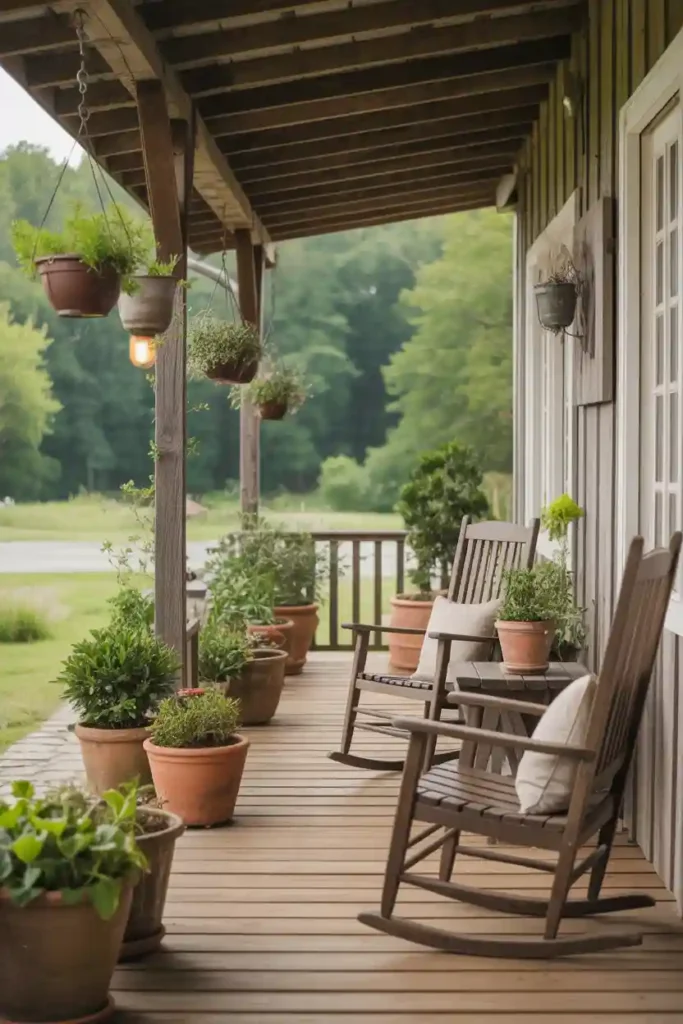
The hardware you hang plants from deserves as much thought as the plants themselves. A wrought iron bracket with a curved scroll, a hand forged S-hook, or a simple wooden bracket adds character before a single leaf appears, and it sets the tone for the whole porch. Black iron suits farmhouse and cottage styles, aged brass warms up a traditional brick home, and a natural wood bracket pairs beautifully with woven baskets and terracotta pots.
Install hooks into a ceiling joist or a solid beam, never into drywall or thin trim alone. A 3 inch lag screw driven into a joist holds far more weight than a small screw in a hollow surface, and a fully watered 14 inch basket can weigh close to 20 pounds. Space brackets 3 to 4 feet apart along the porch ceiling, and hang them at the same height so the baskets line up. Check the hooks once a season for rust or loosening, and tighten or replace them before they fail. A good bracket costs a few dollars and lasts for years, and it turns a plain hanging basket into a small piece of craftsmanship.
- Best hardware: wrought iron brackets, hand forged S-hooks, and solid wooden brackets.
- Install rule: drive a 3 inch lag screw into a ceiling joist or solid beam, never into drywall.
- Care tip: check hooks each season for rust and tighten them before they loosen.
10. Statement Oversized Hanging Planter
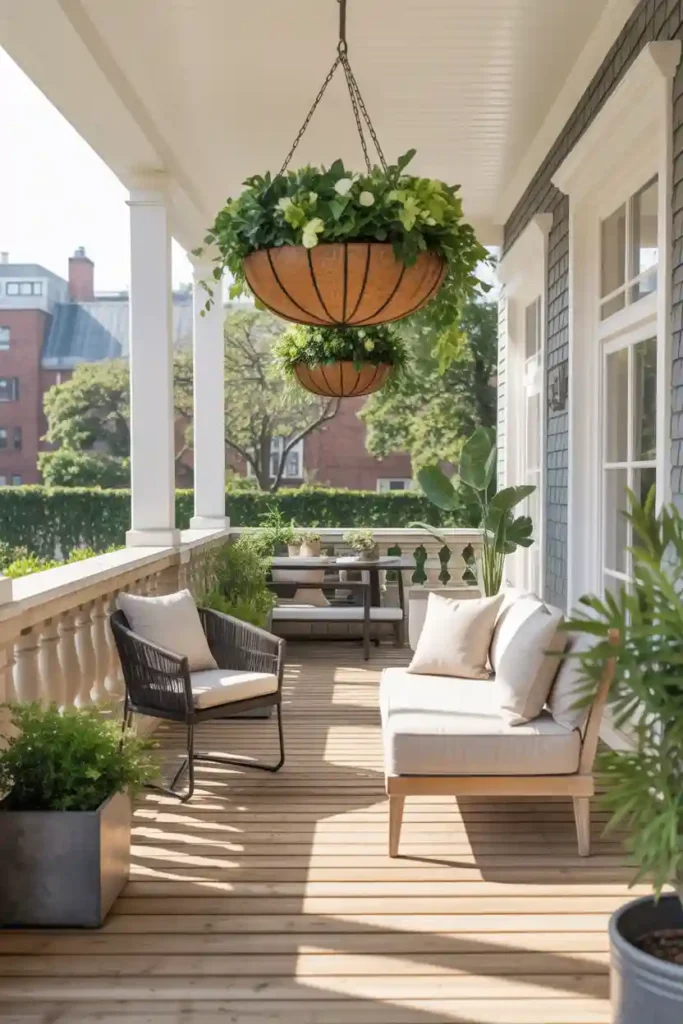
One oversized planter makes a stronger statement than five small ones. A 16 to 20 inch basket filled with ferns, cascading petunias, and trailing ivy becomes the focal point of the porch, drawing the eye the moment someone walks up. This works best on a wide porch with a ceiling at least 9 feet high, where the planter has room to breathe and does not crowd the entrance.
Hang the statement planter in the center of the porch, above a seating area, or flanking the front door as a pair, and keep everything else simple so it stays the star. Fill it with the same thriller, filler, spiller formula as a small basket, just scaled up: two upright plants in the middle, four or five fillers around them, and three spillers at the edge. Because a large basket holds more soil, it dries out more slowly than a small one, so check the moisture with your finger before watering instead of watering on a fixed schedule. Use a pulley style plant hanger if the basket is heavy, because it lets you lower the planter to water and prune it without a ladder.
- Best size: 16 to 20 inches wide for a true statement piece.
- Placement: centered above seating, or as a matching pair flanking the front door.
- Care tip: use a pulley hanger so you can lower a heavy basket to water it safely.
11. Hanging Plants with String Lights
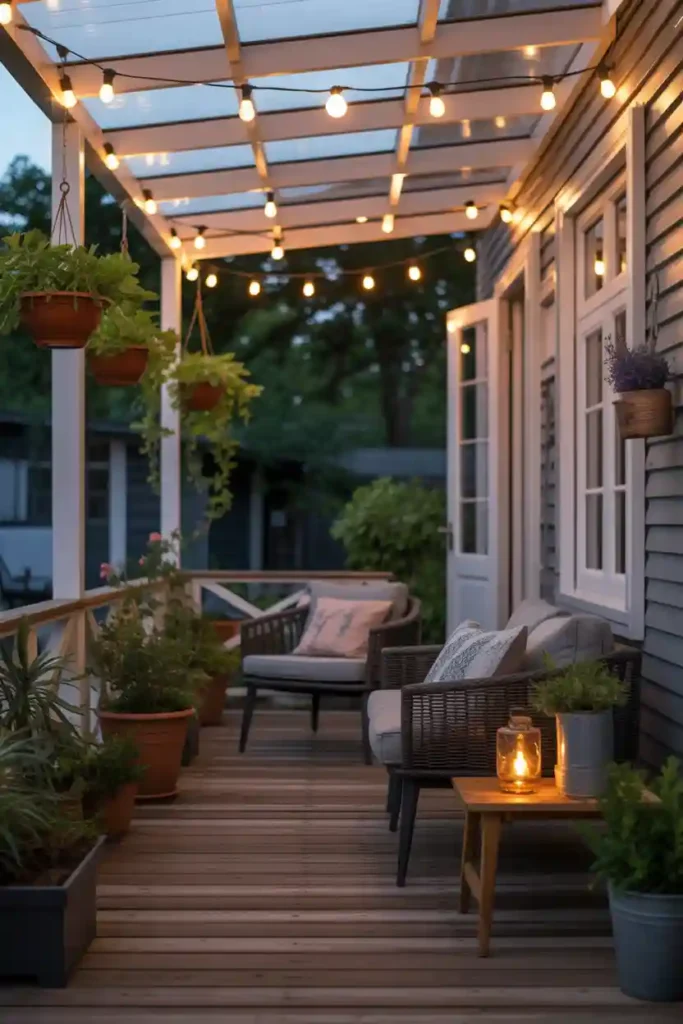
Hanging plants look good in daylight, but paired with string lights they turn magical after sunset. Warm white LED lights woven around a beam, draped above a cluster of baskets, or wrapped loosely around a large planter highlight the shape of the leaves and cast a soft glow across the porch. The combination works for quiet evenings alone and for summer gatherings, because the light is gentle enough to sit under for hours.
Use outdoor rated, weatherproof LED string lights, and choose warm white at 2700K for a cozy glow rather than cool white, which can feel harsh outdoors. Hang the lights first, then position the plants so the bulbs sit just above or behind the foliage, not buried inside it, where the heat and moisture can damage the wire. Keep the plugs and connections under the porch roof and off the ground, and use a timer or a smart plug so the lights come on at dusk and switch off at midnight without you thinking about it. Solar string lights are a good option if you have no outdoor outlet, but they need at least 6 hours of direct sun to charge fully. For more ways to light an outdoor space, these outdoor patio design ideas include lighting layouts that pair well with hanging plants.
- Best lights: outdoor rated warm white LED string lights at 2700K.
- Placement: bulbs just above or behind the foliage, never buried inside the leaves.
- Care tip: use a timer or smart plug so lights switch on at dusk and off at midnight.
12. Seasonal Hanging Plant Displays
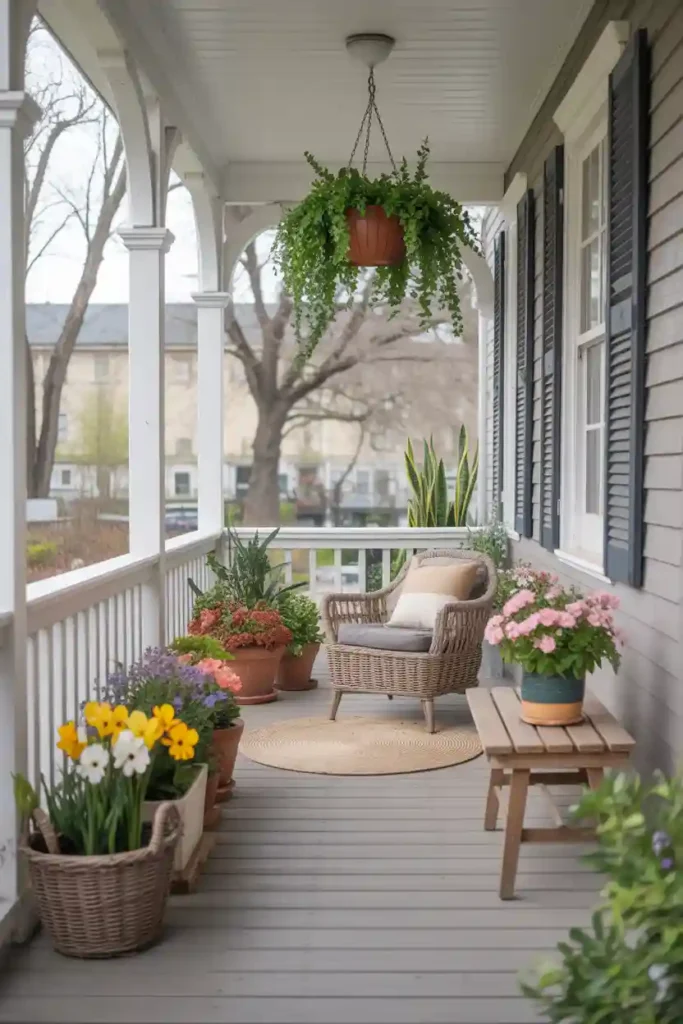
Swapping your hanging plants with the seasons keeps the porch looking fresh all year without a full redesign. Spring calls for pansies, violas, and fresh green ferns. Summer is the season for petunias, geraniums, and trailing lobelia in full color. Fall brings mums, ornamental kale, and grasses in warm rust, gold, and burgundy. Winter works with evergreen branches, pinecones, and a few red berries tucked into a hardy arrangement, or a simple faux greenery basket if your winters are harsh.
Plan the swap on a simple calendar: refresh baskets in early March, early June, and early September, and put the winter arrangement up in late November. Each change takes under an hour if you keep the same baskets and hooks and only replace the plants and soil. Keep a small notebook or a phone note of what you planted and how it performed, so next year you can repeat the winners and skip the plants that struggled. Coordinate the seasonal plants with your wreath, doormat, and cushions, and the porch will always look current with very little effort. For planting ideas that carry from the porch into the rest of the yard, these best plants for a beautiful backyard landscape are a good place to start.
- Spring: pansies, violas, and fresh green ferns.
- Summer: petunias, geraniums, and trailing lobelia.
- Fall and winter: mums, ornamental kale, evergreen branches, and pinecones.
- Care tip: refresh baskets in March, June, September, and late November, and note what thrived.
Final Words
These 12 easy ways to beautify your porch with hanging plants show how small changes can completely transform your outdoor space. Start with one or two ideas that fit your porch, like a classic flower basket by the door or a pair of ferns on the corners, and add more as you get comfortable. Pay attention to sun, water, and weight, and your plants will reward you with months of color and texture.
Whether you love the soft look of cascading vines, the handcrafted charm of macrame, the clean lines of modern planters, or the evening glow of string lights, there is a hanging plant idea here for every porch and every style. Pick your favorites, hang them with care, and enjoy a porch that feels welcoming, stylish, and full of life every time you come home.
Frequently Asked Questions
What are the best hanging plants for a porch that gets full sun?
Petunias, geraniums, lantana, calibrachoa, and trailing verbena all love full sun and bloom heavily through summer. Succulents like string of pearls also handle bright light well. Avoid ferns and pothos in full sun, because their leaves will scorch. Water sun loving baskets daily in hot weather, since they dry out fast.
How do I keep hanging plants from drying out so fast?
Line the basket with coconut fiber or moss to slow evaporation, and mix water retaining crystals or a handful of compost into the potting soil. Water slowly in the morning until a few drops come out of the bottom, and move the basket to a shadier spot on the hottest days. A self watering basket with a built in reservoir can add an extra day between waterings.
How high should I hang plants on my porch?
Hang baskets so the bottom of the planter sits about 7 feet from the porch floor, which keeps it above head height for most people while still being easy to see and water. On a porch with a high ceiling, stagger planters at different heights, but keep the lowest one at least 6 feet 6 inches high so nobody has to duck under it.
Can I hang plants on a porch without a ceiling hook?
Yes. Use a freestanding shepherd’s hook pushed into a large planter, a wall mounted bracket screwed into a post or beam, or a tension rod plant hanger that fits between two posts. A rolling plant stand with a tall pole is another option for renters, because it needs no drilling at all.
How often should I water hanging porch plants?
Most hanging baskets need water every day in summer and every two to three days in cooler weather. Check by pushing your finger an inch into the soil: if it feels dry, water. Ferns and herbs in small pots may need twice daily watering during a heatwave, while succulents and rosemary prefer to dry out between waterings.
More Ideas You Will Love
 12 Tips to Create an Inviting Summer BBQ Area
 12 Ideas to Create the Perfect Summer Hammock Spot
 15 Dark Exterior House Ideas: Bold & Stylish Designs
 15 Outdoor Halloween Decor Ideas You Must Try
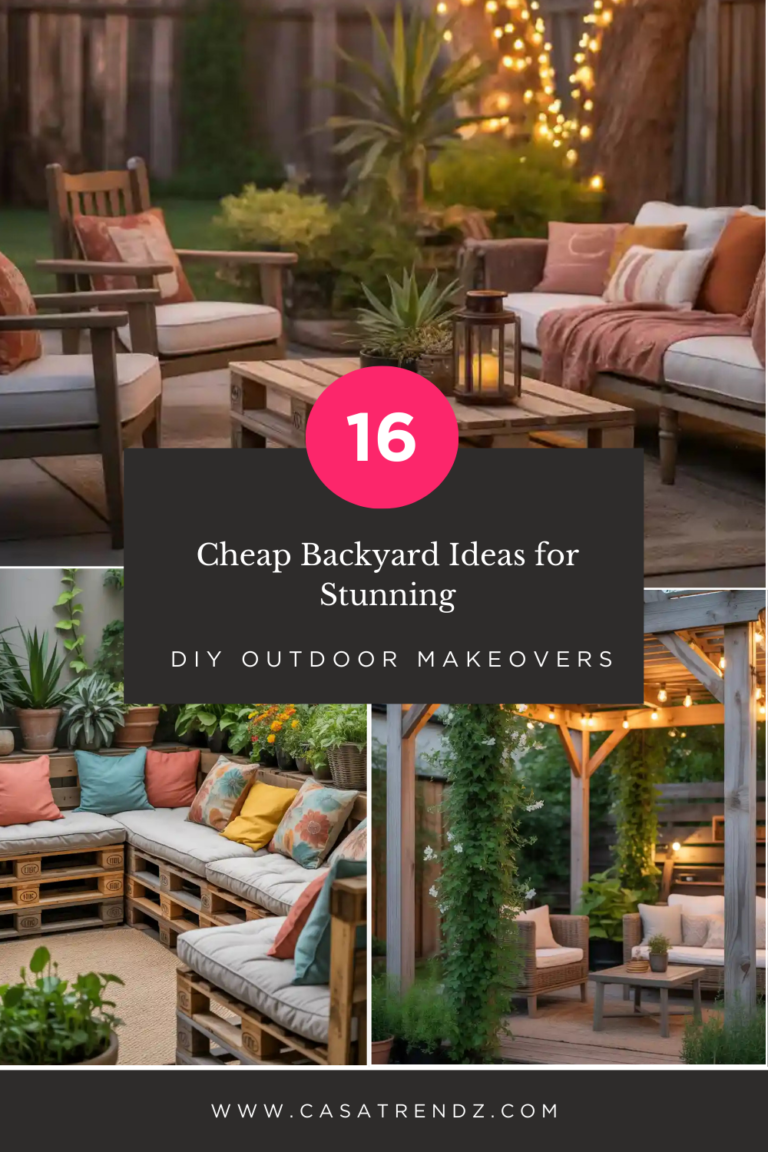 16 Cheap Backyard Ideas for Stunning DIY Outdoor Makeovers
 12 Tips for Choosing Durable Outdoor Cushions for Hot Summers