
11 Terrace Design Ideas for Functional and Stylish Outdoor Living


A terrace is the one part of a home that can change how you live in it. A bare slab of concrete does nothing for you, but the same space with a comfortable seat, a little shade, and a few plants becomes the place where you drink your morning coffee, eat dinner outside on a warm evening, and gather friends on the weekend. It does not take a big budget or a professional designer to get there. It takes a clear plan, furniture that can handle the weather, and a layout that matches how you actually use the space.
These terrace design ideas focus on that practical side first and style second. Each idea below works for a different kind of terrace, from a compact apartment balcony to a wide rooftop, and each one includes the materials, measurements, and steps that make it work in real life rather than only in photos. Read through the list, pick the one or two ideas that fit your space and your budget, and start with those. A terrace that gets used every day is always better than a terrace that only looks good in a picture.
Before you buy anything, measure your terrace and note where the sun falls in the morning and the afternoon. A terrace that bakes in the afternoon sun needs shade and heat proof materials, while a shaded terrace needs light colors and lighting to feel welcoming. Write down the length and width, check the weight limit if you live in an apartment, and confirm where water drains when it rains. Those five minutes of measuring will save you from buying a sofa that does not fit or a rug that stays wet for days.
1. Minimalist Terrace Design
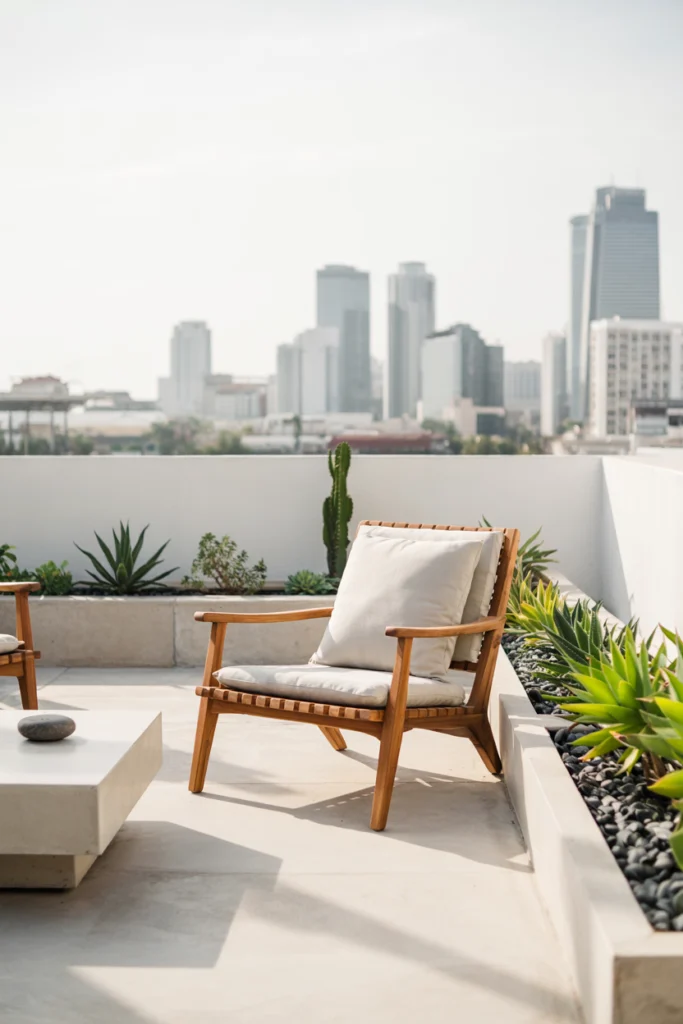
A minimalist terrace works because it leaves room to breathe. Start with a neutral palette of white, warm gray, or light beige for the floor and the large furniture pieces, then add one accent color through cushions or a single planter. Choose furniture with clean, straight lines, such as a low profile bench, a simple two seat sofa, or a pair of slim lounge chairs, and keep the total number of pieces small. Three or four well chosen pieces fill a terrace far better than eight crowded ones, and the open floor space makes even a small terrace feel larger.
Materials matter more than decoration in a minimalist design. Concrete pavers, light wood decking, or large format stone tiles give the floor a calm, even look and need little maintenance. For furniture, powder coated aluminum and teak are the safest choices because they resist rain and sun without constant care. Avoid glossy plastic and thin fabrics, which fade and crack quickly outdoors. A single outdoor rug in a solid color, about 5 by 7 feet for a seating area, is enough to define the zone without adding visual clutter.
To build this look, clear the terrace completely, then place the largest piece first, usually the sofa or bench, against the longest wall or railing. Leave at least 30 inches of walking space in front of it, add a small side table within arm’s reach, and finish with one large planter holding a structural plant such as an olive tree, a snake plant, or ornamental grass. Keep decor to a minimum: one lantern, one throw, and nothing on the walls unless it serves a purpose. The result is a terrace that is easy to clean, easy to rearrange, and calm to sit on every day.
2. Terrace Garden Design
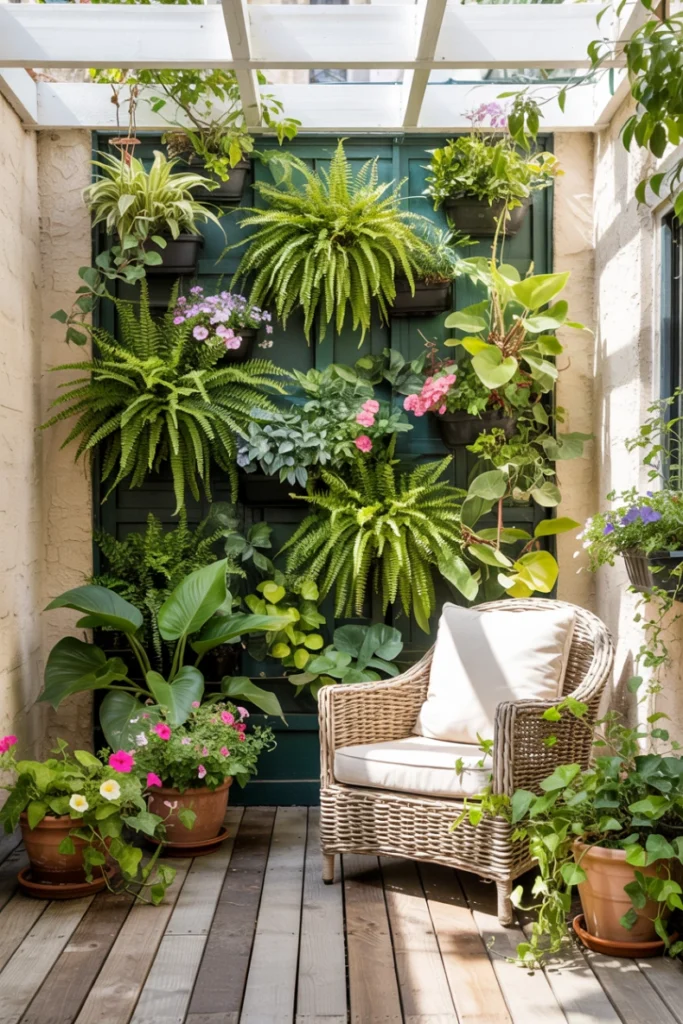
A terrace garden turns an empty outdoor slab into a living, green retreat. Start by deciding how much sun each corner gets, then group plants by their needs: sun loving herbs and flowering plants such as lavender, rosemary, and geraniums in the brightest spots, and shade tolerant plants such as ferns, hostas, and pothos where the building blocks the sun. Use a mix of raised planters, wall mounted pockets, and a few large floor pots so the greenery sits at different heights, which makes the space feel layered and lush instead of flat.
Containers are the key to a terrace garden that survives. Choose pots at least 12 inches deep for herbs and small plants, and 18 inches or deeper for shrubs and small trees, because shallow pots dry out in a single hot afternoon. Make sure every pot has a drainage hole and a saucer, and use a lightweight potting mix rather than heavy garden soil, which can overload a balcony slab. A drip irrigation kit or a set of self watering planters costs little and keeps plants alive during a busy week or a short trip. Add a layer of mulch on top of the soil to hold moisture and keep the roots cool.
Plan the layout before you buy plants. Place the tallest plants, such as a small citrus tree or bamboo in a planter, at the back or in the corners to create privacy and shade. Put herbs and vegetables you use often, such as basil, mint, and cherry tomatoes, near the door so you reach them easily while cooking. Leave a clear path at least 24 inches wide so you can water and prune without stepping on plants. With the right containers and a simple watering routine, a terrace garden stays green through the season and gives you fresh herbs, shade, and a calmer place to sit.
3. Modern Terrace Lounge
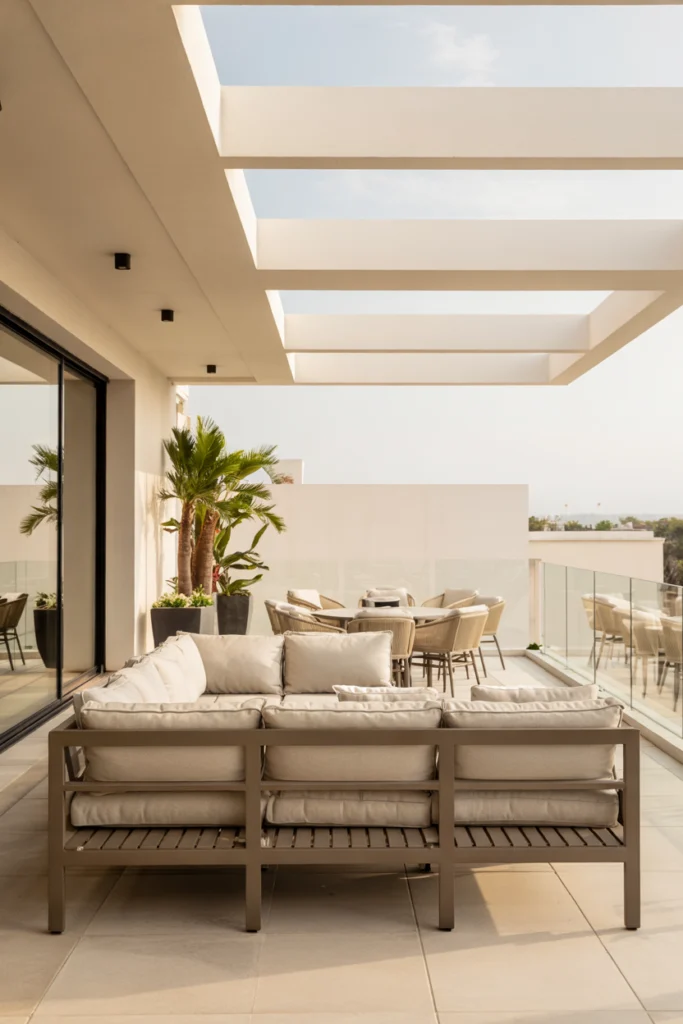
A modern terrace lounge is built around comfort and clean lines. The centerpiece is low profile seating, usually a modular outdoor sofa or a pair of lounge chairs with deep cushions, arranged around a low coffee table. Choose weather resistant materials such as aluminum frames with quick dry foam cushions covered in solution dyed acrylic fabric, which resists fading and dries fast after rain. Stick to a neutral base of charcoal, sand, or light gray, then add warmth with one or two accent colors in the cushions and a textured throw.
Layout is what separates a lounge from a random set of chairs. Place the sofa facing the best view, whether that is the skyline, the garden, or the sunset, and keep the coffee table 16 to 18 inches from the sofa so drinks are easy to reach without crowding your legs. Add a side table at each end for phones and glasses, and an outdoor rug about 8 by 10 feet under the seating group to pull the pieces together visually. Glass railings or slim metal railings keep the view open and make the lounge feel larger, while a low console or a narrow shelf along the wall holds books and a lantern without taking floor space.
Lighting finishes the lounge after sunset. Add a floor lamp rated for outdoor use, or a pair of wall sconces, for soft general light, then layer in string lights or a few LED candles on the table for warmth. Keep the light warm white, around 2700K, so skin tones and food look natural. A modern lounge does not need many accessories: one rug, one throw per seat, and one or two planters are enough. Test the layout by sitting in each seat for a few minutes before you fix anything in place, because a lounge that feels good to sit in will get used far more than one that only looks good from the doorway.
4. Small Terrace Design Ideas

A small terrace needs smart planning more than it needs more stuff. Start by measuring the exact floor area, then choose furniture that folds, stacks, or does double duty. A foldable bistro set, a storage bench that holds cushions and tools, and a wall mounted drop leaf table are the three pieces that transform a tiny terrace. Built in seating along one wall is another strong option, because a bench that is 18 inches deep and 18 inches high gives you seating for two or three people while leaving the center of the terrace open.
Color and light do the heavy lifting in a small space. Light colors on the floor and walls, such as pale gray, white, or light wood, reflect daylight and make the terrace feel bigger. A mirror rated for outdoor use on one wall can double the sense of space, and a glass or open slat railing keeps the view open instead of boxing you in. Choose vertical storage, such as a wall mounted planter rack or a tall narrow shelf, so plants and supplies go up instead of eating floor space. Keep the floor as clear as possible: every square foot you leave open makes the terrace feel larger.
To set up a small terrace, place the bench or the largest seat first, against the longest wall, then add the folding table in front of it with at least 24 inches of clearance so you can pull a chair out comfortably. Use stackable chairs that hang on a wall hook when not in use, and store cushions in the bench so the terrace never looks cluttered. A single string of lights overhead and one compact planter by the door are enough decoration. If you want more ideas for tight outdoor spaces, our small front porch ideas use the same space saving tricks and work well alongside a small terrace.
5. Open Terrace Dining Area

An open terrace dining area turns everyday meals into something you look forward to. Start with the table: a rectangular table 60 inches long seats six comfortably, while a round table 42 to 48 inches across seats four and works better in a square terrace because no one sits at an awkward corner. Choose a table and chairs made from teak, powder coated aluminum, or resin wicker, all of which handle rain and sun without warping. Avoid untreated wood and thin metal, which rust or split within a season.
Comfort depends on spacing and shade. Leave at least 36 inches between the table edge and any wall or railing so chairs can slide back easily, and allow 24 inches of table width per person so elbows do not collide. Add a shade solution above the table, such as a retractable awning, a large cantilever umbrella with a 9 to 11 foot span, or a simple pergola with a shade cloth, so lunch is pleasant even at midday. For evening meals, add a pendant light or string lights hung 7 feet above the table, which is high enough to avoid glare and low enough to light the food.
Build the dining zone step by step. Place the table first and check the spacing, then add chairs and sit in each one to confirm the fit. Add an outdoor rug under the table only if it is made from polypropylene or another weatherproof material, and size it so all four chair legs stay on the rug when the chairs are pulled out, usually at least 24 inches wider than the table on each side. Finish with a simple centerpiece that can survive wind, such as a low bowl of succulents or a heavy lantern, and keep a small storage box nearby for placemats and candles. An open dining terrace becomes the default place to eat from spring through fall once the seating and shade are right.
6. Covered Terrace Design
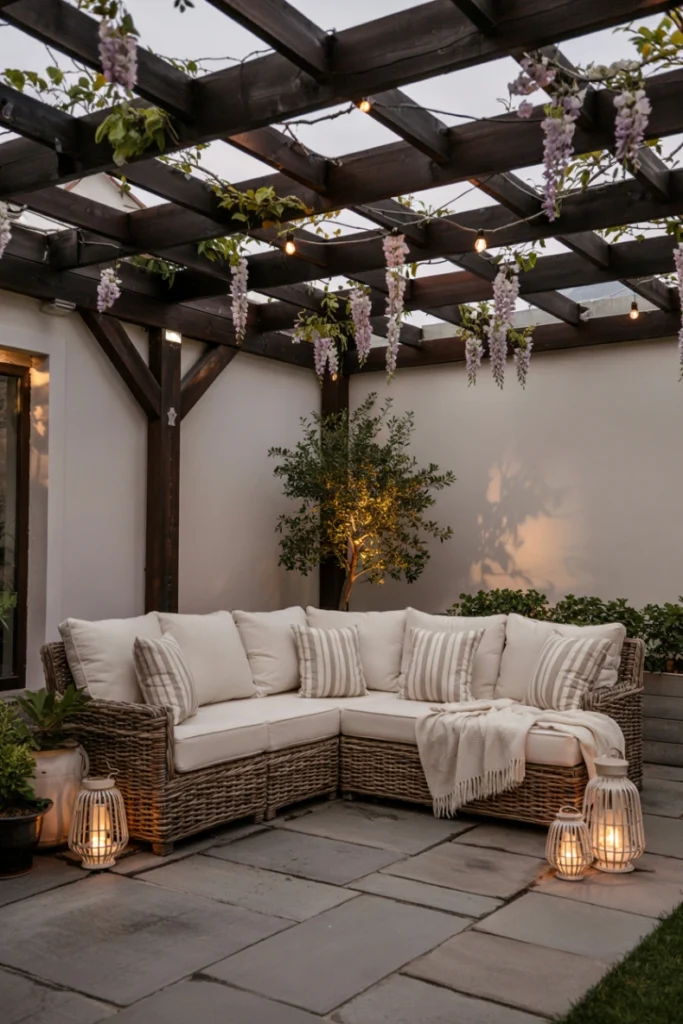
A covered terrace is the most practical terrace of all, because it stays usable in sun, rain, and wind. The cover itself is the first decision. A pergola with a retractable canopy gives you sun when you want it and shade when you need it, a solid roof with a slight slope sheds rain and lasts for decades, and a retractable awning is the cheapest option and works well on a rental or a small terrace. Whichever you choose, make sure the cover extends at least 2 feet beyond the seating area so rain does not blow in sideways, and check that the structure is rated for your local wind and snow loads.
Under the cover, you can use furniture that would not survive in the open. Cushioned sofas, fabric curtains, and wooden side tables all last far longer when they are protected from direct rain, though you should still choose outdoor rated fabrics and quick dry foam. Flooring can also be more decorative under a cover: wood decking, patterned tiles, or even an outdoor rug will stay dry and clean. Add outdoor curtains on one or two sides for privacy and wind protection, and choose a heavyweight fabric that hangs straight and does not blow around.
To plan a covered terrace, mark out the seating zone first, then size the cover to fit it with the extra 2 feet of overhang. Install the structure before you buy furniture, and check the drainage so water runs away from the house rather than pooling at the door. Add lighting under the cover, such as a pair of wall lights or a pendant, so the space works at night, and place a small heater or a fire bowl nearby if you want to use the terrace into the cooler months. For a larger sheltered outdoor space, our outdoor pavilion ideas show how a freestanding structure can create a similar covered retreat in a garden or backyard.
7. Bohemian Terrace Design
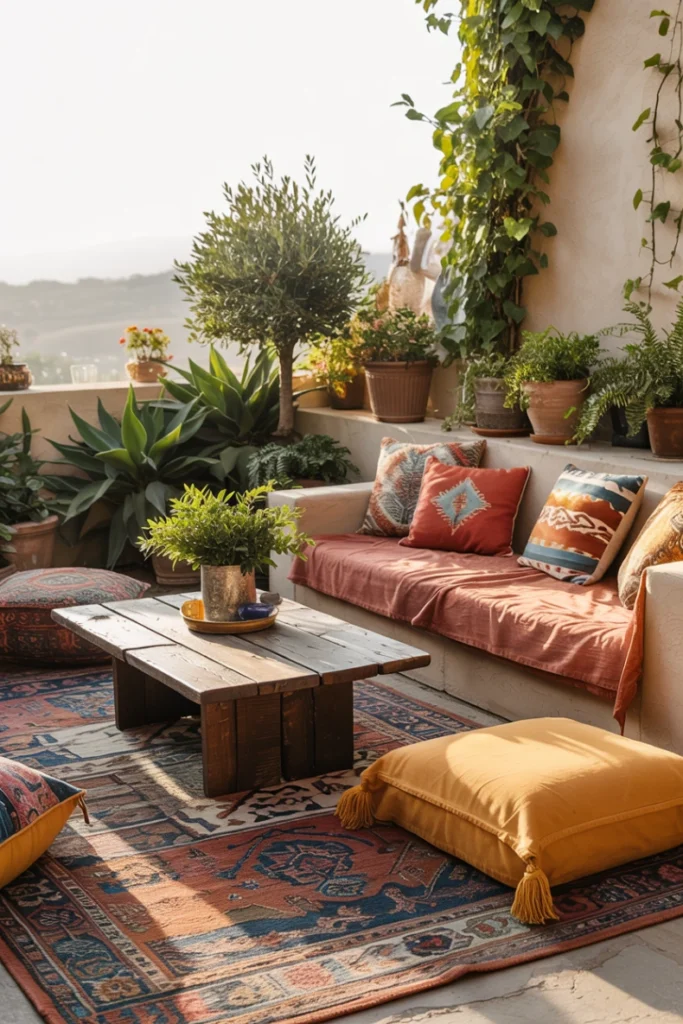
A bohemian terrace is layered, colorful, and personal, and it rewards mixing rather than matching. Start with a base of floor seating: low cushions, a couple of floor pillows, and a pouf or two, arranged on a large patterned rug. Add a hammock or a hanging chair in one corner if the structure allows it, because it instantly creates a relaxed focal point. Layer rugs, one large and one smaller on top at an angle, and mix patterns such as Moroccan trellis, kilim stripes, and solid colors in warm tones like terracotta, mustard, rust, and deep teal.
Plants and texture carry the bohemian look. Fill the terrace with plants at every height: trailing pothos and string of pearls in hanging baskets, tall palms or monstera in floor pots, and small succulents on side tables. Add texture with a macrame wall hanging, woven baskets, a rattan lantern, and a throw with tassels or fringe. Choose natural materials wherever possible, such as rattan, jute, cotton, and unfinished wood, because they age gracefully and keep the space feeling warm rather than staged.
Build the look gradually rather than buying a matching set. Start with the rug and the seating, then add one layer at a time: a throw, a lantern, a plant, a cushion in a new pattern. Step back after each addition and check that the space still feels calm, because a bohemian terrace works when the layers feel collected over time, not dumped in at once. Keep one color repeated in at least three places so the mix holds together, and leave one corner relatively empty so the eye has somewhere to rest. The result is a terrace that feels like a personal retreat, perfect for reading, slow mornings, and long conversations with friends.
8. Terrace Design with Lighting Accents
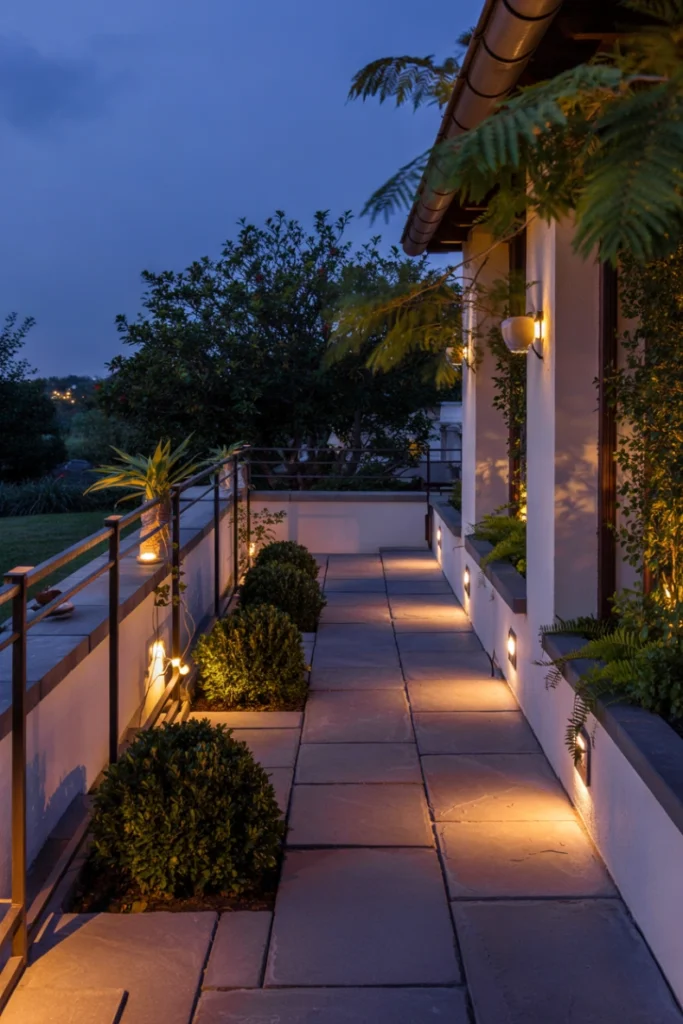
Lighting is what turns a terrace from a daytime space into an evening one. Start with three layers: ambient light for general glow, task light for reading or eating, and accent light to highlight a plant, a wall, or a piece of art. String lights are the easiest ambient option, and a single 25 to 50 foot strand hung in a zigzag or along the railing gives a warm, even glow. Wall sconces or a pair of solar lanterns add a second layer, while a small LED spotlight aimed at a favorite plant creates a focal point after dark.
Choose warm white bulbs, around 2700K, for every fixture, because cool white light makes a terrace feel like a parking lot. Solar lights work well for path edges and planters, but for seating and dining areas use wired or rechargeable lights, which are brighter and more reliable. Check the IP rating before you buy: IP44 or higher handles rain, and IP65 is safer for lights that sit low or face the sky. Keep cables tidy with clips along the railing or under the furniture, and use a timer or a smart plug so the lights come on at dusk without you having to remember.
To install terrace lighting, hang the string lights first and test them at night before you fix anything permanently, because the spacing that looks right in daylight often looks sparse after dark. Add a floor lamp or a table lamp near the main seat for reading, and place a few flameless candles on the table for a soft flicker without the fire risk. Avoid pointing any light directly at the seating area, which causes glare; aim lights at walls, plants, and the floor instead, so the glow bounces back softly. Good lighting adds safety on steps and edges too, so place a small light near any change in level. For more outdoor lighting inspiration, our outdoor furniture ideas include seating and lighting combinations that work well together on a terrace.
9. Terrace Design with Privacy Screens
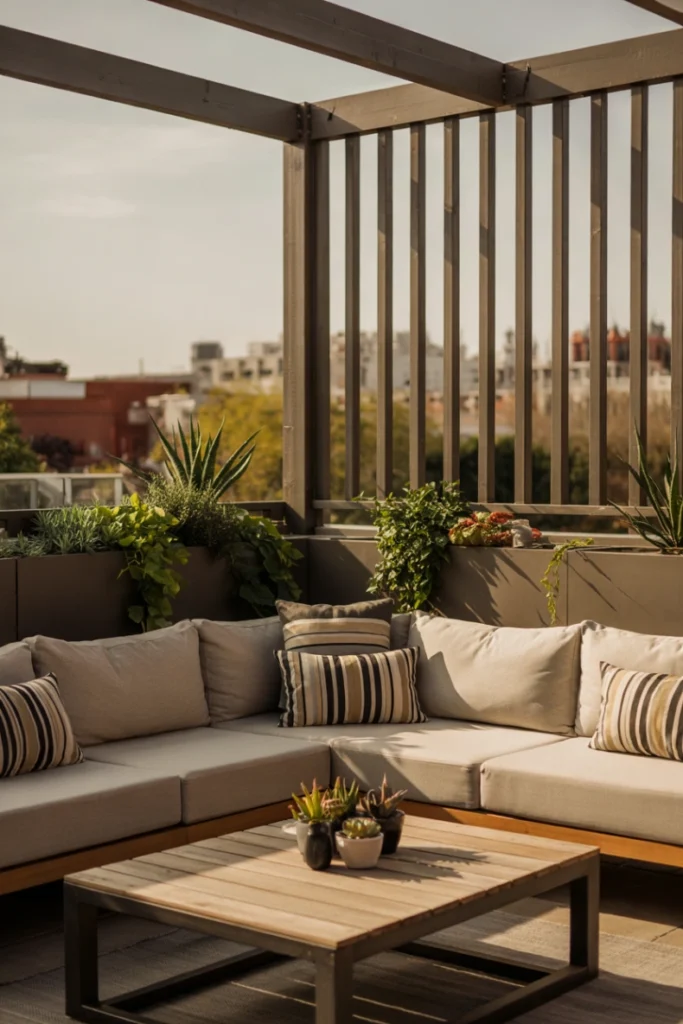
Privacy screens make a terrace feel like a room of your own, even in a crowded neighborhood. The simplest option is a tall planter with dense plants, such as bamboo, tall grasses, or a row of evergreen shrubs in containers 24 inches deep. A wooden slat screen is the next step up: horizontal slats with a half inch gap between them block most views while still letting air and light through, and a screen 5 to 6 feet high is usually enough to block a neighbor’s line of sight from a standing position.
Other screen options suit different styles and budgets. A metal laser cut panel adds a decorative pattern and lasts for years without maintenance. Outdoor curtains on a wire or a rod give you flexible privacy you can open or close in seconds, and they soften the look of a hard wall or railing. A trellis with climbing plants such as jasmine, clematis, or ivy gives you privacy that improves every year as the plants fill in, though it needs a season or two to reach full coverage. Whichever option you choose, check your building or HOA rules first, because some places limit screen height or ban solid panels on balconies.
To install a screen, measure the section you want to block, then fix the screen to the railing or the wall with brackets rather than leaning it, so it stays put in wind. Leave a gap of a few inches at the bottom for air flow and drainage, and avoid blocking the whole terrace, because a fully enclosed space can feel hot and dark. Combine a screen on the most exposed side with plants on the other sides for a softer result. A well placed privacy screen does more than block views: it cuts wind, reduces street noise, and makes the terrace feel calmer and more private, which is why it is one of the most valuable upgrades for an urban terrace.
10. Luxury Terrace Design

A luxury terrace is defined by quality materials, generous space, and careful zoning rather than by how much you spend. Start with the floor: large format porcelain tiles, natural stone, or wide plank teak decking give an immediate sense of quality and need little upkeep. Choose furniture with solid frames, such as powder coated aluminum or teak, and thick cushions in a high performance fabric. One statement piece, such as a sculptural lounge chair, a stone fire table, or a designer outdoor sofa, sets the tone, and the rest of the furniture should support it rather than compete with it.
Zoning is what makes a luxury terrace feel like a resort. Divide the space into two or three areas: a lounge zone with a sofa and a low table, a dining zone with a proper table and chairs, and a quiet corner with a single chair and a side table for reading. Use a rug, a change in flooring, or a planter to mark each zone without building walls. Add a water feature, such as a small wall fountain, or a fire element, such as a fire table with a 40,000 BTU burner, to give the terrace a focal point that draws people outside in the evening.
Details finish a luxury terrace. Add layered lighting with dimmers so you can shift from bright to soft, choose planters in a single material such as concrete or stone for a consistent look, and keep the palette to two or three colors so the space feels calm. Invest in storage, such as a deck box that hides cushions and throws, so the terrace always looks tidy. A luxury terrace does not need to be large: a small terrace with excellent materials, one strong focal point, and clear zones feels far more luxurious than a large terrace filled with ordinary furniture. For a rooftop version of this look, our rooftop terrace design ideas show how the same zoning and materials work on a roof terrace.
11. Multi-Functional Terrace Design
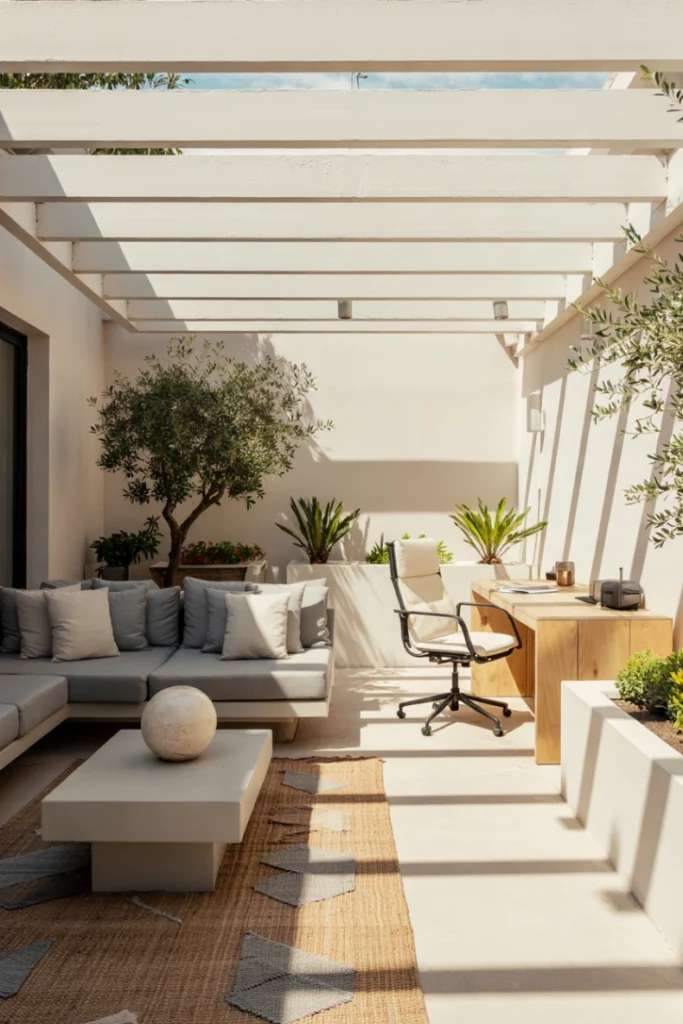
A multi functional terrace earns its keep by serving several purposes in one space. The trick is to divide it into clear zones without building walls. Use a rug to mark the lounge area, a table and chairs to mark the dining area, and a small desk or a folding work table in the quietest corner for a workspace. Modular furniture is the key: a sectional sofa that splits into chairs, a coffee table that rises to dining height, and storage ottomans that work as seats, tables, and boxes all let you change the layout in minutes.
Plan each zone around its real use. The lounge zone needs comfortable seating and soft light. The dining zone needs a sturdy table, shade, and at least 36 inches of clearance around it. The work corner needs a flat surface, a power outlet or a charged power bank, and shade from screen glare, so place it on the side that stays out of direct sun in the afternoon. A small garden zone with herbs or a few pots can sit along the railing, where it gets light without taking floor space. Keep a storage bench or a deck box in the middle of the terrace so cushions, work supplies, and gardening tools are always within reach but never in the way.
To set up a multi functional terrace, sketch the zones on paper first, then place the largest piece in each zone before you buy anything else. Test the layout for a week: eat outside, work outside, and sit outside in the evening, then move anything that gets in the way. The most common mistake is trying to fit too many zones into a small terrace, so if space is tight, pick two zones and do them well rather than squeezing in four. A terrace that works as a lounge by day, a dining room at dinner, and a quiet workspace in the morning is worth more than a terrace that only does one thing, and with modular furniture and clear zones, you can have all three without a renovation.
Conclusion
Well executed terrace design ideas can change how you use your home every single day. A terrace that was once an empty slab becomes the place where you start the morning, eat dinner, work in the fresh air, and gather with friends. The ideas in this guide all share the same foundation: measure first, choose weather proof materials, plan the layout around how you actually live, and add lighting and plants to make the space welcoming after dark.
Start with one idea that fits your space and your budget, whether that is a minimalist layout, a small garden, a dining area, or a privacy screen. Build it properly, live with it for a few weeks, and then add the next layer. A terrace improves with each small change, and the best terrace is not the most expensive one, it is the one you use every day. With the right design, your terrace becomes a real part of your home, not just a space you walk past on the way inside.
Frequently Asked Questions
How much does it cost to design a terrace?
A simple terrace refresh with a folding set, a few planters, and string lights can cost 200 to 500 dollars. A mid range makeover with quality outdoor furniture, a rug, and shade typically costs 1,000 to 3,000 dollars. A full luxury terrace with premium materials, a pergola, and a fire feature can cost 5,000 dollars or more. Start with the pieces you will use daily, such as seating and shade, and add the rest over time.
What is the best flooring for a terrace?
Porcelain tiles, natural stone, and wood decking are the best terrace floors because they handle rain, sun, and foot traffic without much upkeep. Porcelain tiles are the easiest to clean and come in the widest range of styles. Wood decking feels warmer underfoot but needs oiling once or twice a year. Avoid indoor rugs and untreated wood, which hold moisture and wear out quickly outdoors.
How do I keep my terrace private from neighbors?
Use a combination of a privacy screen and tall plants. A wooden slat screen or an outdoor curtain on the most exposed side blocks direct views, while tall grasses or bamboo in planters soften the other sides. A screen 5 to 6 feet high usually blocks a neighbor’s view from a standing position. Check your building or HOA rules before installing a solid screen.
What furniture lasts longest on a terrace?
Powder coated aluminum, teak, and resin wicker last longest outdoors because they resist rust, rot, and sun damage. Pair them with quick dry foam cushions covered in solution dyed acrylic fabric, which dries fast and resists fading. Store cushions in a deck box during heavy rain or winter to double their life, and cover furniture when you will not use it for weeks.
Can I put a garden on a small terrace?
Yes, and a small terrace is often easier to garden than a large one because watering and care take less time. Use vertical planters, wall pockets, and railing planters to grow herbs, flowers, and small vegetables without using floor space. Choose pots at least 12 inches deep, use lightweight potting mix, and add a drip irrigation kit or self watering planters so plants survive hot days and short trips.
More Ideas You Will Love
 13 Vanity Table Ideas: Elegant & Functional Designs for Every Space
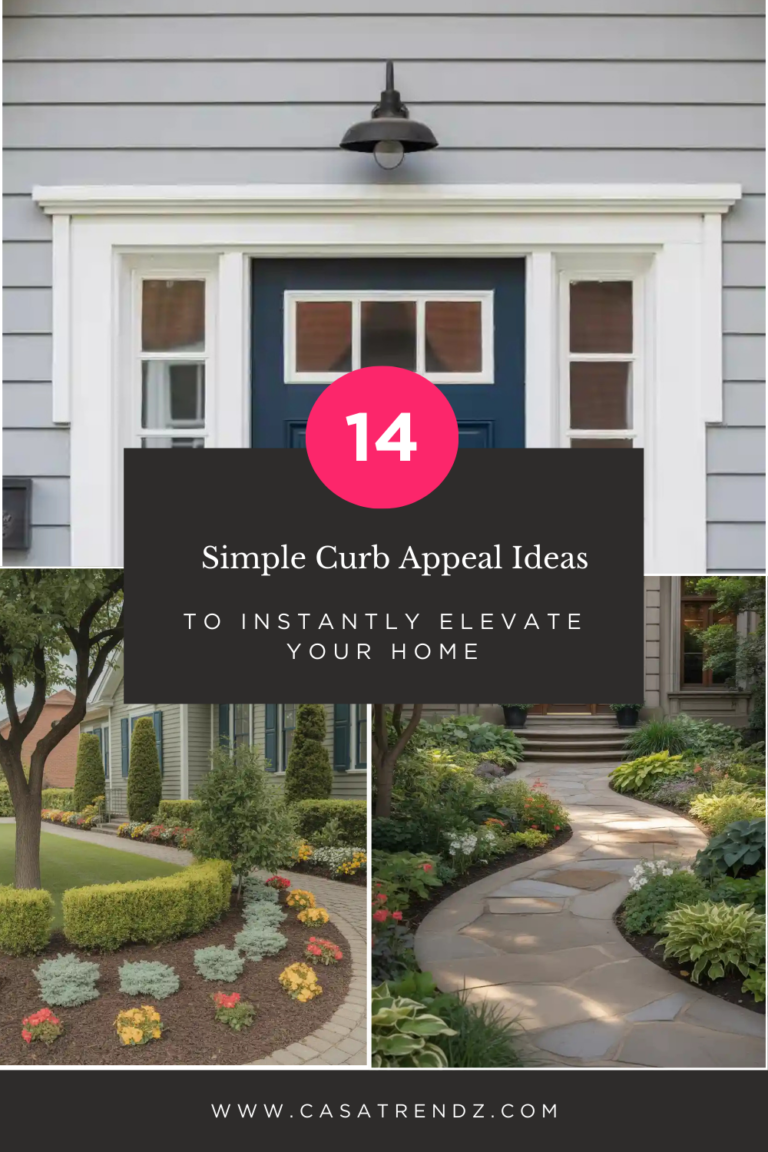 14 Simple Curb Appeal Ideas to Instantly Elevate Your Home
 13 Safety Guidelines for Summer Fire Pits: Cozy Nights Made Safe
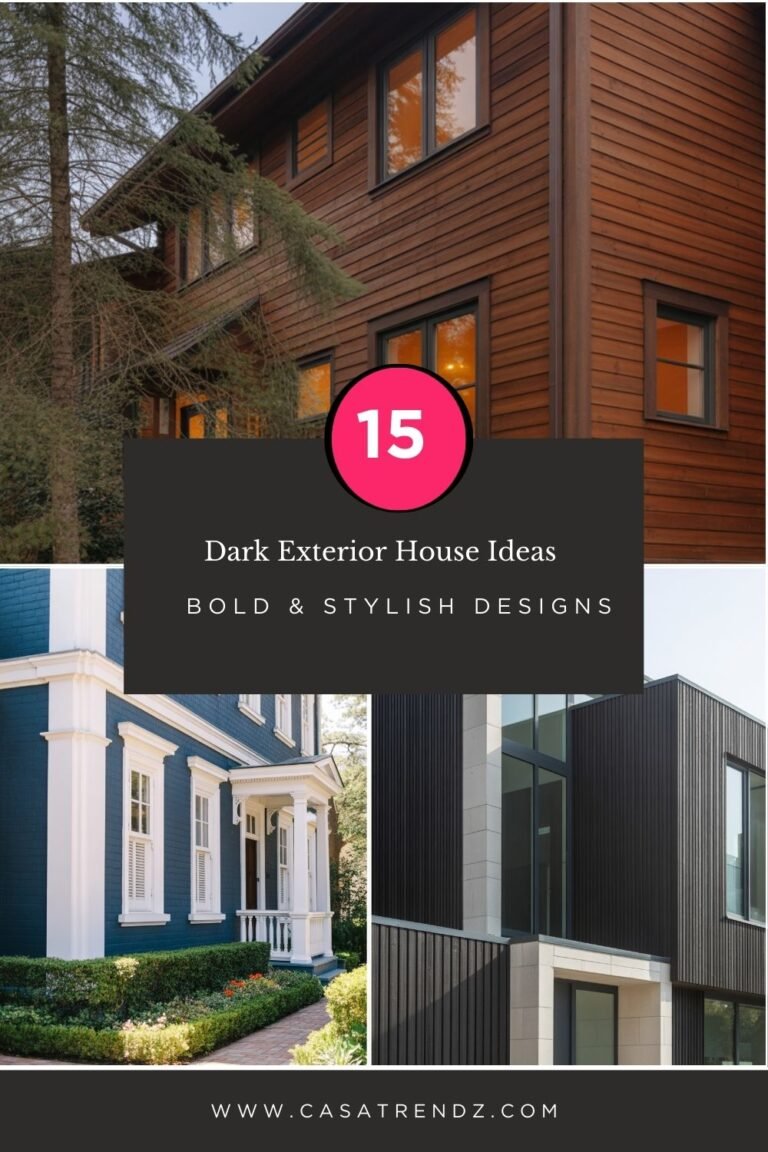 15 Dark Exterior House Ideas: Bold & Stylish Designs
 17 Modern Exterior Wall Design Ideas for a Stylish Home
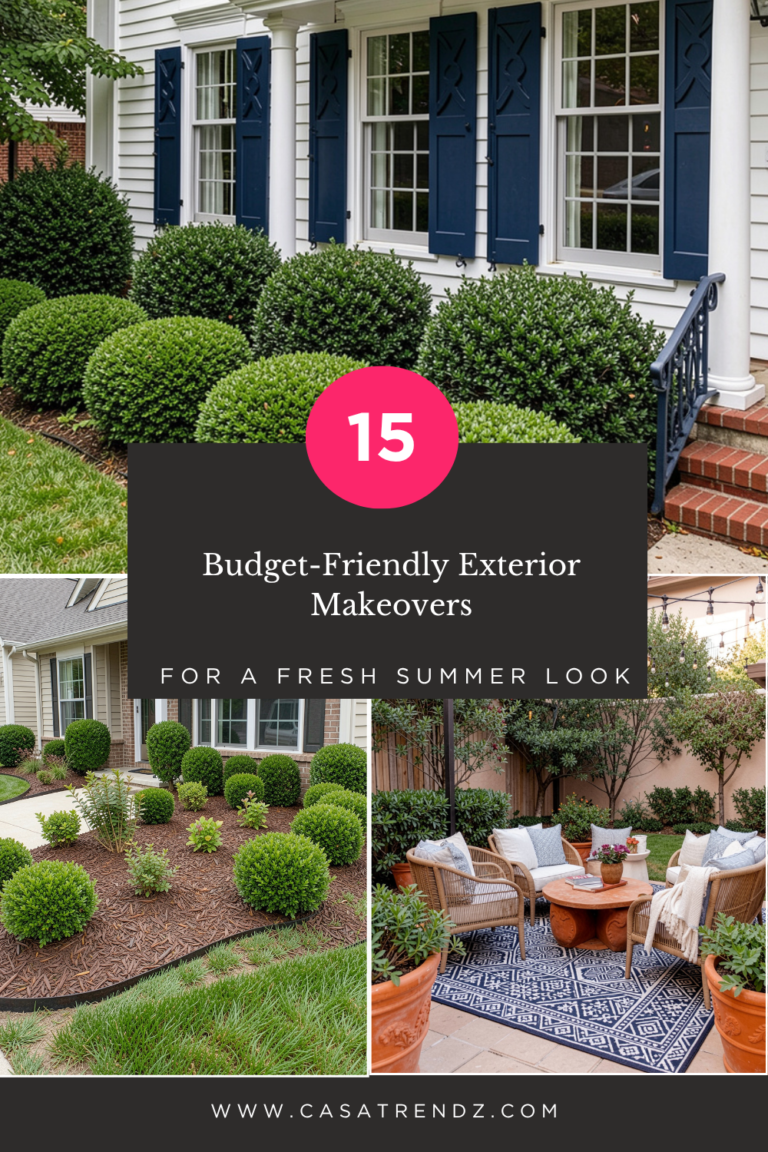 15 Budget-Friendly Exterior Makeovers for a Fresh Summer Look