
20 Hallway Wall Decor Ideas That Transform Any Space Instantly

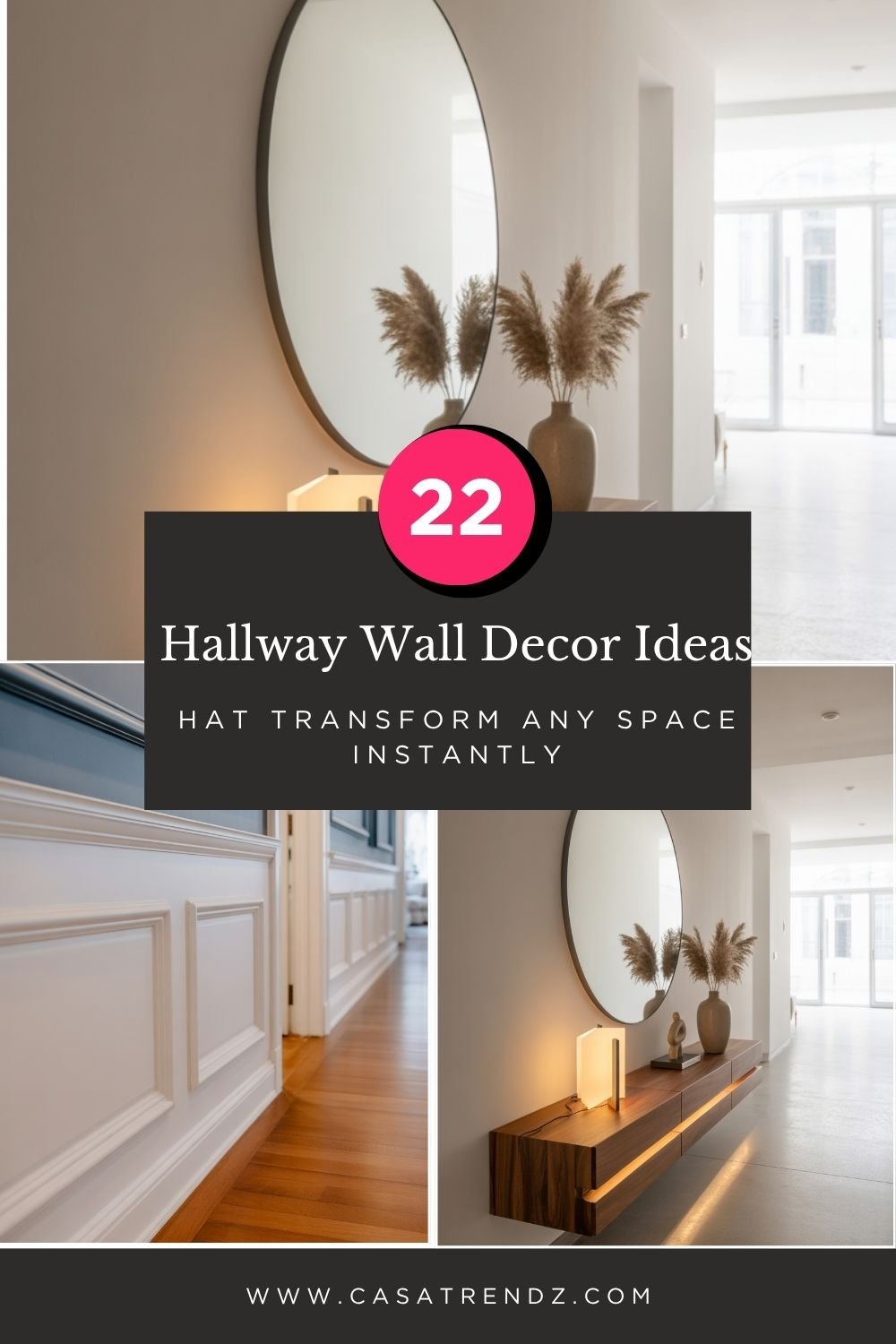
Your hallway is the first space guests see and the last one you pass through every day, yet it is often the most neglected room in the house. It is easy to leave it blank because it feels like a passage rather than a destination, but that is exactly why a little attention goes such a long way. The right wall decor can make a narrow corridor feel wider, a dark hallway feel brighter, and a plain entry feel warm and intentional. You do not need a full renovation to get there. A coat of paint, a well placed mirror, or a row of shelves can change the whole feeling of the space in a single weekend.
This guide covers 20 hallway wall decor ideas that work in apartments, family homes, and older houses alike. Each idea includes practical details on size, placement, materials, and color so you can actually put it into practice, not just admire it on a screen. Whether your hallway is only 36 inches wide or a generous entry corridor, you will find options that fit your budget, your style, and your skill level. Start with one or two ideas that solve your biggest problem, whether that is darkness, blank walls, or missing storage, and build from there.
If your hallway is especially tight, pair these ideas with our narrow hallway makeovers, which focus on slim furniture, light colors, and clear walkways. Together, the two guides cover both the structure of a small hallway and the finishing touches that make it feel finished.
1. Gallery Wall Perfection
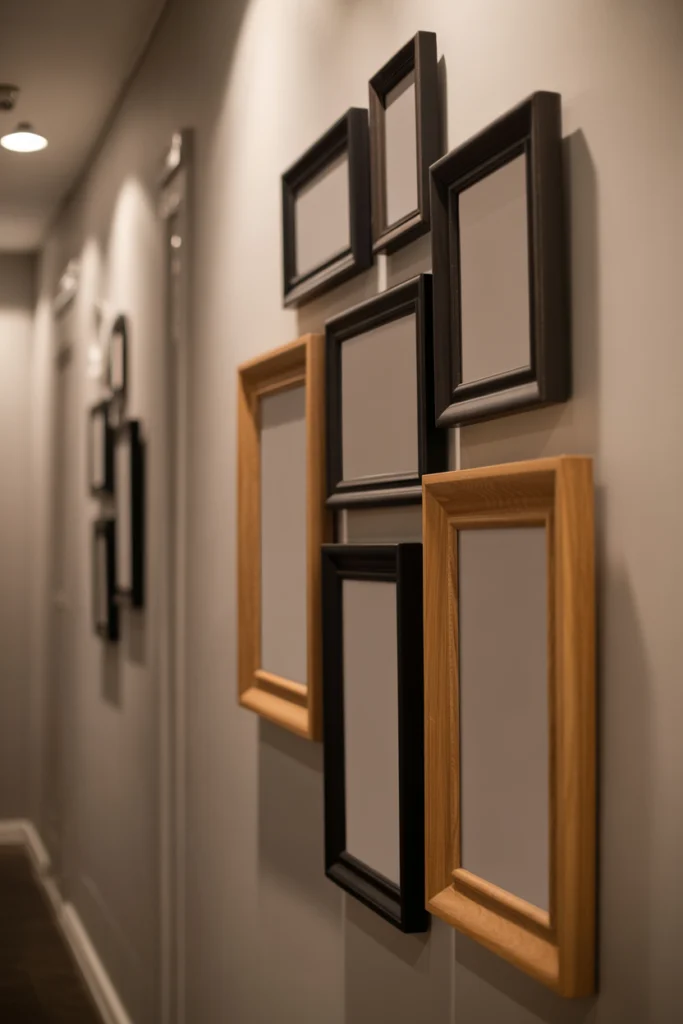
A gallery wall is the fastest way to give a hallway personality, because it turns a blank wall into a story. Start by choosing a theme that ties the collection together, such as black and white photography, botanical prints, family travel photos, or abstract art in a shared color palette. Mix frame sizes for rhythm, for example large 16 by 20 inch frames as anchors, medium 11 by 14 inch frames in between, and small 8 by 10 inch frames to fill gaps, but keep the frame finish consistent, or limit yourself to two finishes such as black and natural wood, so the wall looks curated rather than cluttered.
Hang the center of the arrangement at eye level, about 57 to 60 inches from the floor to the center of the grouping, and keep spacing between frames consistent at 2 to 3 inches. Lay the arrangement on the floor first and photograph it before you hang anything, which saves you from extra nail holes. Use picture hanging strips for lighter frames in a rental, and proper wall anchors for heavier pieces. Step back after every three or four frames to check the overall balance, and leave a little breathing room at each end so the gallery does not crowd door frames or light switches.
2. Oversized Wall Mirrors
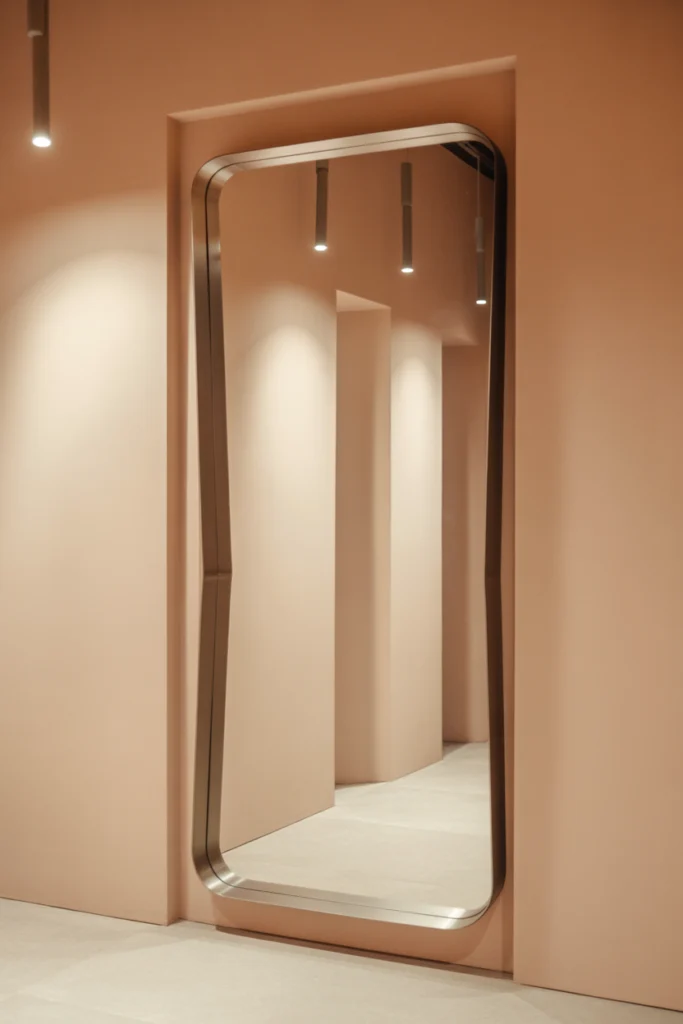
A large mirror is one of the most effective tools for a narrow or dark hallway, because it reflects both light and the opposite wall and makes the space feel almost twice as wide. A full length mirror around 24 by 60 inches works well on a long wall, while a round mirror 30 to 36 inches across suits a wider entry wall. For a dramatic look, hang two or three matching mirrors in a row, spaced evenly, to create a rhythm that draws the eye down the corridor.
Frame choice sets the mood. An ornate gold frame suits a classic or traditional home, a slim black metal frame suits modern minimalism, and a natural wood frame warms up a farmhouse or coastal hallway. Hang the mirror opposite a window, a glass door, or a piece of art so it has something pleasant to reflect, and keep the bottom of the mirror at least a few inches above any console or bench below it. Always anchor a heavy mirror into a wall stud or use rated wall anchors, and check that it is level before you tighten the fixings.
3. Floating Shelves for Decor and Storage
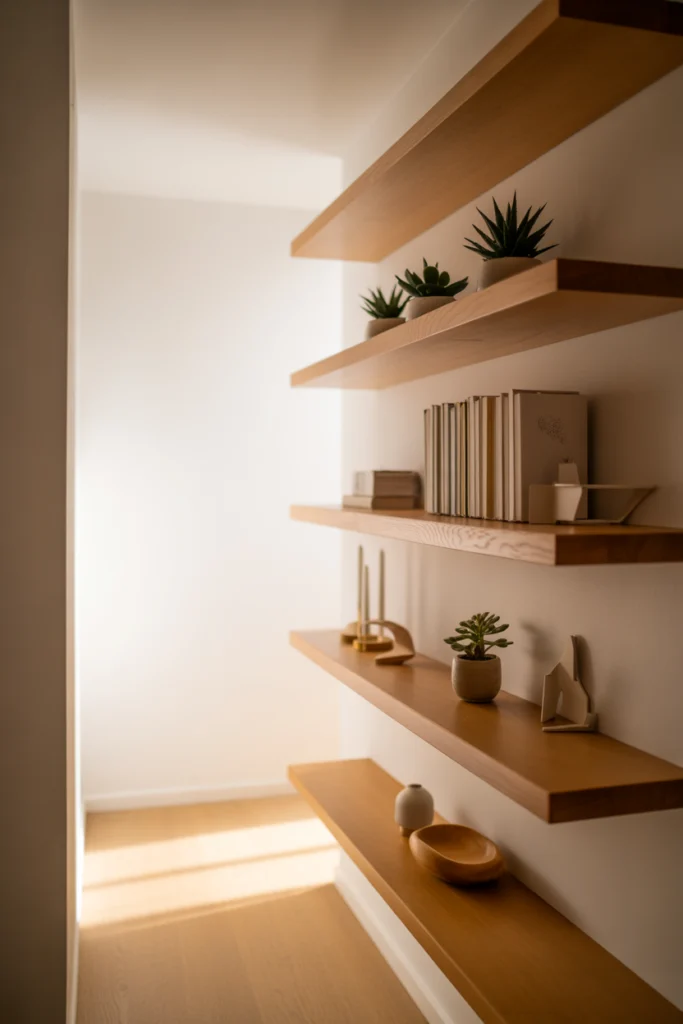
Floating shelves add display space without taking up floor space, which makes them ideal for hallways where every inch of walkway matters. Choose shelves 24 to 36 inches long and no deeper than 8 to 10 inches, so they hold candles, small framed photos, a trailing plant, or a stack of books without blocking the passage. Natural wood shelves warm up a white wall, while matte black shelves create a crisp contrast in a modern home. Install two or three shelves staggered at different heights, with about 12 to 15 inches between them, for a layered look.
Style each shelf with a mix of heights and textures, for example a tall candle beside a small framed print and a tiny plant, and leave some empty space so the display does not look crowded. Keep heavier items close to the wall brackets and anchor every shelf into a stud or use heavy duty wall anchors, since hallway shelves get bumped more than shelves in other rooms. For more ways to combine display and storage in a corridor, see our hallway decor ideas, where shelves, mirrors, and consoles work together in tight entries.
4. Wall-Mounted Lighting Fixtures
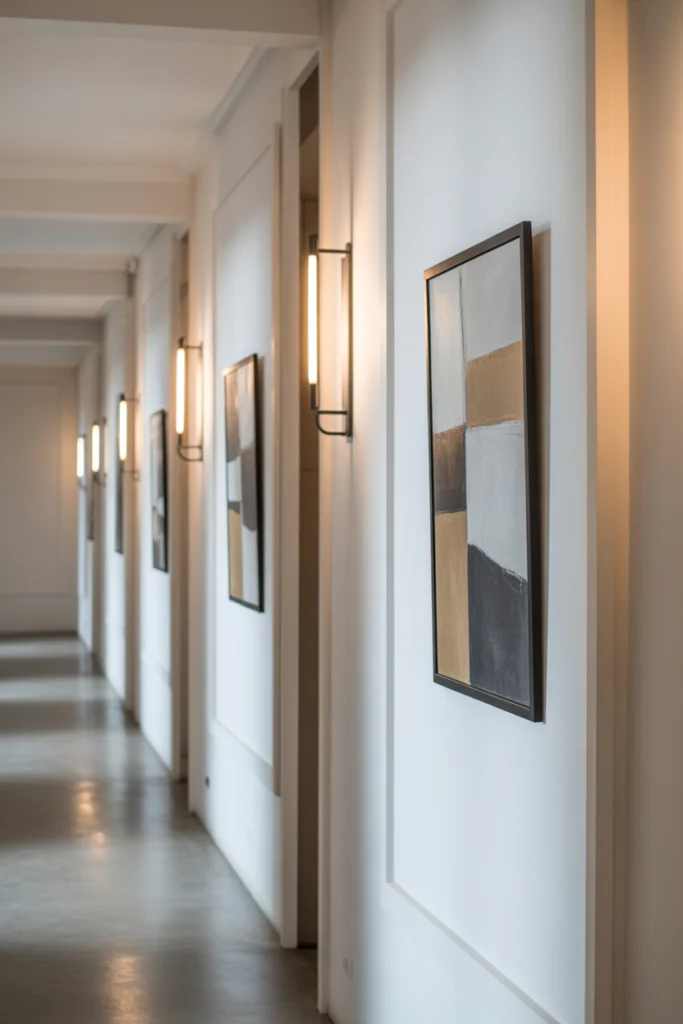
Lighting changes a hallway more than almost any other single detail, because it sets the mood and highlights everything else on the wall. Wall sconces are the classic choice: install them 60 to 66 inches from the floor, spaced 6 to 8 feet apart along a long hallway, so the light is even rather than pooled in one spot. Picture lights mounted 6 to 8 inches above a framed piece add a gallery feel, while small directional spotlights can wash a textured wall or a mural with soft light.
Match the fixture to your style. Brass sconces with warm white bulbs around 2700K suit vintage and traditional homes, while slim matte black or brushed nickel fixtures suit modern interiors. Put hallway lights on a dimmer switch if you can, so you can use bright light when cleaning or carrying bags and a softer glow in the evening. If you cannot add new wiring, battery operated sconces and plug in picture lights give you the same layered effect without an electrician, and a light at the far end of the hallway pulls the eye forward and makes the corridor feel longer.
5. Statement Wallpaper
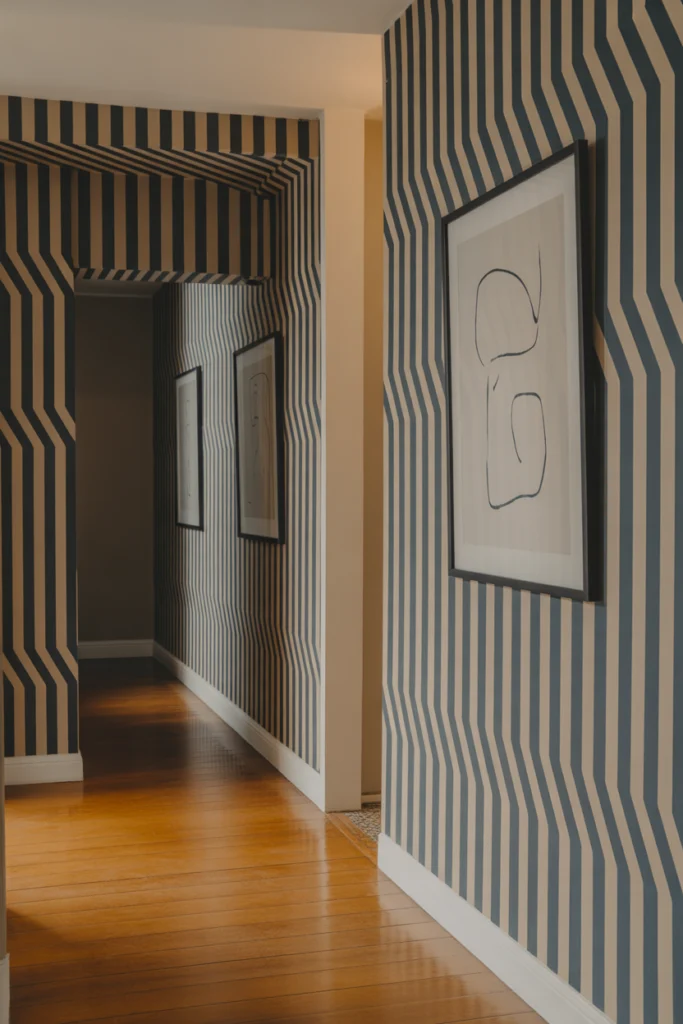
Wallpaper is a bold way to give a hallway instant character, and modern peel and stick options make it renter friendly too. Geometric prints, botanical designs, and subtle textured patterns all work well, but scale matters in a narrow space. Choose a medium scale pattern rather than a very large one, which can overwhelm a small hallway, and consider vertical stripes or light background colors to make the ceiling feel higher and the walls feel brighter. A single accent wall, usually the longest wall or the wall at the end of the hallway, often has more impact than papering every surface.
Measure carefully before you order. Measure each wall in feet, multiply length by height to get square footage, subtract door and window openings, and add 10 percent extra for pattern matching and mistakes. Peel and stick wallpaper is the easiest option for a first project: clean the wall, start at the top, smooth downward with a plastic smoother, and trim the excess with a sharp utility knife. For traditional pasted wallpaper in a busy hallway, choose a washable vinyl finish so scuffs and fingerprints wipe off easily.
6. Wainscoting or Wall Paneling
Wainscoting adds architectural depth that paint alone cannot achieve, and it also protects the lower wall from scuffs in a busy hallway. The classic height is 32 to 36 inches from the floor, roughly one third of a standard 8 foot wall, with a chair rail cap on top. Paint the paneling in a crisp white or soft cream and the upper wall in a complementary color, such as pale sage, warm greige, or dusty blue, for a layered look that works in both traditional and contemporary homes.
You can build wainscoting from MDF boards and trim for a budget friendly project, or buy ready made panels for a faster install. Use a level for every vertical board, keep spacing consistent, and caulk the joints before painting for a professional finish. In a very narrow hallway, keep the paneling profile slim, no more than half an inch proud of the wall, so it does not narrow the walkway. A satin or semi gloss paint finish on the paneling is easier to clean than flat paint, which matters in a high traffic corridor.
7. Leaning Art Displays
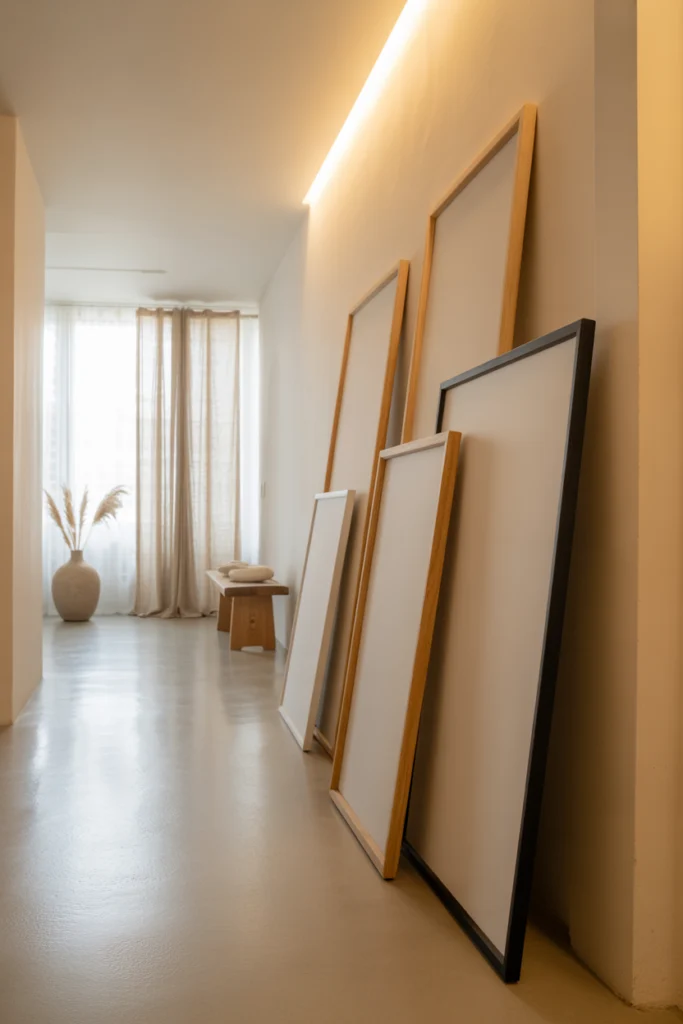
Leaning large artwork against the wall, instead of hanging it, creates a relaxed, gallery style look that is easy to change. Choose oversized pieces at least 30 by 40 inches so they hold their own in the space, and lean them at a slight angle with the bottom edge a few inches from the wall and the top resting securely against it. This works best on a wider hallway wall or above a low bench, where the art will not be knocked over by passing traffic. Pair a leaning mirror with a leaning print for depth, and add a small floor washer light to cast soft shadows.
Safety matters with leaning art. Use small adhesive wall bumpers behind the top corners so the frame does not slide, and keep leaning pieces out of narrow pinch points where shoulders or bags might catch them. In a home with children or pets, secure the top of the frame to the wall with a discreet picture hanging wire or a museum putty anchor. The beauty of this approach is flexibility: you can swap art seasonally, try a new print without new nail holes, and build a collection over time. For entry styling that pairs well with leaning art, see our entrance hall decor ideas.
8. Accent Paint or Two-Tone Walls
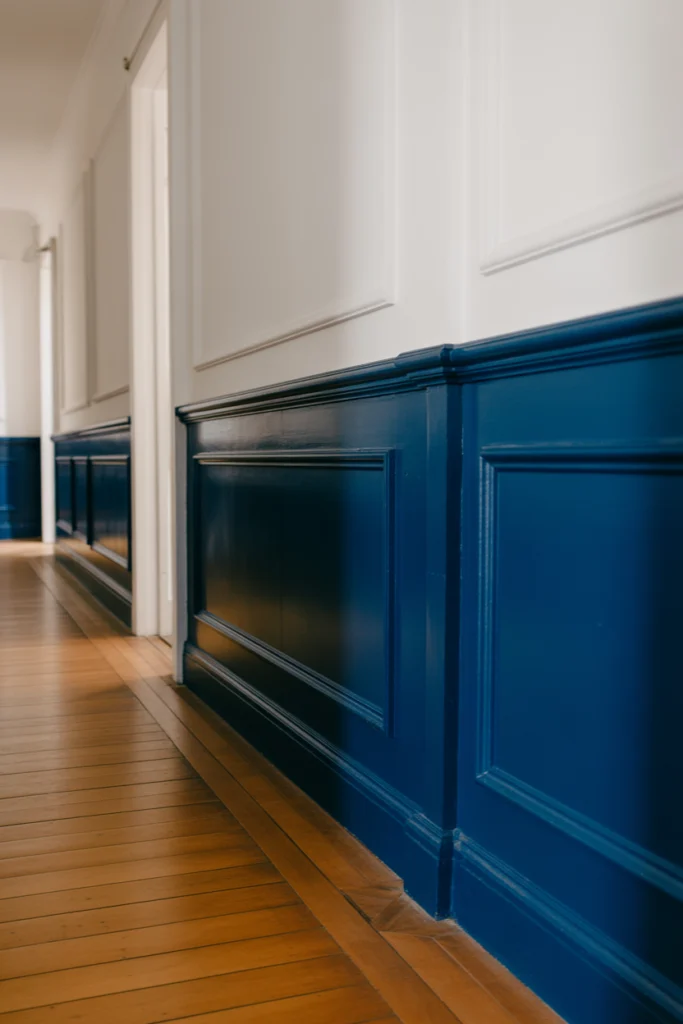
An accent wall is the cheapest dramatic change you can make in a hallway, and two tone paint gives you the same impact with more control. Paint one long wall in a bold color such as deep green, navy, terracotta, or charcoal, and keep the other walls light so the hallway still feels open. For a two tone look, paint the lower third in the darker color and the upper two thirds in a lighter shade, with a crisp dividing line at 36 to 42 inches, or add a slim trim strip along the divide for a finished, panelled effect.
Preparation makes the difference between a sharp result and a messy one. Clean the walls, fill nail holes, sand lightly, and use painter’s tape along the dividing line, pressing the edge down firmly and removing the tape while the paint is still slightly tacky for a clean edge. Use eggshell or satin paint in a hallway, since flat paint marks easily in a high traffic space. Test your color with a large swatch, at least 12 by 12 inches, and look at it in both daylight and evening light before you commit to a full wall.
9. Built-In Wall Niches
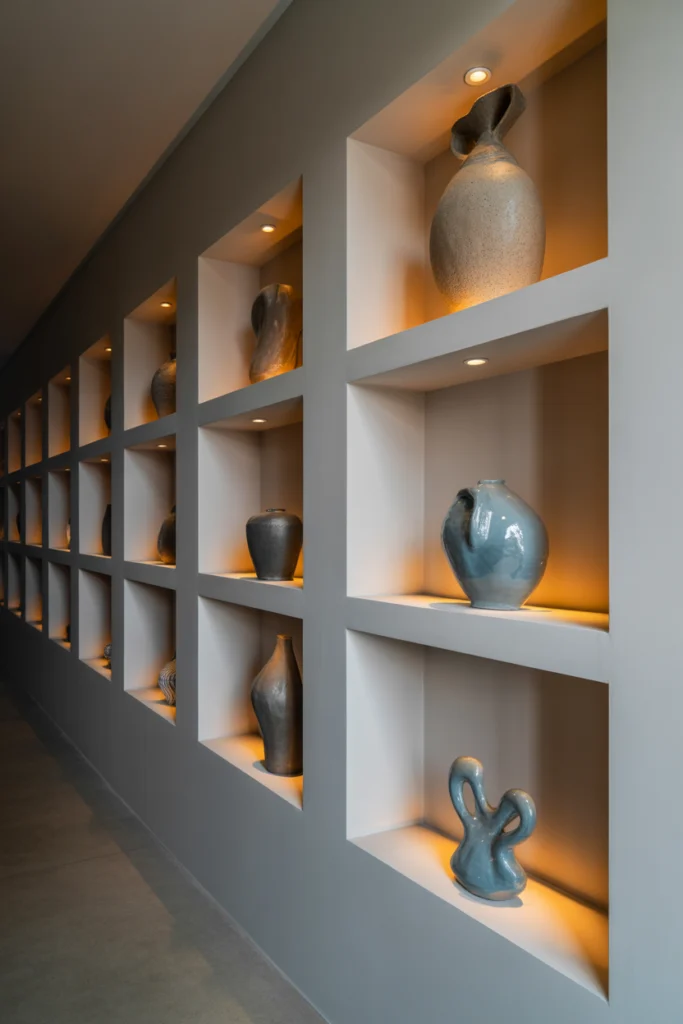
Wall niches turn an ordinary hallway wall into a custom architectural feature, giving you a perfect spot for art, ceramics, or a small plant. A niche 16 to 24 inches wide and 24 to 36 inches tall suits most hallways, and a depth of 4 to 6 inches is enough for display without weakening the wall structure. If you are building a niche into a stud wall, work between existing studs, usually spaced 16 inches apart, and frame the opening carefully so the surrounding wall stays solid.
Install a slim LED strip along the top inside edge of the niche, in warm white around 2700K, to create a soft glow that makes the displayed object stand out in the evening. Keep the display simple, one object per niche, or a small group of three related items, so the niche reads as intentional rather than cluttered. In a hallway without space for new construction, a recessed medicine cabinet style box or a shallow shadow box mounted on the wall can give you a similar look with far less work.
10. Framed Wallpaper Panels
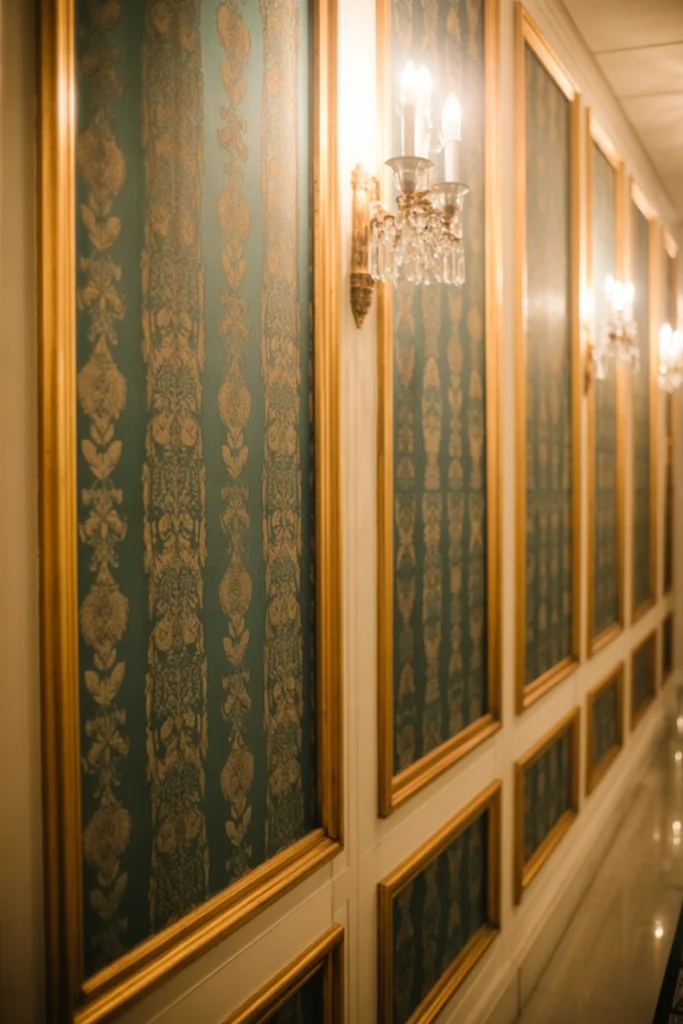
Framed wallpaper panels give you the luxury of wallpaper without committing to a whole wall, and they are an excellent project for a hallway. Apply wallpaper inside rectangular molding frames on the wall, each panel roughly 24 to 36 inches wide and 48 to 60 inches tall, spaced evenly along the corridor. Choose a subtle print, such as a fine botanical, a tone on tone damask, or a soft geometric, in colors that already appear elsewhere in your home, so the panels feel connected rather than random.
Install the molding first, using lightweight MDF or polyurethane trim, and paint it the same color as the wall for a seamless look or in a contrasting white for definition. Measure and mark each rectangle with a level before you glue or nail the trim, and keep the spacing between panels consistent, usually 4 to 6 inches from door frames and corners. Paste the wallpaper inside each frame, trim carefully at the edges, and seal the seams with a clear wallpaper seam adhesive if the hallway is humid. The result looks like custom wall art, but it costs far less than full wallpapering.
11. Decorative Wall Hooks
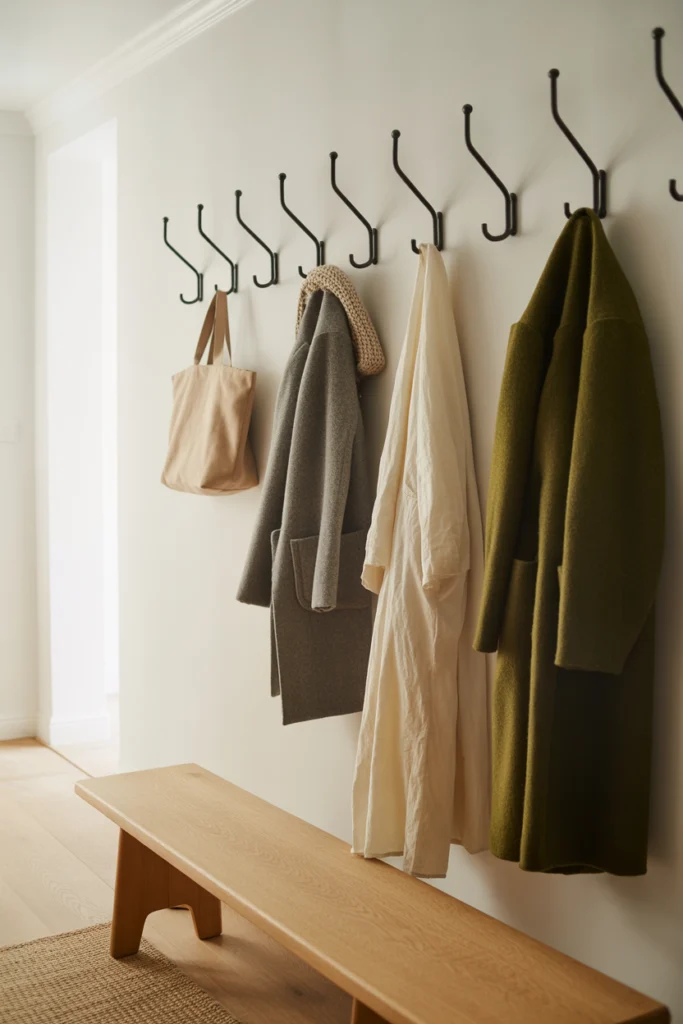
Wall hooks are one of the few hallway decorations that earn their place by being useful every single day. Choose hooks in a finish that matches your other hardware, such as brass for a warm traditional look, matte black for modern style, or natural wood for a farmhouse feel. Install a row of hooks at 60 to 66 inches from the floor for adult coats and bags, and add a lower row at 42 to 48 inches if children use the hallway. Space hooks 8 to 12 inches apart so coats do not overlap and bunch up.
Anchor every hook into a wall stud or use heavy duty anchors rated for at least 15 to 20 pounds each, since a wet winter coat and a heavy bag weigh more than you expect. A wall mounted rail with four to six hooks works well in a narrow hallway, because it spreads the load across several fixings and looks more finished than scattered individual hooks. Keep the area below the hooks clear, or add a slim shoe tray underneath, so the hallway stays tidy and the hooks remain easy to reach.
12. Indoor Greenery Displays
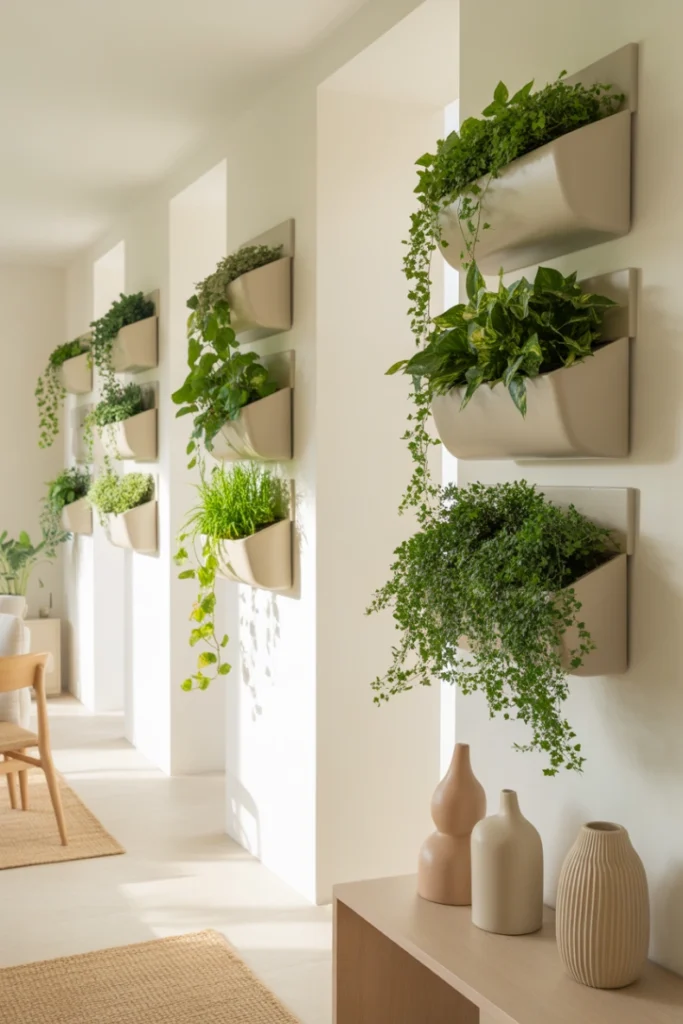
Plants soften a hallway instantly, adding color, texture, and a sense of life to a space that can otherwise feel hard and bare. Wall mounted planters, hanging pots, and slim vertical gardens all work in a hallway, because they keep plants off the floor and out of the walkway. Choose low maintenance plants that tolerate lower light, such as pothos, ferns, philodendron, or snake plants, and avoid plants that need direct sun unless your hallway has a bright window or skylight.
Watering is the main practical concern. Use planters with drainage trays or self watering inserts, and hang trailing plants high enough that leaves do not brush faces, usually with the bottom of the planter at least 72 inches from the floor in a walkway. Group plants in odd numbers, three or five, for a natural look, and mix leaf shapes, broad monstera style leaves beside fine fern fronds, for visual interest. If your hallway gets almost no natural light, high quality faux plants in wall planters give you the same greenery effect with no watering at all.
13. Wall Art Grid Arrangement
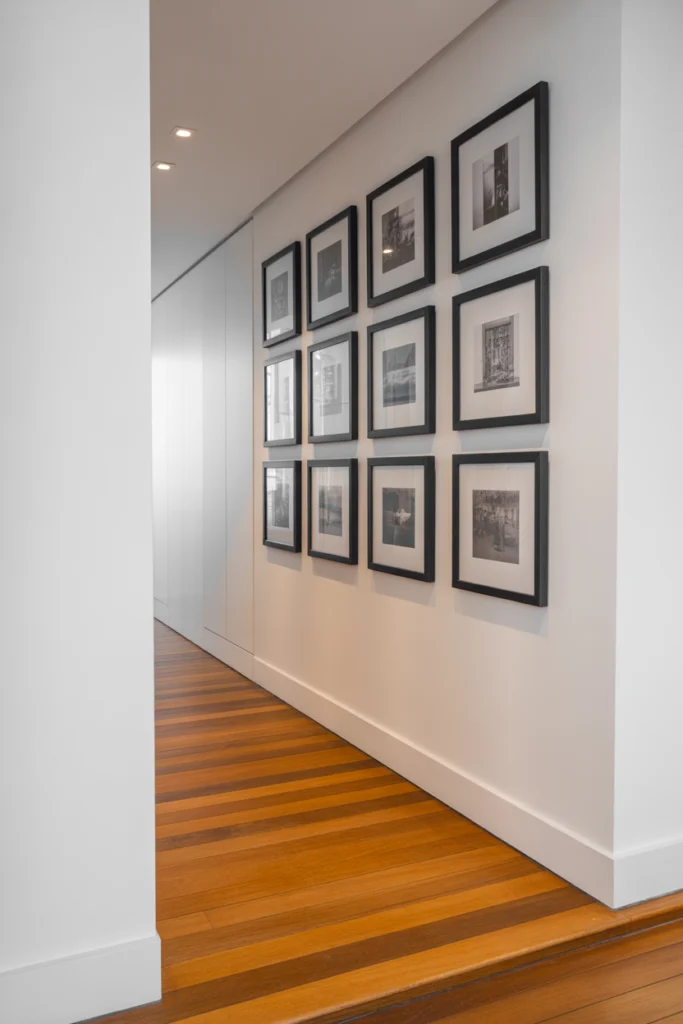
A symmetrical grid of framed prints brings order and calm to a hallway, and it is one of the easiest arrangements to get right. Choose identical frames, for example nine 12 by 12 inch frames in a three by three grid, or six 11 by 14 inch frames in two rows of three, and keep the spacing between frames exactly the same, usually 2 to 3 inches in every direction. Black and white photography, botanical prints, or simple abstract works suit a grid best, because the repetition of the frames, rather than a busy image, creates the visual impact.
Measure the total grid size before you hang anything, and mark the outer corners on the wall with light pencil marks. Start with the center frame or the top center frame and work outward, using a level for every row. A paper template helps enormously: trace each frame onto kraft paper, tape the templates to the wall, adjust until the grid looks balanced, and only then drive the nails. Keep the center of the grid at eye level, about 57 to 60 inches from the floor, and leave equal space on each side so the grid does not crowd a doorway.
14. Textured Wall Panels
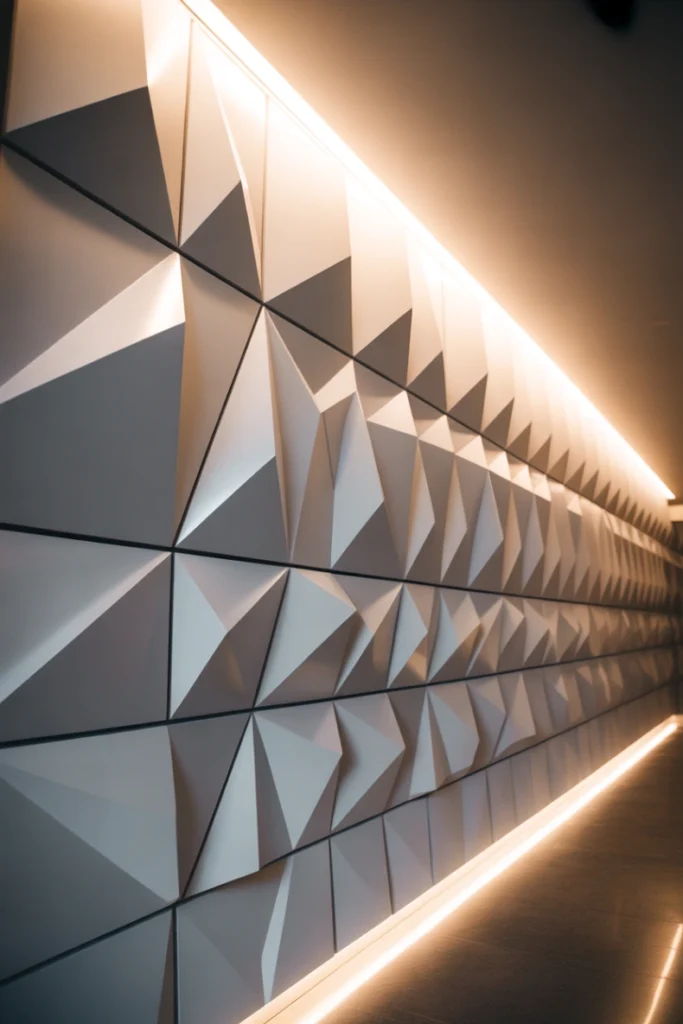
Three dimensional wall panels add depth and shadow to a hallway without adding furniture or clutter, which makes them ideal for narrow spaces. Materials include MDF, bamboo, gypsum, and PVC, each with a different look and price. MDF panels are affordable and easy to paint, bamboo adds natural warmth, and gypsum panels give a crisp, high end finish. Choose a subtle geometric or fluted pattern for a hallway, since a very bold 3D design can feel overwhelming in a tight corridor.
Paint the panels in a single monochrome color, such as warm white, soft greige, or pale sage, so the texture itself creates the interest through light and shadow. Install panels with construction adhesive and a few finishing nails, starting from one corner and working outward, and caulk the joints before painting for a seamless finish. Covering one feature wall, usually the longest wall or the wall at the end of the hallway, is often enough, and it keeps the project affordable and the hallway feeling open.
15. Floating Console with Art Above
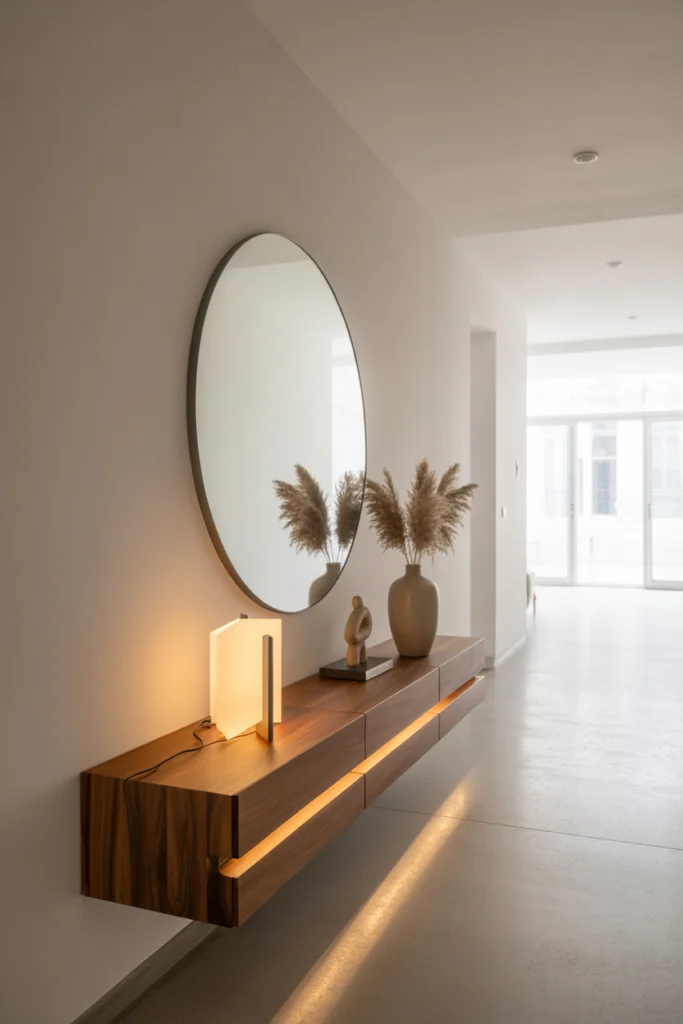
A floating console table gives you a useful surface in a hallway without the bulk of legs, keeping the floor area open and easy to clean. Choose a console no deeper than 10 to 12 inches and 36 to 48 inches long for a standard hallway, mounted at 30 to 32 inches from the floor, which is comfortable for dropping keys, mail, or a small vase. Anchor it firmly into wall studs, since a floating console carries weight and gets leaned on, and check that it is perfectly level before you tighten the fixings.
Hang a statement mirror or a large piece of abstract art above the console, with the bottom of the art 6 to 8 inches above the console surface, so the two pieces read as one composition. Style the console sparingly: a small vase with stems, a stack of two books, and a shallow bowl for keys is plenty, and anything more can make a narrow hallway feel cluttered. For entry tables that match this look, see our modern entryway ideas, which include slim consoles and wall art pairings for small entries.
16. Wall Clocks as Statement Pieces
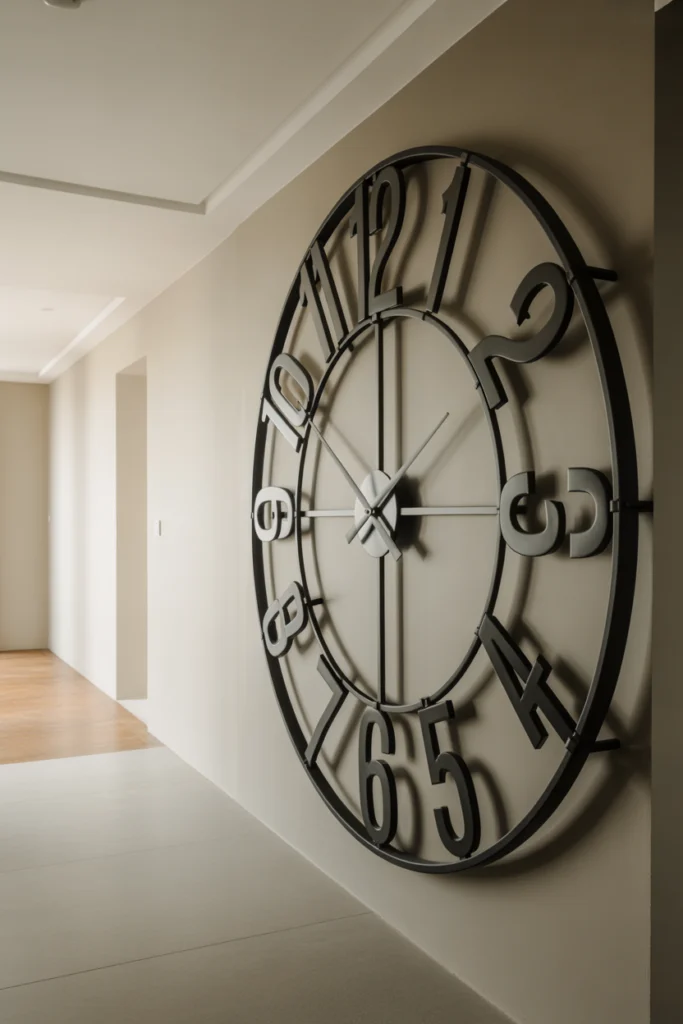
A large wall clock works as both a practical tool and a piece of art, and it gives a hallway a clear focal point. Choose a clock 24 to 36 inches across for a main hallway wall, large enough to read from the far end of the corridor but not so large that it overwhelms the space. A rustic wood clock suits a farmhouse hallway, a slim metal clock suits a modern home, and a classic roman numeral clock suits a traditional entry. Hang the clock at eye level, with its center about 60 to 66 inches from the floor, so it is easy to read as you walk past.
Keep the wall around the clock simple, since the clock itself is the statement. Avoid hanging competing art within 12 inches of it, and make sure the clock face contrasts enough with the wall color to read clearly, for example a dark frame on a light wall. Check that the clock is level, use a wall anchor rated for its weight, and keep spare batteries in a nearby drawer so a stopped clock does not sit unnoticed for weeks. A silent sweep movement is worth choosing for a hallway near bedrooms, since ticking can carry at night.
17. Wall Murals and Art Paintings
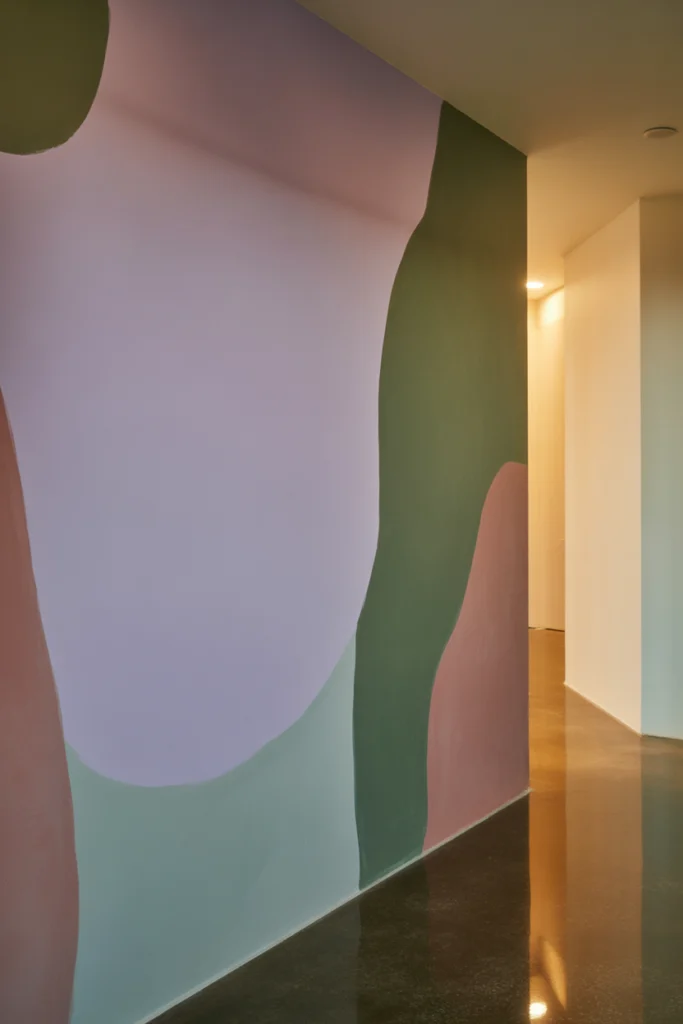
A mural turns a hallway wall into a one of a kind feature, whether it is a hand painted landscape, an abstract wash of color, or a botanical design that climbs the wall. Murals work best on the longest wall in the hallway or on the wall at the end of the corridor, where you see it head on as you walk toward it. Keep the rest of the hallway simple when you add a mural, with plain flooring and minimal competing decor, so the mural remains the star of the space.
For renters or anyone who wants a reversible option, peel and stick mural wallpaper gives you the same impact with easy removal. Measure the wall carefully, order a mural sized to your exact wall dimensions, and install it panel by panel from one side to the other, smoothing out air bubbles as you go. If you commission a hand painted mural, agree on a small scale sketch first, confirm the colors against your hallway lighting, and seal the finished work with a clear matte protective coat so it survives hallway scuffs.
18. Picture Ledges for Rotating Art
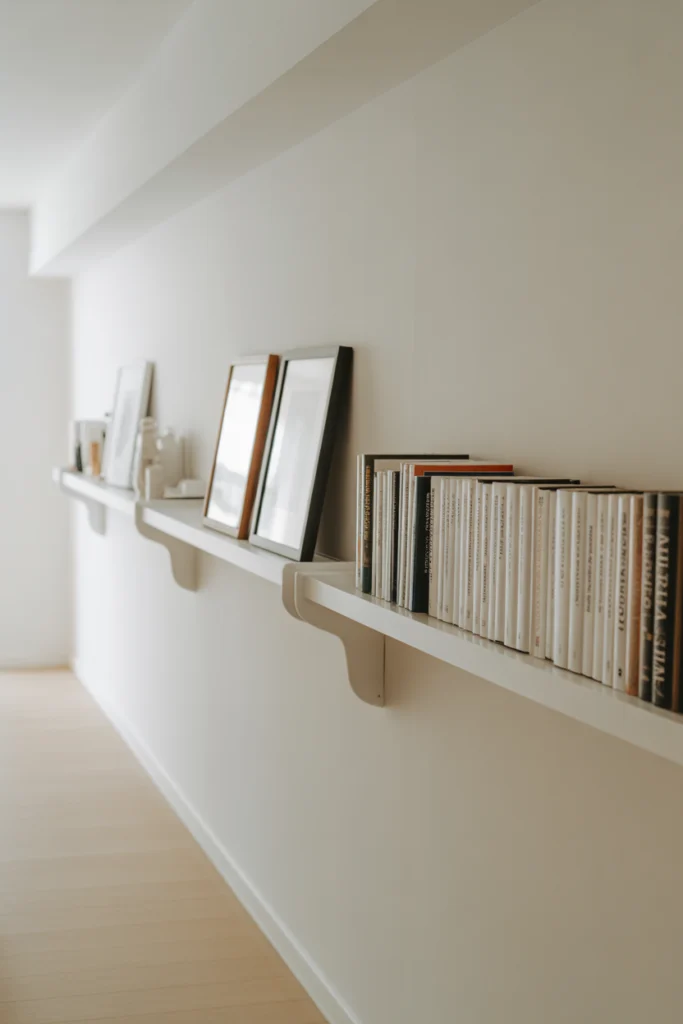
Picture ledges are slim shelves with a lip that holds framed art upright, and they are perfect for hallways because you can change the display without new nail holes. Install ledges 36 to 48 inches long, with the top ledge at about 60 inches from the floor and a second ledge 12 to 15 inches below it for a layered effect. Choose ledges no deeper than 3 to 4 inches, so frames sit securely without sticking far into the walkway, and anchor each ledge into studs for safety.
Style a ledge by overlapping frames of different sizes, leaning a large frame at the back, a medium frame in front of it, and a small print or a tiny object at the end. This layered look feels collected and casual, and it lets you rotate art seasonally, swap in family photos, or try a new print without tools. Keep the heaviest frame closest to the wall and the lightest at the front, and leave a little space at each end of the ledge so the display does not look crammed against a door frame.
19. Decorative Wall Molding
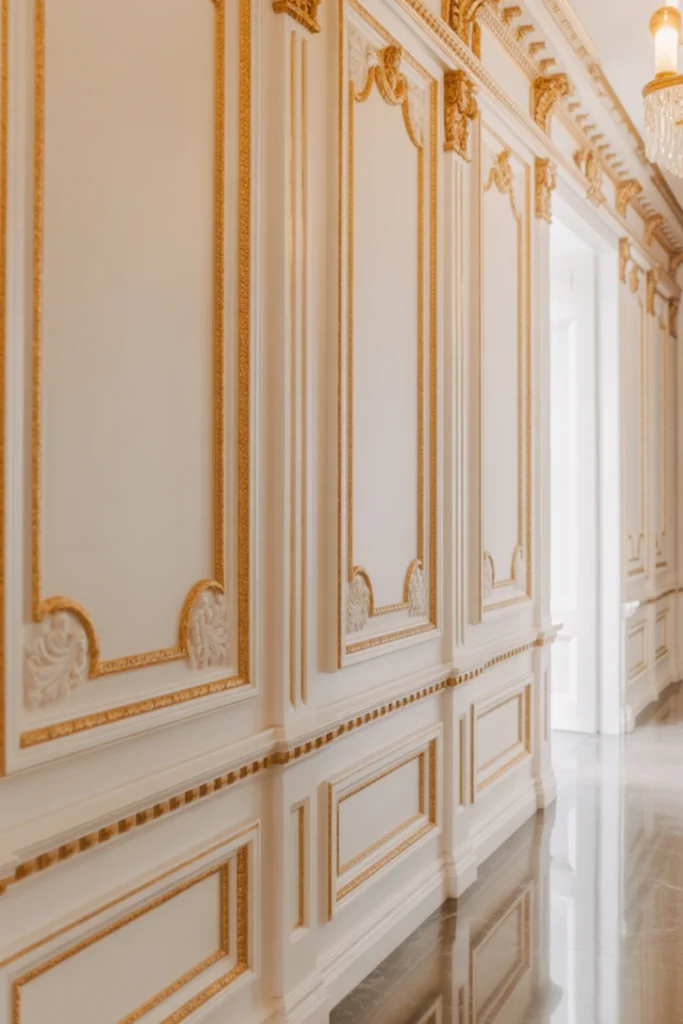
Wall molding adds classic architecture to a hallway with a relatively simple and affordable project, and it works in traditional, transitional, and even modern homes when the profile is kept simple. Create large rectangular frames on the wall using lightweight MDF or polyurethane trim, each rectangle roughly 24 to 36 inches wide and 48 to 60 inches tall, spaced evenly with 4 to 6 inches between rectangles and door frames. Paint the molding the same color as the wall for a subtle, seamless effect, or paint it in a contrasting white for a crisper, more defined look.
Measure and mark every rectangle with a level before you attach the trim, and cut the corners at 45 degrees with a miter box or miter saw for clean joints. Glue the trim in place, add a few small finishing nails for security, fill the nail holes, caulk the edges, and then paint the whole wall and molding together for the most professional finish. In a narrow hallway, keep the molding profile slim, about 2 to 3 inches wide, so it adds texture without narrowing the walkway or catching on bags and coats.
20. Sculptural Wall Decor
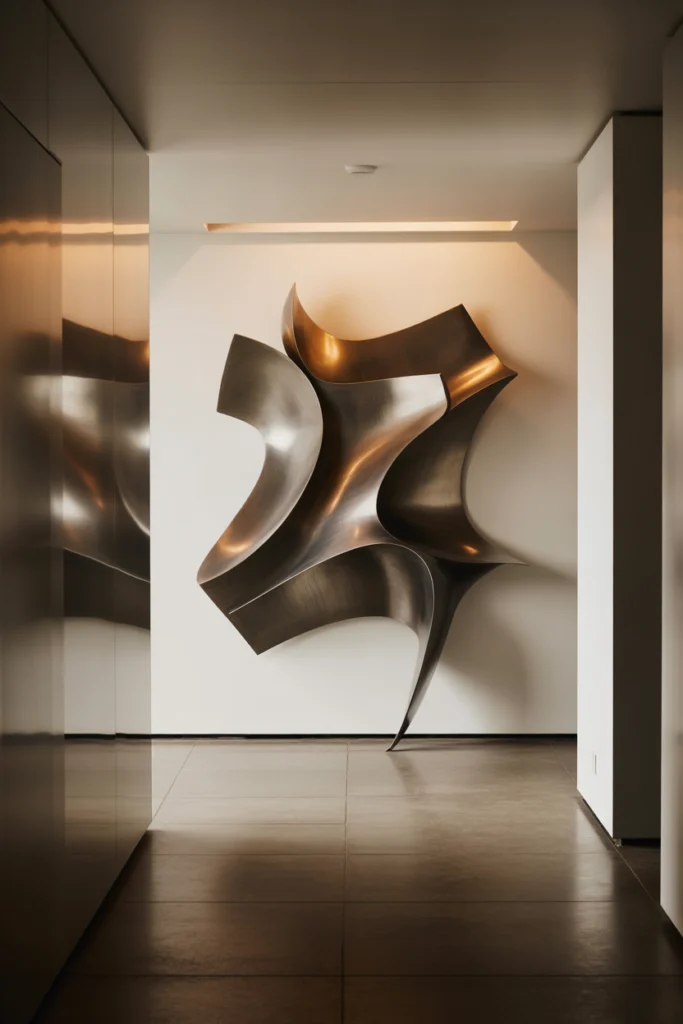
Sculptural wall decor takes a hallway beyond flat art, adding shadows, depth, and a sense of movement that changes as the light changes through the day. Metal wall sculptures, carved wood panels, ceramic wall pieces, and woven fiber art all qualify, and they suit contemporary homes especially well. Choose one large statement piece, around 36 to 48 inches wide, as a focal point, or a trio of smaller coordinated pieces spaced evenly, rather than scattering many small sculptures that can look cluttered in a narrow space.
Lighting makes sculptural decor work. A picture light or a directional spotlight mounted above the piece casts shadows that emphasize its three dimensional form, especially in the evening. Hang sculptural pieces at eye level, anchor them securely with fixings rated for their weight, and keep the surrounding wall plain so the sculpture stands out. Balance is key: if the sculpture is bold and dark, pair it with a light wall color and simple flooring, and let the piece itself carry the visual weight of the hallway.
Conclusion
Your hallway is the bridge between the rooms of your home, but with the right wall decor it can also be a destination in itself. From gallery walls and oversized mirrors to textured panels, greenery, and sculptural art, each of these 20 hallway wall decor ideas blends beauty with function, giving your walls purpose as well as style. The best hallway is not the one with the most decoration, but the one where every piece earns its place, whether by adding light, storage, color, or personality.
Start with the changes that solve your biggest problem first, whether that is darkness, blank walls, or missing storage, and add the rest one step at a time. Measure before you hang, anchor heavy pieces properly, and step back often to check the balance of the whole corridor. With thoughtful choices and a little patience, your hallway can become a stylish, welcoming, and expressive part of your home, and every step through it can feel inspiring.
Frequently Asked Questions
How high should I hang art in a hallway?
Hang the center of a single piece or a grouping at 57 to 60 inches from the floor, which is eye level for most adults. In a hallway with a console or bench below, leave 6 to 8 inches between the top of the furniture and the bottom of the art so the two pieces read as one composition. Always step back and check the arrangement from the far end of the hallway, since that is the view you will see most often.
What is the best wall decor for a very narrow hallway?
Flat or slim decor works best in a very narrow hallway. Choose framed art, mirrors, wallpaper, paint, wall molding, or textured panels, all of which add style without reducing walkway width. Keep any protruding decor, such as shelves, consoles, or hooks, no deeper than 8 to 12 inches, and always measure the remaining clear walkway after installation, keeping at least 30 to 36 inches free.
How do I make a dark hallway feel brighter with wall decor?
Use mirrors opposite light sources, light colored paint or wallpaper, and layered lighting with sconces and picture lights. A large mirror at the end of a dark hallway reflects light back down the corridor, while warm white bulbs around 2700K to 3000K keep the space feeling cozy rather than clinical. Avoid very dark art or heavy frames in a dark hallway, since they absorb the little light available.
Can I decorate a rental hallway without damaging the walls?
Yes, many hallway ideas are renter friendly. Use peel and stick wallpaper, picture hanging strips for light frames, leaning art, battery operated sconces, and freestanding or adhesive hooks. Avoid drilling into studs without permission, keep a record of the original wall condition, and choose removable products that are rated for the weight of each piece you hang.
How much should I budget for hallway wall decor?
A hallway refresh can cost very little or quite a lot, depending on your choices. Paint and a few frames can transform a hallway for under 100 dollars, while mirrors, wallpaper, paneling, and lighting together may cost several hundred dollars. Start with paint and lighting, which give the biggest impact per dollar, and add mirrors, art, and shelving over time as your budget allows.
More Ideas You Will Love
 20 Hallway Decor Ideas That Instantly Elevate Your Home’s Entrance
 22 Upstairs Hallway Ideas to Elevate Your Home’s Style
 12 Modern Hallway Renovation Ideas for Your Homes
 22 Entrance Hall Decor Ideas for a Welcoming, Functional Entryway
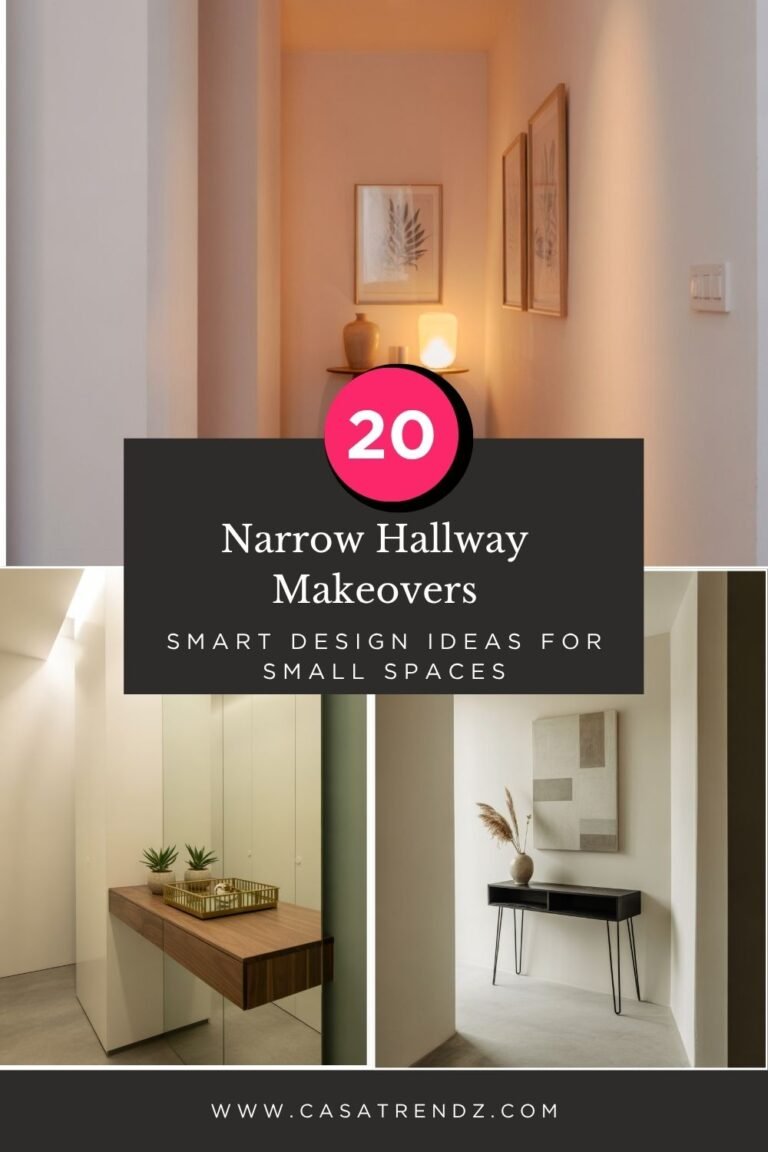 20 Narrow Hallway Makeovers: Smart Design Ideas for Small Spaces
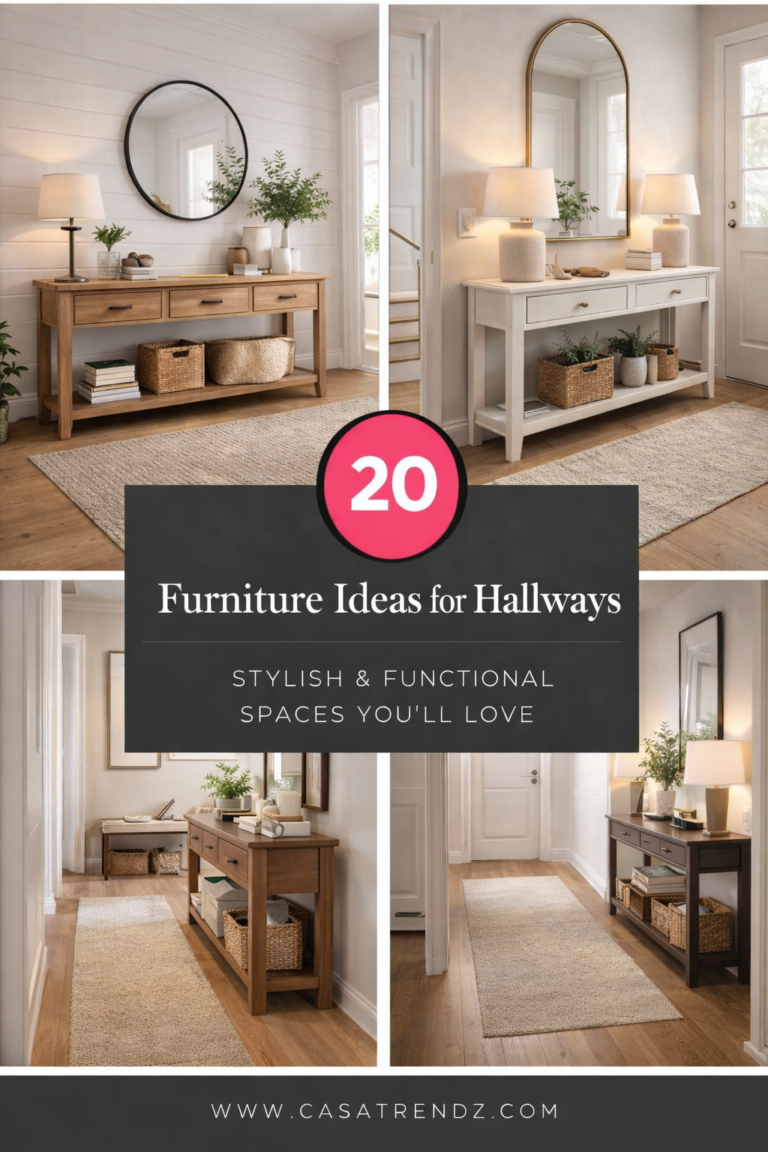 20 Furniture Ideas for Hallways: Stylish & Functional Spaces You’ll Love