
20 Aesthetic DIY Christmas Bedroom Light Ideas for 2025


Nothing changes how a bedroom feels at Christmas quite like light. A single warm strand across the headboard can turn an ordinary room into a soft, glowing retreat, and a few well placed lanterns can make cold December nights feel calm and inviting. The ideas in this guide are all easy to make at home, most of them in under an hour, and none of them require an electrician or a big budget.
This collection brings together 20 aesthetic DIY Christmas bedroom light ideas, from a dreamy fairy light canopy above the bed to a simple ceiling garland that adds sparkle to the whole room. Each idea includes the materials you need, realistic measurements, color suggestions, and step by step instructions, plus practical tips on safety, timers, and storage so your lights look good all season and pack away neatly in January.
Start with one idea that fits your room and your bed size, then add a second layer only if the room still feels dark in the corners. Two or three light sources at different heights, for example a canopy, a bedside lantern, and a dresser garland, usually look far better than ten strands crowded in one spot. If you want more Christmas bedroom inspiration beyond lighting, these Christmas bedroom decor ideas pair beautifully with every project below.
1. Fairy Light Canopy Above the Bed
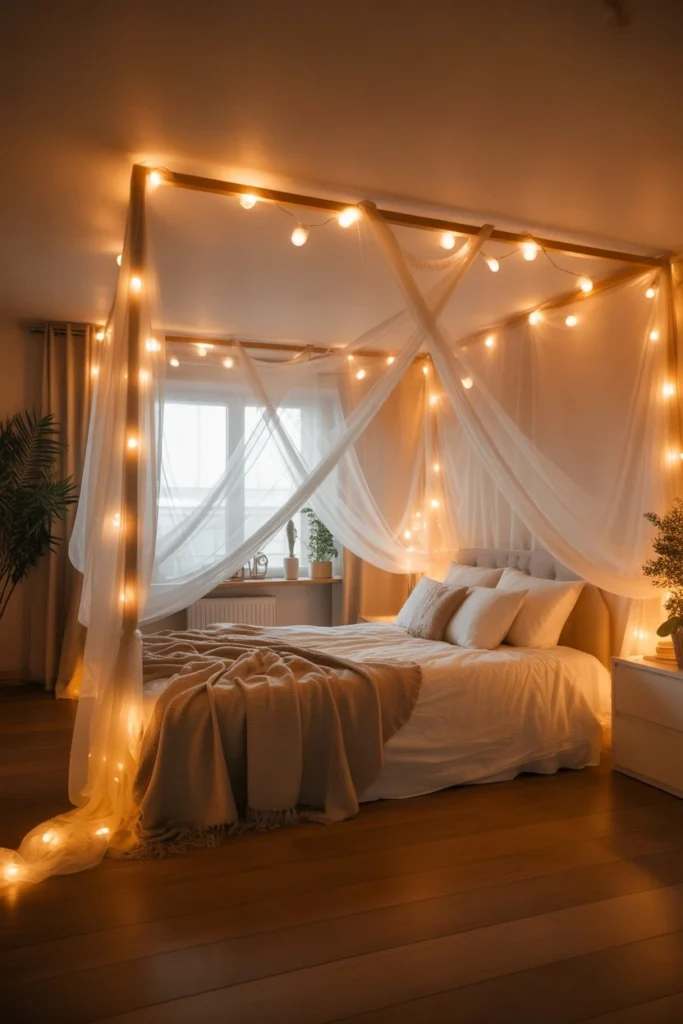
A fairy light canopy is the fastest way to make a bedroom feel magical. You will need two to three strands of warm white fairy lights, each 5 to 10 meters long depending on your bed size, plus small transparent adhesive hooks or a lightweight net canopy. For a double bed, plan on hooks spaced about 40 to 50 cm apart across the ceiling above the bed, and let the lights drape down 20 to 30 cm at the sides so the glow wraps around you rather than sitting flat overhead.
Start at the wall behind the headboard and work toward the foot of the bed, looping each strand loosely across the hooks so the lights hang in soft swags rather than straight lines. Tuck the battery pack or plug behind the headboard where it stays out of sight, and choose a timer setting, usually 6 hours on and 18 hours off, so the canopy switches itself on at dusk. Warm white at 2700K looks cozy and flattering, while cool white can feel harsh in a bedroom, so check the box before you buy.
For an even softer effect, drape a sheer voile panel over the lights. The fabric diffuses each bulb into a gentle glow and hides the wire, which is especially helpful with cheaper lights that have visible green or clear cable. Keep lights away from pillows and bedding by at least 15 cm, never run them under a mattress, and switch to LED lights only, because old incandescent strands get hot enough to be a fire risk near fabric.
2. Mason Jar Light Lanterns
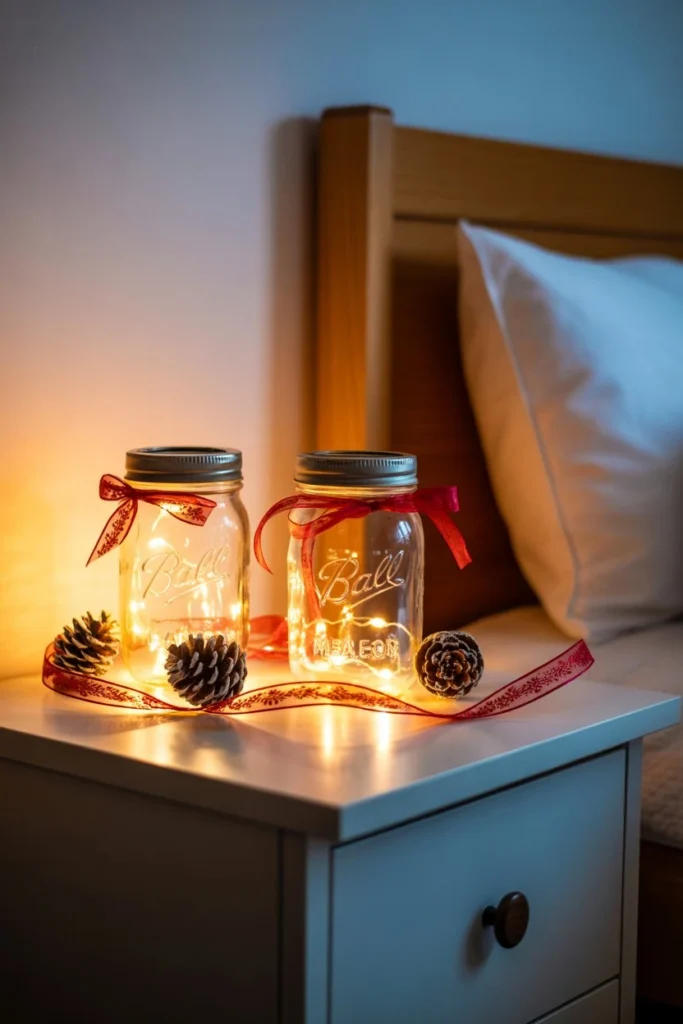
Mason jar lanterns give you a rustic, farmhouse glow on a nightstand or shelf for very little money. You will need wide mouth mason jars in 500 ml or 1 liter size, one short battery operated fairy light strand per jar, and simple decorations such as a strip of burlap ribbon, a small pinecone, or a dusting of faux snow around the rim. A 1 to 2 meter strand with 20 LEDs fits a single jar without tangling, and warm white suits wood furniture better than multicolor.
Coil the lights loosely inside the jar instead of packing them tight, so the light spreads evenly, then screw the lid on loosely or leave it off and tie ribbon around the neck to hide the battery pack. Place one jar on each nightstand for symmetry, or group three jars of different heights on a dresser. If the jar sits close to your bed, choose a strand with a dimmer or a warm amber tone, which is easier on the eyes at night than bright white.
To keep the look fresh all season, swap the ribbon in mid December for a deeper red or a plaid pattern, and wipe the jars weekly, because dust dulls the glow quickly on glass. Use battery lights with a built in timer so you never have to reach behind furniture at bedtime, and keep a spare set of AA batteries in the nightstand drawer, because timer strands tend to run out right when guests arrive.
3. Christmas Light Headboard
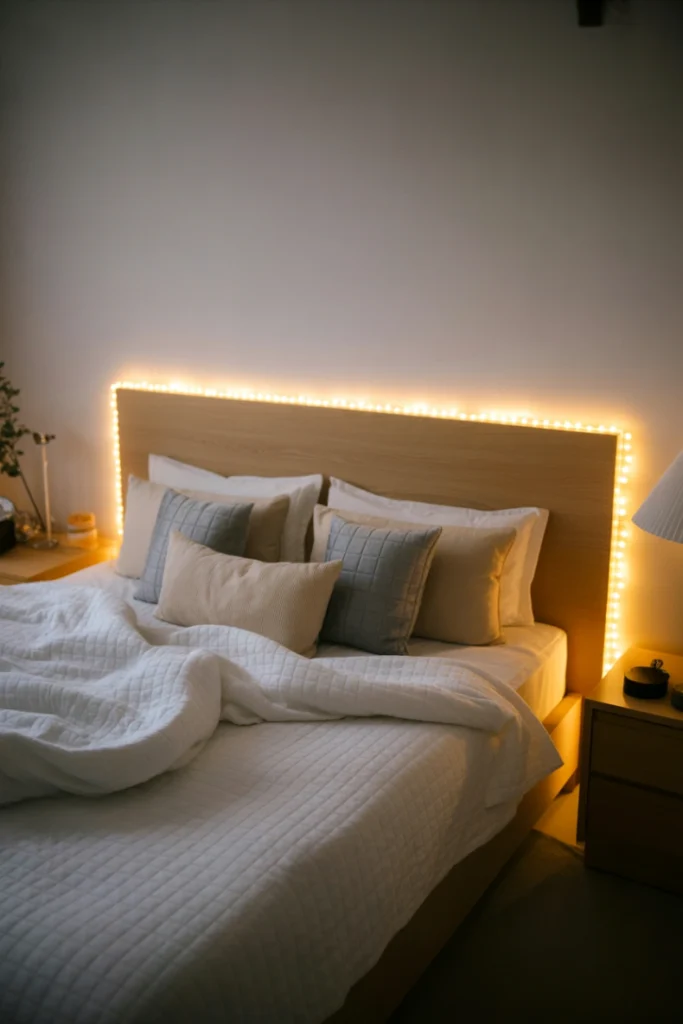
Outlining your headboard with lights turns the bed into the clear focal point of the room, and it works on almost any headboard style. For a standard queen headboard about 150 cm wide, one 5 meter warm white LED strand is usually enough to outline the top and sides once, while a tall upholstered headboard may need 7 to 10 meters if you also weave lights through the padding. Stick to warm white or soft gold, and avoid flashing modes in a bedroom, where a steady glow feels far more restful.
Attach the strand with small clear clips or removable adhesive hooks placed every 25 to 30 cm along the headboard frame, then weave the remaining length through a slim evergreen garland draped across the top. Tuck the plug end behind the bed and run the cable along the skirting board with cable clips so nobody trips on it in the dark. If your headboard is metal, magnetic clips made for string lights grip neatly and leave no marks when you remove them in January.
Finish the look with two or three textured cushions in cream, plaid, or deep green, and a folded throw at the foot of the bed. The lights will catch the texture of the fabric and make the whole bed look layered rather than flat. Check the strand once a week for any bulb that has gone out, and replace the whole strand rather than mixing old and new lights, because mismatched brightness is easy to spot on a headboard.
4. Twinkling Wall Garland
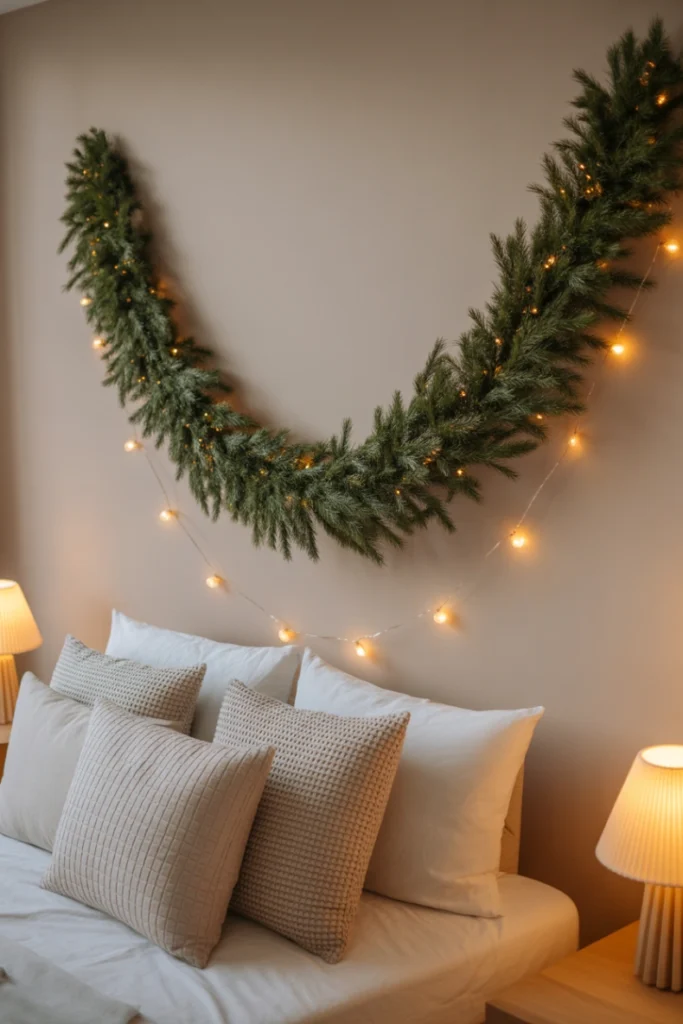
A twinkling wall garland is a classic Christmas feature that suits a wall above a dresser, a window, or the bed itself. Start with a faux evergreen garland 180 to 270 cm long, which fits most walls without looking stretched, and a 5 meter fairy light strand woven through it before you hang it. Mix in a few red berries, small pinecones, or gold baubles, but keep decorations to about one item every 20 cm so the garland still reads as greenery first and decoration second.
Hang the garland in a gentle swag shape using two or three sturdy adhesive hooks rated for at least 1 kg each, and let the center dip 20 to 30 cm lower than the ends for a natural, relaxed curve. Weave the lights through the branches from the inside out, pushing each bulb slightly forward so it is not buried in the foliage. A plug in strand with a remote control is ideal here, because the garland often sits too high to reach the battery pack comfortably.
This idea works best when the rest of the wall stays fairly plain, so the garland has room to stand out. If your bedroom already has busy wallpaper or large art, choose a slimmer garland and fewer ornaments. At the end of the season, wrap the garland and lights together in a large bag rather than pulling the lights out, which saves you the whole weaving job next year.
5. Curtain Light Backdrop
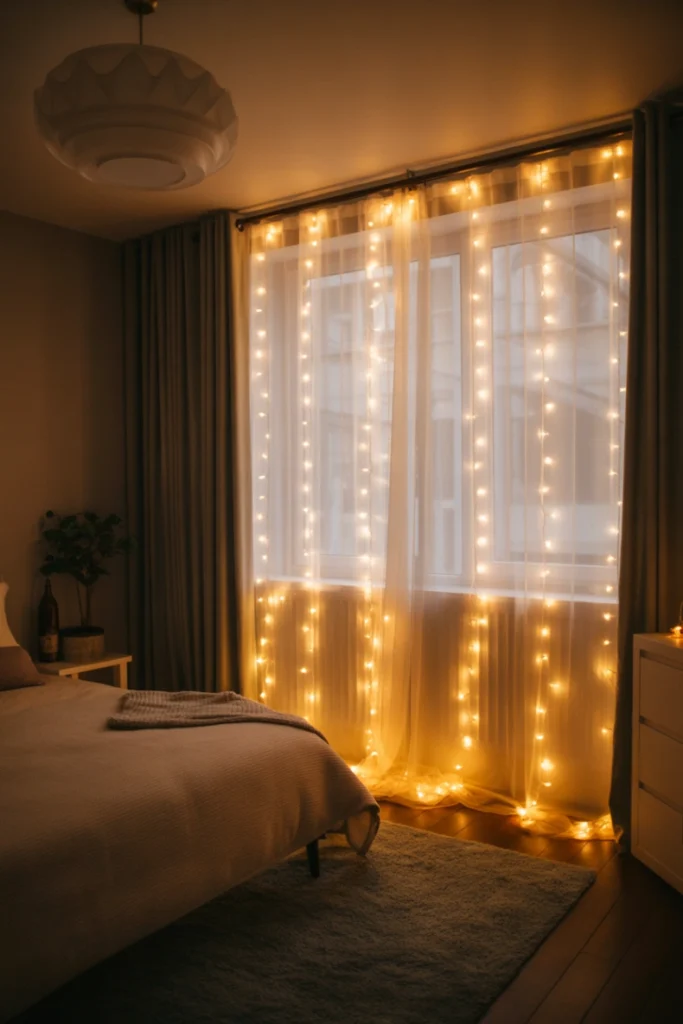
Curtain lights turn a plain window or accent wall into a glowing backdrop in about fifteen minutes. A standard curtain light set is about 3 meters wide and 2 to 3 meters long, with vertical drops spaced 30 to 50 cm apart, which fits a double window or a single accent wall behind a bed. Hang the top rail from a curtain rod or a row of adhesive hooks, then let the drops fall straight down and straighten any tangled strands before you switch them on.
Warm white gives a calm, cozy atmosphere and suits cream or blush bedding, while pure white looks crisper against grey or navy walls and reads more like winter snow. For extra depth, hang the curtain lights behind a sheer curtain panel. The fabric softens the bulbs, hides the top rail, and creates a layered glow that looks expensive even with a budget light set. Keep the bottom of the drops at least 10 cm above any radiator or heater, and never let fabric bunch around a plug in transformer.
If you use curtain lights behind the bed, set them on a timer that switches off at bedtime, because a full wall of light can disturb sleep even with your eyes closed. A dimmer plug or a smart plug with a schedule solves this neatly. Fold the set carefully when you store it, winding it around a piece of cardboard, so next December you can hang it in one go instead of untangling it for an hour.
6. Bed Frame Wrapped in Lights
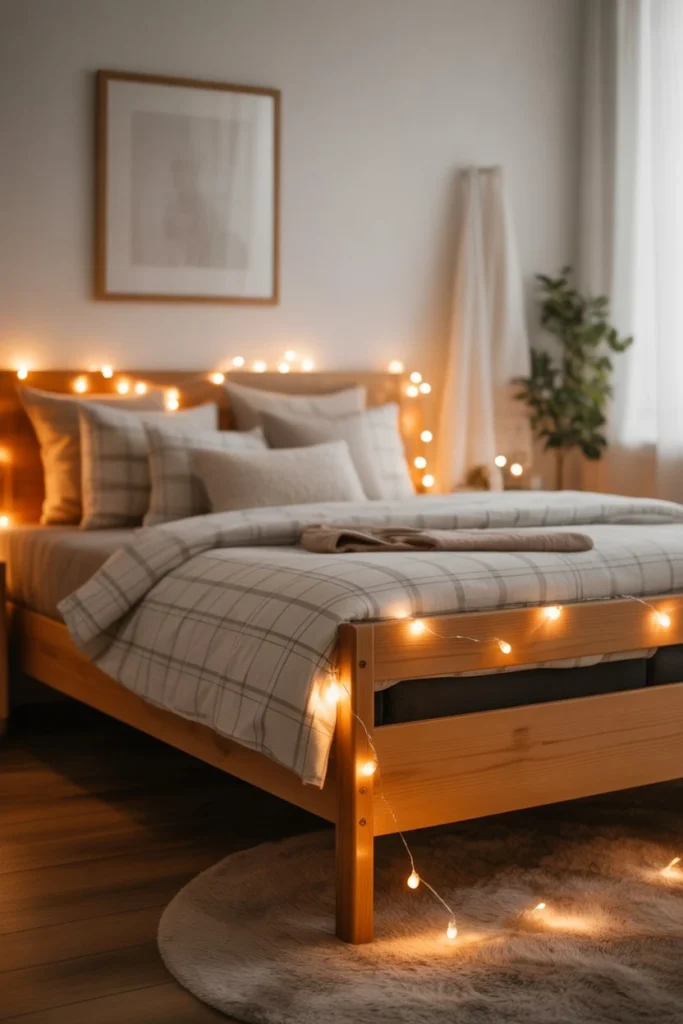
Wrapping lights around the bed frame is a quiet, minimalist idea that suits people who want festive warmth without a big display. One 5 to 7 meter battery operated strand is enough to wrap the footboard and both side rails of a double bed once, with about 15 to 20 cm of spacing between wraps. Choose a thin wire strand in warm white, because thick cable looks clumsy on a slim metal or wooden frame.
Start at the headboard end of one side rail and wrap toward the footboard, keeping gentle tension so the strand does not slide down overnight. Secure it every 40 cm with a small clear cable tie or a dot of removable putty on wooden frames, and tuck the battery pack under the bed near the headboard where you can reach it without crawling. Battery lights are the best choice here, because a plug in cable running across the floor beside a bed is a trip hazard in the dark.
This idea looks best on a bed with plain bedding in one or two colors, so the lights provide the pattern. If your duvet is already busy, keep the lights to the footboard only. Test the strand at night before you commit to the wrapping, because a strand that looks soft in daylight can look surprisingly bright in a dark room, and a dimmer strand is an easy fix at that stage.
7. Hanging Star Lights
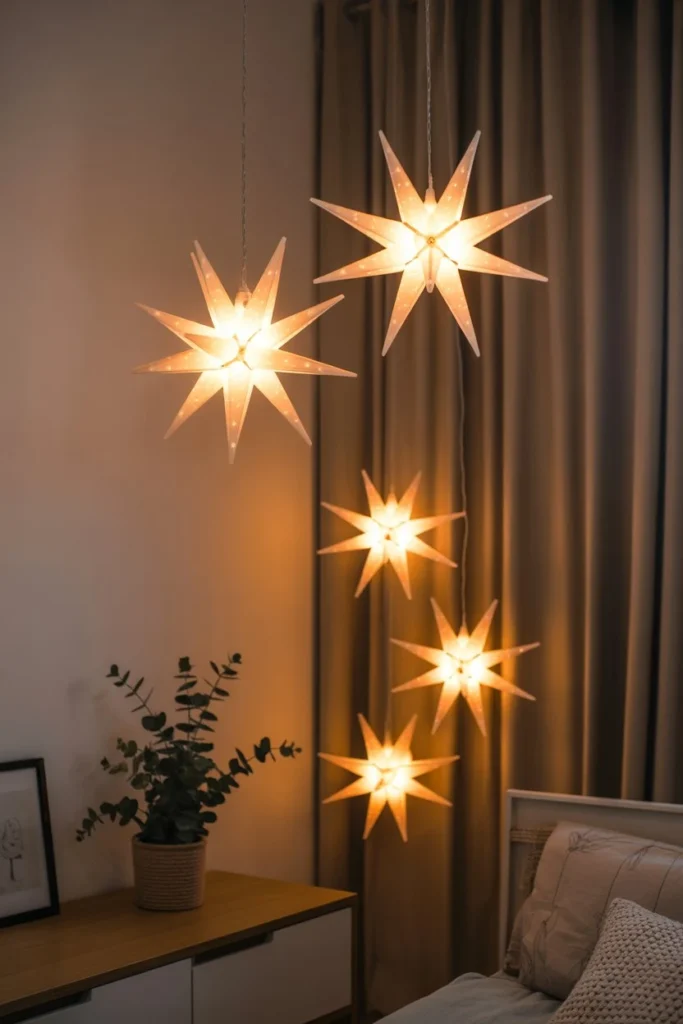
Hanging star lights add a calm, celestial feel that works well over a bed or beside a reading chair. You will need a star light set, usually 10 to 20 stars on a 3 to 5 meter strand, plus ceiling hooks or a small curtain rod to hang them from. Hang the stars at staggered heights, with the longest drop about 60 to 90 cm below the ceiling, so they read as a scattered sky rather than a flat line.
Gold stars suit warm, traditional bedrooms with wood furniture, while white or silver stars suit modern rooms with grey or white bedding. Place the densest cluster above the headboard or reading nook, and let a few single stars trail off to one side for balance. If the stars are paper or thin plastic, keep them away from real candles and radiators, and choose LED stars only, which stay cool even after hours of use.
For a reading nook, hang three to five stars at eye level beside the chair and pair them with a small table lamp, so you have both festive glow and enough light to read by. Star lights alone are too dim for reading, so treat them as atmosphere, not task lighting. Store paper stars flat between sheets of tissue paper to avoid crushing the points before next Christmas.
8. Lighted Christmas Wreath
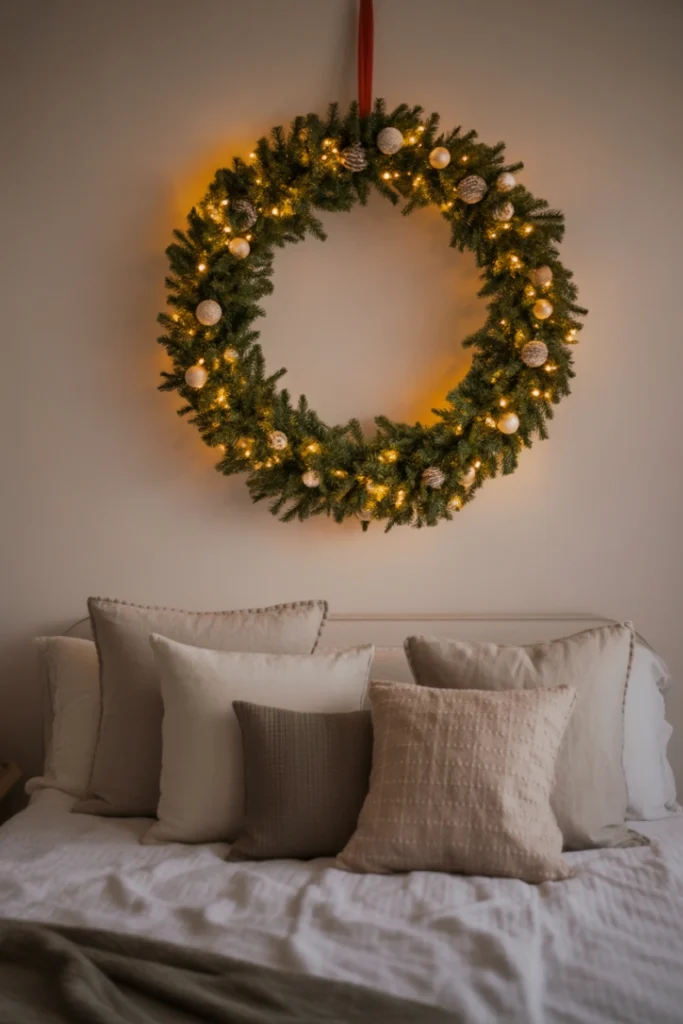
A lighted wreath above the bed or on an interior wall gives you instant Christmas charm without using any floor or shelf space. Choose a wreath 45 to 60 cm across for a wall above a bed, or 30 to 40 cm for a narrow wall or door. A pre lit wreath with 30 to 50 warm white LEDs saves weaving time, but you can also wrap a 3 meter fairy light strand around a plain faux pine wreath in about ten minutes.
Hang the wreath from a single sturdy adhesive hook rated for at least 2 kg, centered about 20 to 30 cm above the headboard or at eye level on a plain wall. Add three or four small ornaments in one accent color, such as gold or deep red, and a simple ribbon bow at the bottom, but resist the urge to cover every branch, because the lights need open space to shine through. If you love making wreaths from scratch, these DIY Christmas wreath ideas include plain and lighted styles you can adapt for a bedroom wall.
Because a wreath hangs at head height, check it from the bed as well as from the door. A wreath that looks perfect from across the room can look lopsided from the pillow, so step back to both spots before you finish. Use a battery pack hidden behind the wreath itself, and choose a timer strand so the wreath glows in the evening and rests overnight without you having to reach up to switch it off.
9. Fireplace Mantle Lights (Electric or Faux)

If your bedroom has a small fireplace, an electric mantle, or even a faux fireplace frame, lights turn it into a cozy focal point in minutes. Drape a 180 cm evergreen garland along the mantle, weave a 5 meter warm white strand through it, and add two or three flameless candles in different heights at each end. Keep real flames out of this display entirely, because garlands and fabric are close by and bedrooms are used at night.
Balance is the key to a mantle that looks styled rather than cluttered. Place the tallest candle or lantern at one end, a medium piece in the center, and a shorter piece at the other end, then fill the gaps with small pinecones or baubles. Leave at least 15 cm of clear space around any electric heater vent, and never drape fabric over an electric fire, even if the fire is switched off. If you want more fireplace styling ideas for the rest of the house, these Christmas fireplace decor ideas translate well to a smaller bedroom mantle.
For a faux fireplace with no heat at all, you can go further and place a cluster of LED candles inside the firebox itself, with a mirror behind them to double the glow. This looks surprisingly realistic in the evening and costs almost nothing to run. Dust the garland weekly, because a dusty garland next to warm lights loses its fresh green look fast, and replace any candle battery as soon as it dims so one side of the mantle does not go dark.
10. Hanging Glass Ornaments with Lights
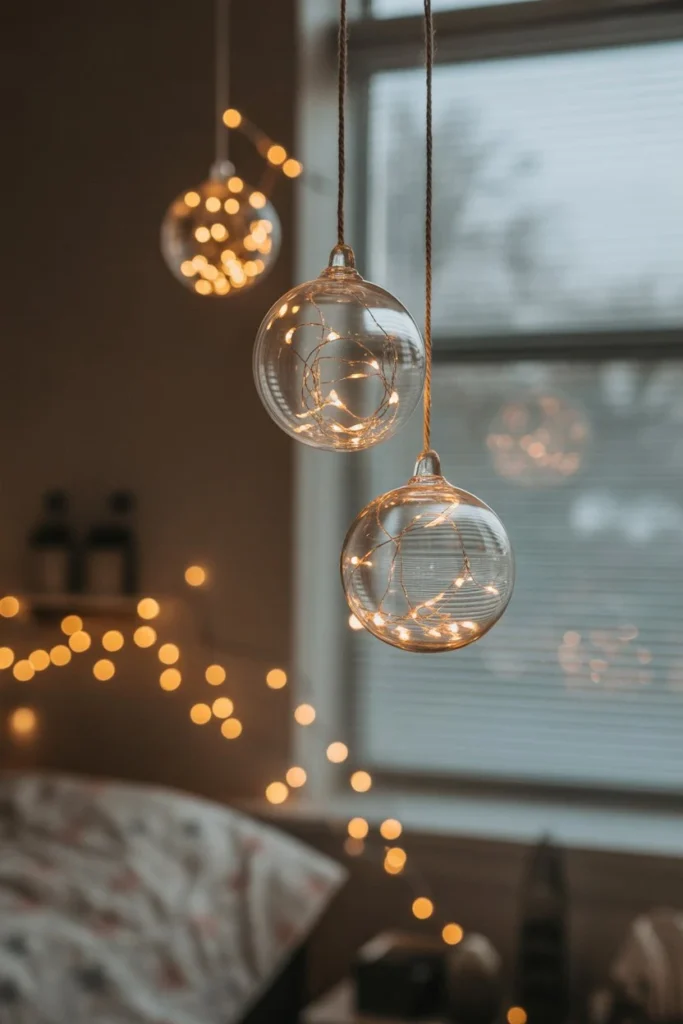
Clear glass ornaments filled with mini lights look elegant hanging from a ceiling or curtain rod, and they catch light beautifully. You will need clear plastic or glass baubles 8 to 10 cm across, which are safer than large glass ornaments above a bed, plus a short strand of micro LED lights or individual LED bauble lights. Fill each ornament with a small coil of lights, or place one tiny LED inside, then close the cap and hang the ornament from clear fishing line cut to different lengths.
Hang five to nine ornaments in a loose cluster, with drops ranging from 30 to 90 cm, so the group looks natural rather than uniform. Mix in two or three ornaments filled with faux snow, fine glitter, or a tiny pine sprig for texture, but keep at least half of them clear so the light can shine through. Hang the cluster away from the center of the bed if you use glass, or switch to shatterproof plastic for complete peace of mind, especially in a child’s bedroom.
This idea works best against a plain wall or window, where the reflections are easy to see. In a busy room, the ornaments can disappear into the background, so move the cluster to the darkest corner instead. Check the fishing line knots after the first night, because a single slipped knot can drop an ornament, and store filled ornaments in their original divided box so the lights do not tangle.
11. Window Frame Lights
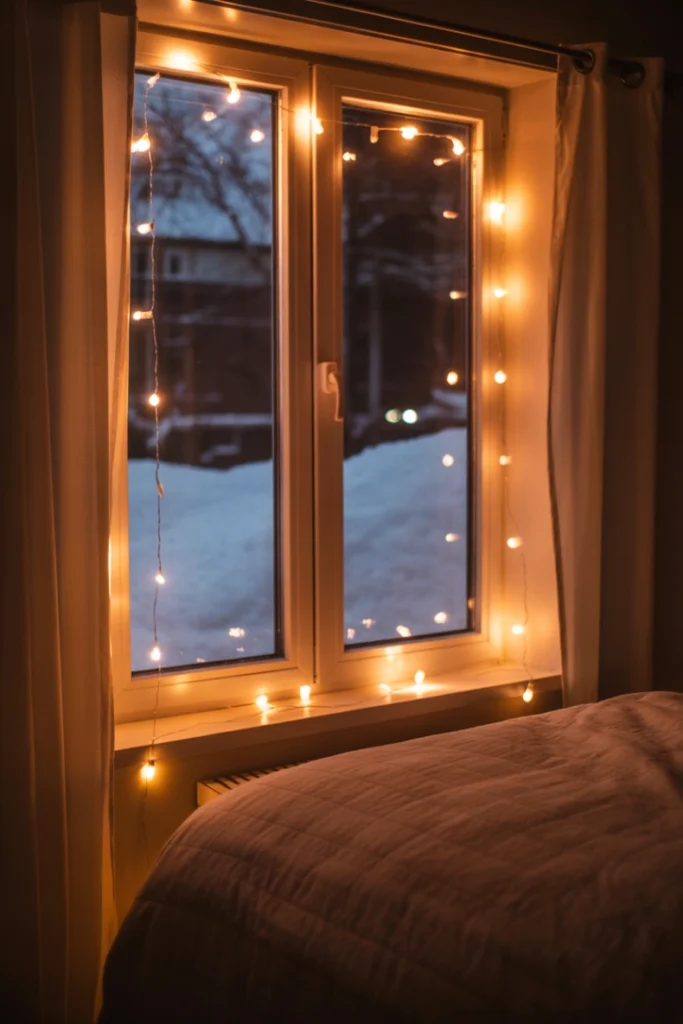
Outlining a window frame with lights creates a glowing border that highlights the winter night outside and adds symmetry to the room. For a standard window about 120 cm wide and 150 cm tall, one 5 to 7 meter LED strip or fairy light strand is enough to outline the frame once. LED strip lights give a clean, continuous line and suit modern rooms, while fairy lights give a softer, twinkling edge that suits traditional or farmhouse bedrooms.
Clean the frame first, then attach the strip or strand with the clips supplied, working from the bottom of one side, across the top, and down the other side, so the join and the plug end up at the bottom corner near a socket. Keep the lights on the frame itself, not on the glass, so you can still open the window for fresh air. If you use a plug in strip, choose one with a remote dimmer, because a full brightness outline can feel too bright when you are lying in bed facing the window.
Window frame lights look especially good in small bedrooms, where they add warmth without taking up any surface space. Pair them with a plain curtain in cream or soft grey, and avoid heavy patterned curtains that fight with the outline. In the morning, the frame still looks neat, because a slim LED strip reads as a simple trim even when it is switched off.
12. Lighted Bed Canopy with Sheer Drapes
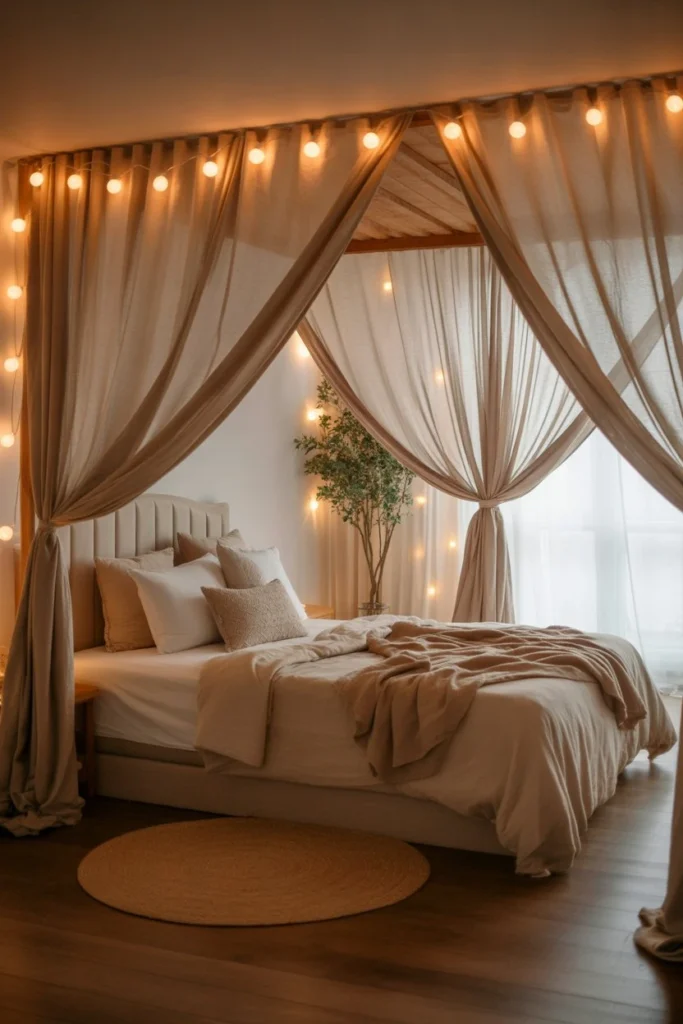
A lighted canopy with sheer drapes is the most romantic idea in this guide, and it is easier than it looks. You will need a ceiling mounted canopy frame or four ceiling hooks, two to three sheer voile panels about 280 cm long, and two 5 meter warm white fairy light strands. Hang the panels first, letting them fall to the floor or pool slightly at the corners, then weave the lights through the top of the canopy so the glow sits above the fabric rather than inside it.
The secret to a canopy that looks soft instead of messy is spacing. Keep the fabric gathers about 15 to 20 cm apart at the ceiling, and let the lights follow the same spacing, so the glow is even across the whole bed. Warm white at 2700K suits neutral, blush, or cream bedding best, and it flatters skin tones in the evening far better than cool white. Tuck both battery packs or plugs behind the headboard, and use a remote control so you can switch the canopy on from bed.
Safety matters more with a canopy than with any other idea here, because fabric and lights sit close together. Use LED lights only, keep the strand at least 15 cm from pillows, and never let fabric rest directly on a transformer or battery pack. Wash the voile panels before you hang them, because clean sheer fabric diffuses light far better than dusty fabric, and it will look fresh in photos as well as in person.
13. Lantern Cluster in a Corner
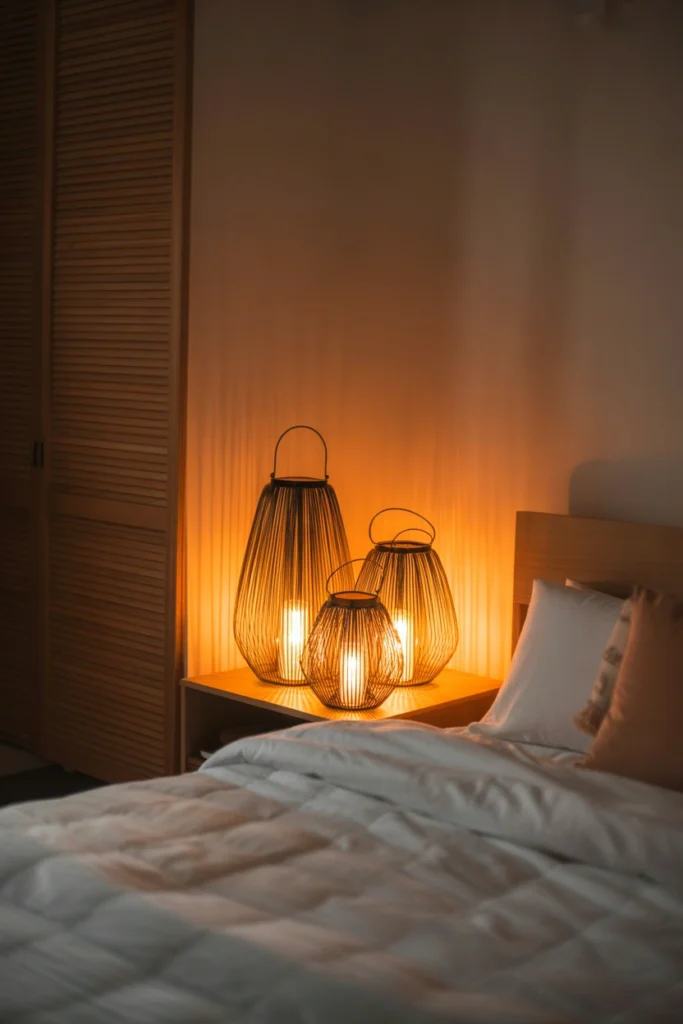
A cluster of lanterns in a corner creates a cozy reading nook and a soft pool of light where a bedroom often feels darkest. Gather three to five lanterns in different heights, for example 15 cm, 25 cm, and 35 cm tall, and place the tallest at the back of the corner with smaller ones in front. Fill each lantern with an LED candle or a short fairy light strand, and stick to one metal finish, such as black, gold, or brushed brass, so the cluster looks intentional.
Place the cluster on a small stool, a sturdy crate, or directly on the floor beside an armchair, and add a folded throw and a small stack of books to complete the nook. Metallic lanterns give a more elegant, reflective glow, while wooden lanterns suit rustic or farmhouse bedrooms and soften the light further. Choose flameless candles with a flicker mode for the most realistic effect, and set them all to the same timer so the whole corner switches on together at dusk.
Keep the lanterns at least 30 cm from curtains and bedding, and avoid real candles in this spot entirely, because a reading nook is exactly where fabric and paper sit close together. If floor space is tight, hang one lantern from a ceiling hook in the same corner and place two smaller ones below it, which gives you the same layered effect in half the footprint. Wipe glass panels weekly, because fingerprints and dust dim a lantern faster than any other decoration.
14. Shelf Glow Lighting
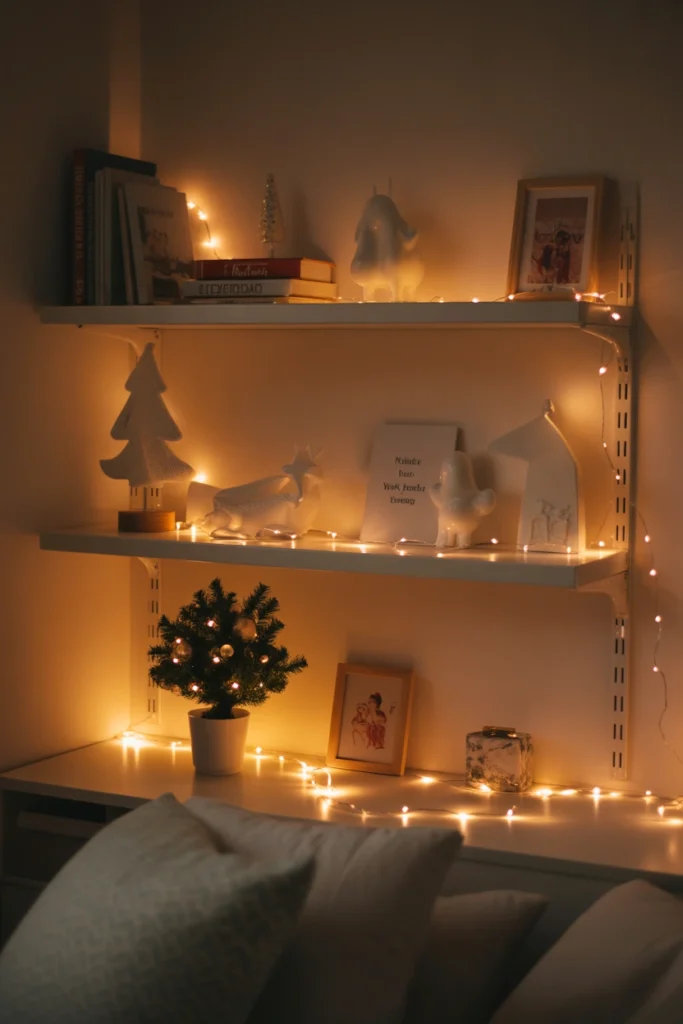
Shelf glow lighting adds layered light to a bedroom without any new furniture, and it makes your existing decorations look far more special. Wrap a 3 to 5 meter fairy light strand along the back edge of each shelf, or tuck a small battery operated puck light behind a favorite object, so the light spills forward and outlines the items on display. Warm white works best on wood shelves, while a soft gold tone suits white or pastel shelves.
Style each shelf with a clear focal point, such as a mini Christmas tree, a snow globe, or a small stack of books topped with a candle, then add one or two smaller items around it. The backlight will make the focal point stand out and cast gentle shadows that give the shelf depth. A mini tree on a shelf is a lovely touch, and if you want to style the tree itself, these Christmas tree light ideas include small scale options that work just as well on a tabletop tree as on a full size one.
Do not overload a lit shelf, because too many objects block the light and turn the glow into clutter. Leave at least one third of each shelf empty, and keep paper, dried flowers, and fabric at least 10 cm from any plug in light. Battery strands with timers are ideal for shelves, since you rarely want to reach behind decorations every night, and a single set of spare batteries covers most shelf strands for the whole season.
15. Mirror Frame Lights
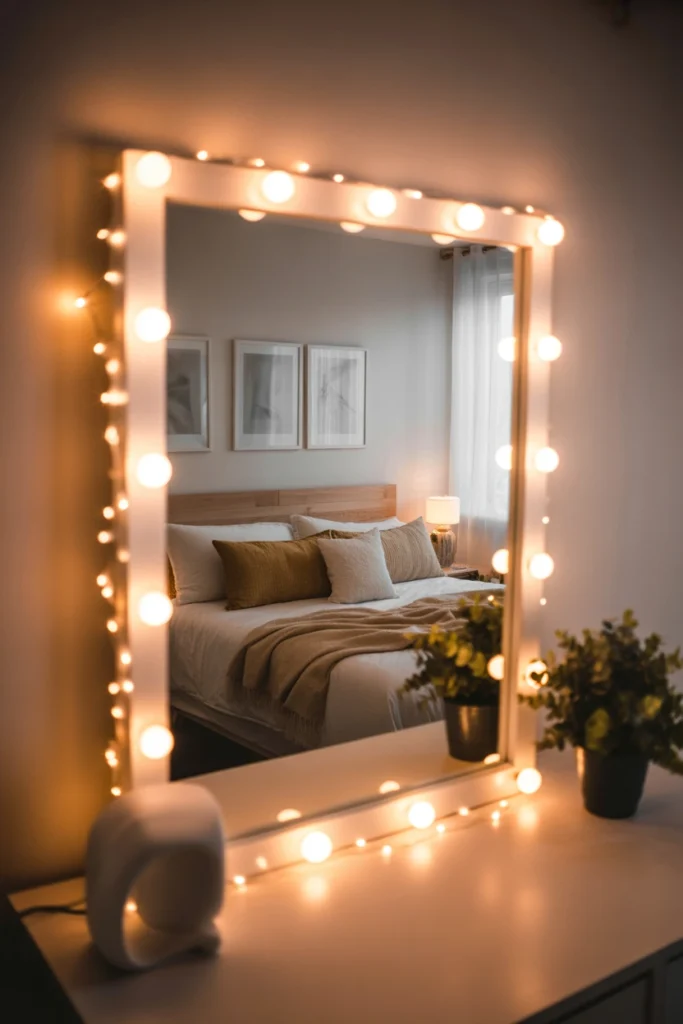
Outlining a mirror with fairy lights is both festive and practical, because it brightens your morning routine while adding a warm Christmas touch. For a mirror 60 to 90 cm wide, one 3 to 5 meter warm white strand is usually enough to outline it once, attached with small clear clips every 20 cm. Battery powered lights are the simplest choice here, because most mirrors hang away from a convenient socket.
Start at the bottom center of the mirror and work outward in both directions, so the join sits at the bottom where it is least visible, then tuck the battery pack behind the mirror or on top of the dresser. The lights will double in effect, because the mirror reflects them back into the room, so a modest strand can light a whole dressing area. This reflection also means you should check for glare from the bed, and move the mirror angle slightly if a bulb shines straight at your pillow.
Keep the mirror glass clean, because dust and toothpaste spots show up clearly once lights outline the frame. A quick wipe once a week keeps the reflection sharp and the glow even. At the end of the season, remove the clips gently rather than pulling the strand off, which can chip a painted frame or pull off gilt on an older mirror.
16. DIY Light-Up Wall Art
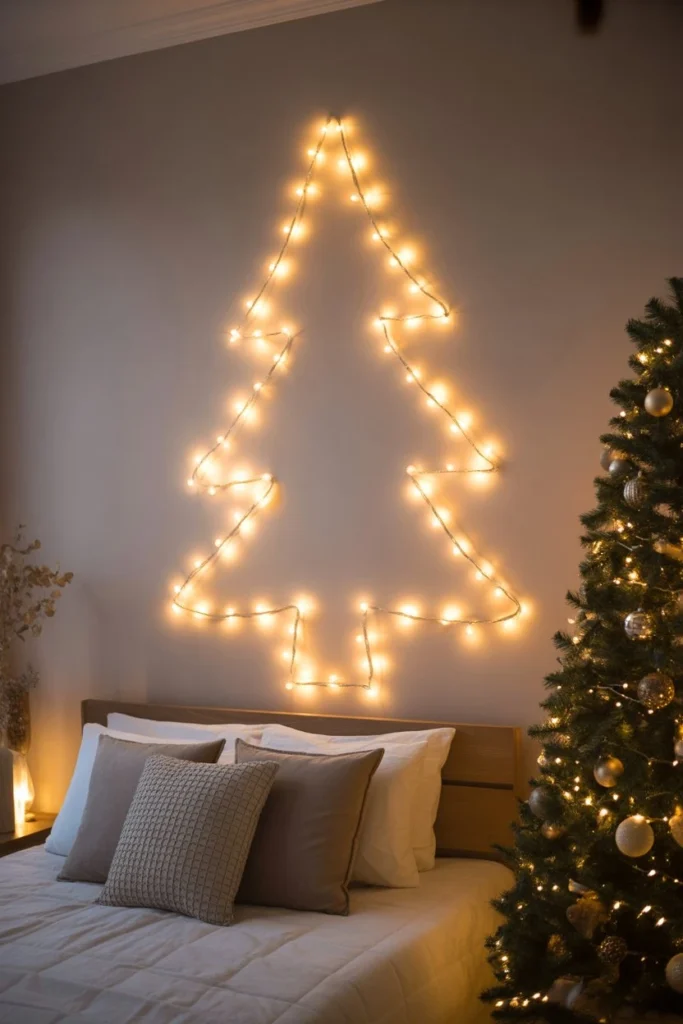
Light up wall art is a fun, personal project that suits craft lovers and older children, and it costs very little. You will need a wooden frame or a stretched canvas about 40 by 50 cm, a 3 meter fairy light strand, and a simple design such as a star, a tree, or a snowflake drawn lightly in pencil. Drill or poke small holes along the design lines, push one bulb through each hole from the back, and secure the strand behind the canvas with tape or small clips.
Keep the design simple and bold, because tiny details disappear once the lights are on. A star needs about 15 to 20 bulbs, a simple tree needs 25 to 35, and a snowflake needs 20 to 30, depending on size. Paint the canvas in a dark color, such as deep green, navy, or charcoal, so the warm lights stand out, and hang the art at eye level on a plain wall where it has room to glow without competing with other decorations.
Use battery lights with a timer for wall art, and mount the battery pack on the back of the frame with removable tape so it stays hidden but reachable. This is a great project to make with children, but let an adult handle any drilling and keep the finished art out of reach of very small hands, since the bulbs and wire are not toys. Store the art flat in a large bag, with the battery pack removed, so the bulbs do not get crushed.
17. Lighted Garland on Dresser
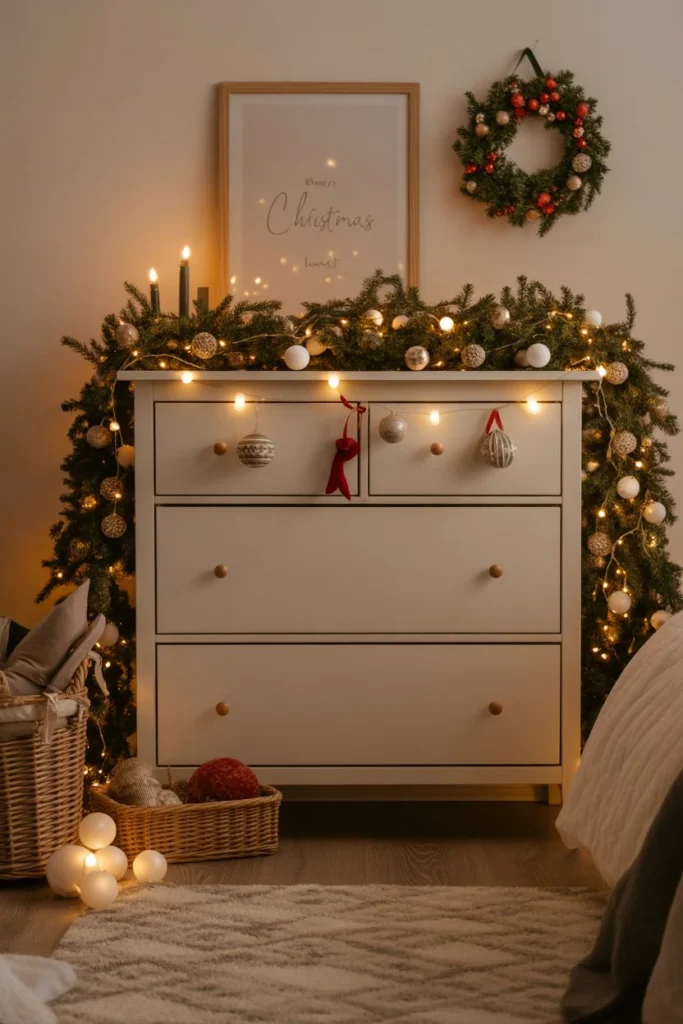
A lighted garland on a dresser or vanity turns everyday furniture into a festive feature in about twenty minutes. Choose a garland 180 cm long for a standard dresser, weave a 3 to 5 meter warm white strand through it, and lay it along the back edge of the dresser in a gentle wave, letting the ends drape 15 to 20 cm down each side. Add small pinecones, two or three baubles, and a short length of ribbon in one accent color for detail.
Keep the front of the dresser clear for daily use, and place the garland behind your usual items, such as a jewelry tray or a perfume bottle, rather than in front of them. This keeps the dresser functional while the lights and greenery frame the objects you already use. If your dresser holds a mirror, let the garland run beneath the mirror so the lights reflect and double the glow, but keep the garland clear of any hot styling tools.
A dresser garland looks best when it matches the rest of the room in color, so pick up one color from your bedding or curtains for the ribbon and baubles. A gold ribbon suits warm rooms, silver suits cool rooms, and deep red suits traditional rooms. Shake the garland outside before you bring it in, and wipe the dresser top after you remove it, because faux garlands shed small needles that can scratch a polished surface if they sit all season.
18. Candlelight Centerpiece
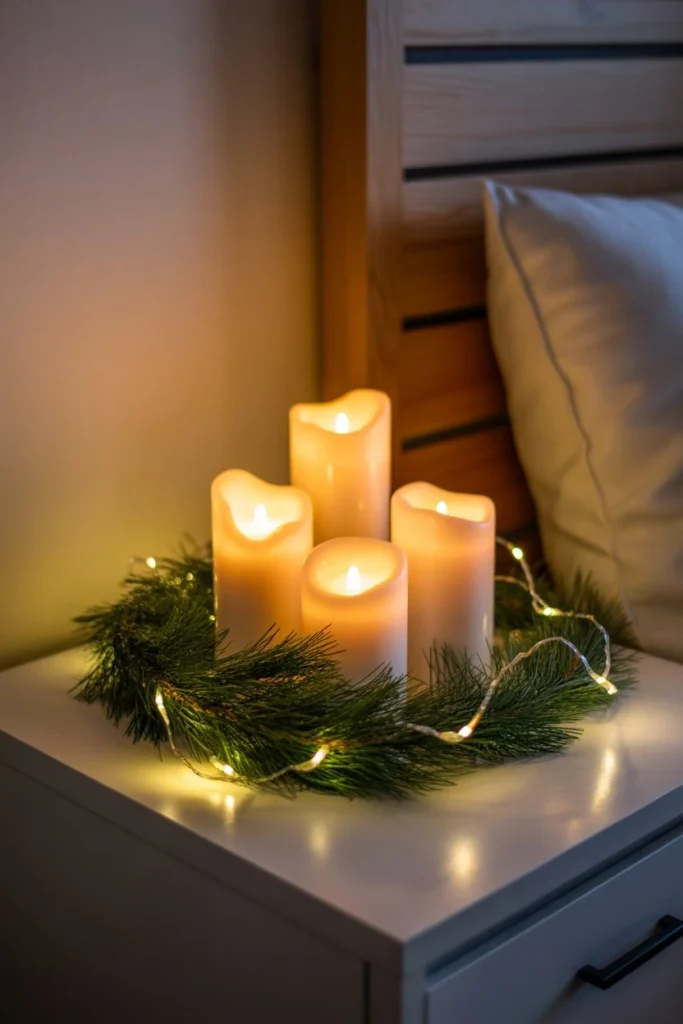
A candlelight centerpiece on a nightstand or dresser gives you a soft, layered glow that feels calm and safe when you use flameless candles. Gather LED candles in three heights, for example 10 cm, 15 cm, and 20 cm, plus a small tray or wooden board about 30 cm across, a few sprigs of faux greenery, and a short fairy light strand to weave between the candles. Place the tallest candle at the back, the medium candle to one side, and the shortest at the front, so the group reads as a triangle from the bed.
The flicker mode on good LED candles looks remarkably like real candlelight, especially in a dark room, and it gives the whole bedroom a warm, slow feeling that is perfect for winding down. Add the greenery around the base of the candles, not over the tops, so the flicker stays visible, and weave the fairy lights loosely through the greenery for extra sparkle. Keep the tray at least 20 cm from the edge of the nightstand so it cannot be knocked off in the dark.
Never substitute real candles for LED candles on a nightstand, because bedding, books, and curtains sit close by and bedrooms are occupied while people sleep. Set all the candles to the same timer, usually 6 hours, so the centerpiece switches itself off overnight, and keep spare batteries in the nightstand drawer. A candlelight centerpiece also makes a lovely gift display if you add a small wrapped present or a handwritten card beside the tray.
19. Twinkle Light Curtain Behind Bed
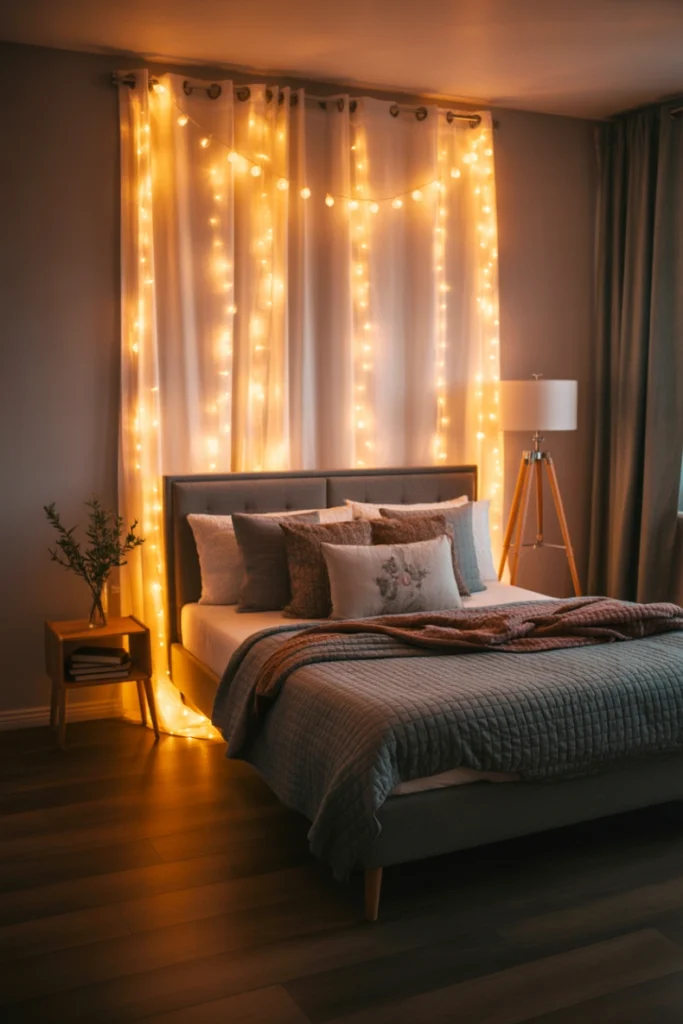
Hanging a curtain of twinkling lights directly behind the bed creates a stunning feature wall that transforms the whole room. Use a curtain light set about 2 to 3 meters wide, which fits a double or queen bed, and hang it from a curtain rod or a row of hooks mounted 20 to 30 cm above the headboard. Let the drops fall behind the headboard, not in front of it, so the headboard frames the lights rather than blocking them.
Layer the curtain with soft pillows in cream, blush, or soft grey, and a textured throw in chunky knit or faux fur at the foot of the bed. The lights will reflect softly against the bedding and create a calming holiday ambiance that photographs beautifully. Choose a steady glow mode for sleep, and save twinkle or chase modes for evenings when you are awake and entertaining, because flashing lights can disturb sleep and strain tired eyes.
If your bed sits against a window, hang the curtain lights in front of the window instead, with a sheer panel behind them for depth. Either way, keep the plug end near the floor on one side of the bed, run the cable along the skirting board, and use a timer or smart plug so the feature wall switches on at dusk without you having to reach behind the bed. Fold the set around cardboard for storage, and label the box with the bed size it fits, so next year you can find it instantly.
20. Ceiling Light Garland
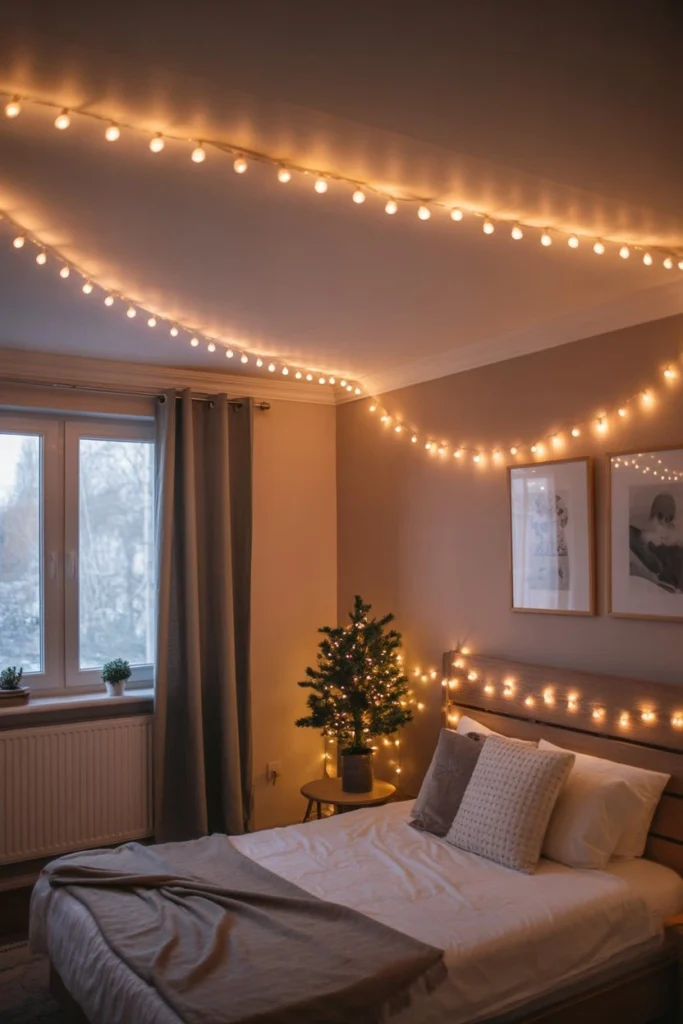
Stringing fairy lights around the edges of your ceiling or along a beam gives you a soft, room wide glow that ties the whole bedroom together. For a small bedroom about 3 by 4 meters, you will need 10 to 15 meters of lights to run around the full perimeter once, while a larger room may need 20 meters or two strands joined with a connector. Use small adhesive ceiling clips spaced 40 to 50 cm apart, and keep the strand tight enough that it does not sag, but loose enough that you can remove it without pulling paint.
This idea suits a minimalist, Scandinavian style bedroom best, with neutral bedding, pale wood, and only a few other decorations, because the ceiling line itself becomes the decoration. Pair it with plain white or cream walls, a simple garland on the dresser, and one bedside lantern, and the room will feel festive without feeling crowded. Warm white suits this style perfectly, while multicolor lights can make a calm room feel busy.
Install the strand with a second person if you can, because holding a long strand overhead while placing clips is awkward alone, and a step ladder is safer than standing on a bed or chair. Run the plug end down one corner near a socket, and hide the cable with a slim cable cover painted to match the wall. At the end of the season, remove the clips slowly and clean any adhesive residue with warm soapy water before it hardens, so your ceiling looks fresh for the new year.
Conclusion
Your bedroom can become a cozy Christmas sanctuary with these DIY Christmas bedroom light ideas, whether you love a glowing canopy, elegant lanterns, or a subtle garland along the ceiling. The best results come from layering two or three light sources at different heights, choosing warm white LEDs, and using timers so your room glows in the evening and rests peacefully overnight. Start with the idea that fits your room best, add one more layer if a corner still feels dark, and keep safety first by using LED lights, keeping fabric clear of plugs, and choosing flameless candles near bedding.
With a little creativity and a few strands of light, your Christmas bedroom will shine with handmade warmth all season, and most of these projects pack away neatly in a single labeled box, ready to glow again next December. Try one idea this weekend, live with it for a few nights, and then decide whether you want more sparkle or whether the soft glow you already have is exactly right.
Frequently Asked Questions
What color Christmas lights look best in a bedroom?
Warm white lights at about 2700K look best in most bedrooms, because they give a soft, cozy glow that flatters bedding and skin tones and helps you wind down in the evening. Pure white suits modern rooms with grey, navy, or white decor and reads more like winter snow, while multicolor lights suit a playful or family bedroom but can feel too busy for sleep. If you are unsure, start with warm white, because it pairs with every color scheme in this guide.
Are fairy lights safe to leave on overnight in a bedroom?
LED fairy lights are much safer than old incandescent lights, because they stay cool and use very little power, but it is still best not to leave any lights on all night in a bedroom. Use a timer set for 6 hours, or a smart plug that switches off at bedtime, and keep lights at least 15 cm from pillows, bedding, and curtains. Check strands for damaged wire before you hang them, and replace any strand with frayed cable or a hot transformer immediately.
How many fairy lights do I need for a bedroom?
Most single ideas in this guide need one strand of 3 to 10 meters, depending on the size of the bed, wall, or window you are decorating. A headboard needs about 5 meters, a window frame needs 5 to 7 meters, a canopy needs 10 to 15 meters in total, and a full ceiling perimeter needs 10 to 20 meters. Measure your space first, then buy a strand slightly longer than you think you need, because a strand that is too short looks stretched, while extra length can be looped neatly at the back.
Can I use battery operated lights instead of plug in lights in a bedroom?
Yes, battery operated LED lights are ideal in a bedroom, especially for headboards, bed frames, mirrors, and shelves that sit far from a socket. They remove trip hazards, they are easy to move, and most sets include a timer so they switch themselves off. The trade off is battery cost over a long season, so use timer strands, keep spare AA batteries handy, and switch to plug in lights for large displays such as a full ceiling perimeter or a curtain wall, where batteries would run out quickly.
How do I store Christmas bedroom lights so they do not tangle?
Wind each strand around a flat piece of cardboard, starting from the plug end and keeping gentle tension, then secure the loose end with a small clip and label the cardboard with where the strand was used and how long it is. Store garlands with their lights still woven through them in a large bag, keep paper stars flat between tissue paper, and keep glass ornaments in a divided box. Labeled, wound strands hang in minutes next December, while tangled strands can waste an hour before you even start decorating.
More Ideas You Will Love
 19 Teen Girls Bedroom Ideas: Dreamy & Personalized Decor Inspiration
 20 Men’s Bedroom Ideas That Are Modern, Masculine & Stylish
 24 Wardrobe & Armoire Ideas: Smart Storage for Every Room
 12 Summer-Friendly Fabric Ideas to Refresh Your Home
 18 Indoor Christmas Light Ideas for 2025 Inspiration
 16 Tan Bedroom Ideas with Neutral Boho Vibes You’ll Adore